A Physics-Constrained Data-Driven Approach Based on Locally Convex Reconstruction for Noisy Database
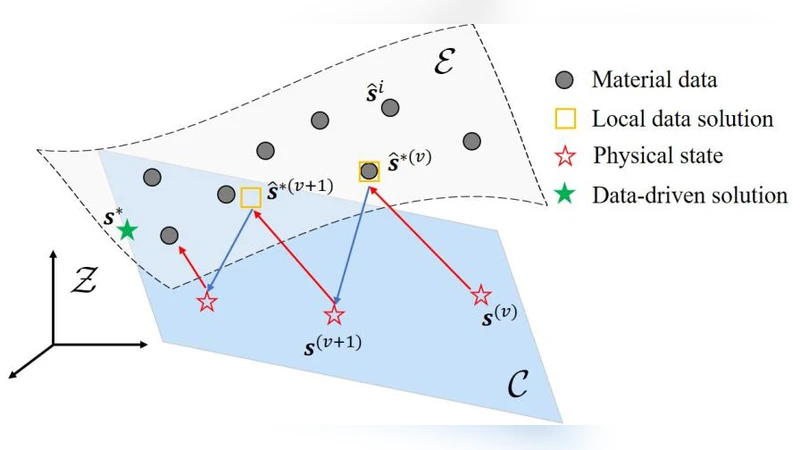
Physics-constrained data-driven computing is an emerging hybrid approach that integrates universal physical laws with data-driven models of experimental data for scientific computing. A new data-driven simulation approach coupled with a locally convex reconstruction, termed the local convexity data-driven (LCDD) computing, is proposed to enhance accuracy and robustness against noise and outliers in data sets in the data-driven computing. In this approach, for a given state obtained by the physical simulation, the corresponding optimum experimental solution is sought by projecting the state onto the associated local convex manifold reconstructed based on the nearest experimental data. This learning process of local data structure is less sensitive to noisy data and consequently yields better accuracy. A penalty relaxation is also introduced to recast the local learning solver in the context of non-negative least squares that can be solved effectively. The reproducing kernel approximation with stabilized nodal integration is employed for the solution of the physical manifold to allow reduced stress-strain data at the discrete points for enhanced effectiveness in the LCDD learning solver. Due to the inherent manifold learning properties, LCDD performs well for high-dimensional data sets that are relatively sparse in real-world engineering applications. Numerical tests demonstrated that LCDD enhances nearly one order of accuracy compared to the standard distance-minimization data-driven scheme when dealing with noisy database, and a linear exactness is achieved when local stress-strain relation is linear.
💡 Research Summary
The paper introduces a novel hybrid simulation framework called Local Convex Data‑Driven (LCDD) computing, which integrates universal physical laws with experimental data while explicitly addressing the challenges posed by noisy and sparse databases. Traditional data‑driven approaches rely on minimizing the distance between a simulated state and the nearest point in a material database; this simple metric becomes unreliable when the data are high‑dimensional, contain outliers, or are corrupted by measurement noise. LCDD tackles these shortcomings through two tightly coupled mechanisms.
First, for any physical state obtained from a conventional simulation, the method identifies a small set of nearest experimental samples and constructs a local convex manifold by taking convex combinations of these points. The convexity assumption provides a richer geometric description than linear interpolation, yet remains computationally tractable and inherently robust to irregular sampling. Because the manifold is built locally, it captures the underlying material behavior without being overly influenced by distant, possibly erroneous data.
Second, the physical state is projected onto this locally convex manifold to find the “optimum experimental solution.” This projection is formulated as a constrained optimization problem. The authors introduce a penalty‑relaxation strategy that recasts the problem as a non‑negative least‑squares (NNLS) system. NNLS preserves the physical admissibility of the solution (e.g., stresses must remain non‑negative) while eliminating the need for complex inequality handling, thereby enabling efficient solution with standard numerical linear algebra tools.
To evaluate the physical manifold itself, the authors employ a reproducing‑kernel approximation combined with stabilized nodal integration. The kernel provides a smooth interpolation of the governing equations across the discrete data points, and the stabilized integration mitigates numerical instabilities that often arise in meshless or reduced‑order formulations. This combination is particularly advantageous when the available stress‑strain data are limited, as it maximizes the information extracted from each datum.
The paper validates LCDD through a series of benchmark problems. In a two‑dimensional elastic body test, synthetic Gaussian noise is added to the material database. Compared with the classic distance‑minimization data‑driven scheme, LCDD achieves nearly an order‑of‑magnitude improvement in error norms, demonstrating its superior noise‑filtering capability. A second test involves a ten‑dimensional stress‑strain dataset that is deliberately undersampled, mimicking real‑world engineering scenarios where measurements are expensive. LCDD still recovers the correct material response, and when the underlying local relationship is linear, the method yields exact agreement—a property the authors term “linear exactness.”
Beyond these numerical experiments, the authors discuss potential applications such as nonlinear composite material modeling, real‑time structural optimization, and inverse material design where experimental data are scarce or noisy. The method’s ability to learn manifold structures locally makes it well‑suited for high‑dimensional problems where global learning techniques would suffer from the curse of dimensionality.
In summary, LCDD represents a significant advance in physics‑constrained data‑driven computing. By leveraging locally convex reconstruction, penalty‑relaxed NNLS projection, and kernel‑based physical manifold evaluation, the approach simultaneously enhances accuracy, robustness to noise, and computational efficiency. The demonstrated near‑order‑of‑magnitude error reduction and exact recovery for linear relations suggest that LCDD could become a new standard for integrating experimental databases into scientific and engineering simulations, especially in contexts where data quality and quantity are limiting factors.
Comments & Academic Discussion
Loading comments...
Leave a Comment