A Multiresolution Census Algorithm for Calculating Vortex Statistics in Turbulent Flows
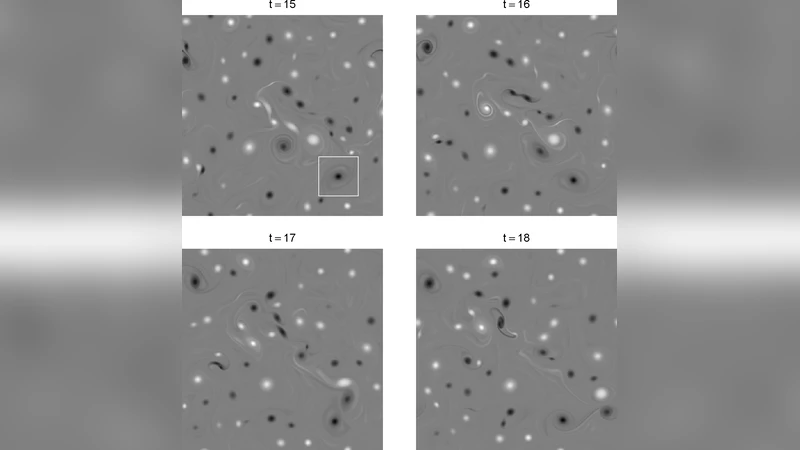
The fundamental equations that model turbulent flow do not provide much insight into the size and shape of observed turbulent structures. We investigate the efficient and accurate representation of structures in two-dimensional turbulence by applying statistical models directly to the simulated vorticity field. Rather than extract the coherent portion of the image from the background variation, as in the classical signal-plus-noise model, we present a model for individual vortices using the non-decimated discrete wavelet transform. A template image, supplied by the user, provides the features to be extracted from the vorticity field. By transforming the vortex template into the wavelet domain, specific characteristics present in the template, such as size and symmetry, are broken down into components associated with spatial frequencies. Multivariate multiple linear regression is used to fit the vortex template to the vorticity field in the wavelet domain. Since all levels of the template decomposition may be used to model each level in the field decomposition, the resulting model need not be identical to the template. Application to a vortex census algorithm that records quantities of interest (such as size, peak amplitude, circulation, etc.) as the vorticity field evolves is given. The multiresolution census algorithm extracts coherent structures of all shapes and sizes in simulated vorticity fields and is able to reproduce known physical scaling laws when processing a set of voriticity fields that evolve over time.
💡 Research Summary
The paper addresses the long‑standing difficulty of extracting quantitative information about coherent vortex structures directly from turbulent flow simulations. Instead of the traditional signal‑plus‑noise decomposition, the authors develop a multiresolution census algorithm that operates entirely in the wavelet domain. A user‑provided vortex template—typically a simple Gaussian‑shaped image—is first transformed using the non‑decimated discrete wavelet transform (NDWT), yielding a set of coefficients across multiple scales and orientations. These coefficients serve as the predictor matrix in a multivariate multiple linear regression model, while the NDWT coefficients of the simulated vorticity field constitute the response variables. Crucially, the regression allows any level of the template decomposition to model any level of the field decomposition, giving the algorithm the flexibility to adapt the template’s size, symmetry, and intensity to the actual flow features.
Statistical significance testing isolates locations where the fitted template explains a substantial portion of the wavelet energy, designating them as vortex candidates. Overlapping candidates are merged through a non‑overlapping clustering step, resulting in a final list of vortices. For each vortex the algorithm automatically computes physical attributes such as centroid, effective radius, peak vorticity, circulation, and contribution to kinetic energy. By repeating this procedure on successive time frames, a comprehensive “vortex census” is built, tracking the birth, evolution, and decay of vortices throughout the simulation.
Application to two‑dimensional turbulence simulations demonstrates that the method reliably extracts vortices of diverse shapes and scales, reproducing known scaling laws such as the power‑law distribution of vortex sizes and the –5/3 energy spectrum predicted by Kolmogorov‑Kraichnan theory. Remarkably, even with a simple circular Gaussian template, the regression adjusts the coefficients to capture asymmetric and elongated structures, showing the algorithm’s robustness to template mismatch.
The computational cost is dominated by the NDWT and linear regression, both of which scale quasi‑linearly (O(N log N)) with the number of grid points, making the approach feasible for large‑scale datasets. The authors discuss extensions to three‑dimensional flows, the incorporation of multiple templates to target specific phenomena (e.g., vortex merging, shear layers), and potential integration with experimental particle‑image‑velocimetry data. In summary, the work presents a novel, flexible, and efficient framework for the automated detection and statistical analysis of coherent structures in turbulent flows, advancing both the methodological toolkit and our ability to validate theoretical scaling predictions against high‑resolution simulation data.
Comments & Academic Discussion
Loading comments...
Leave a Comment