Disentangled Adversarial Transfer Learning for Physiological Biosignals
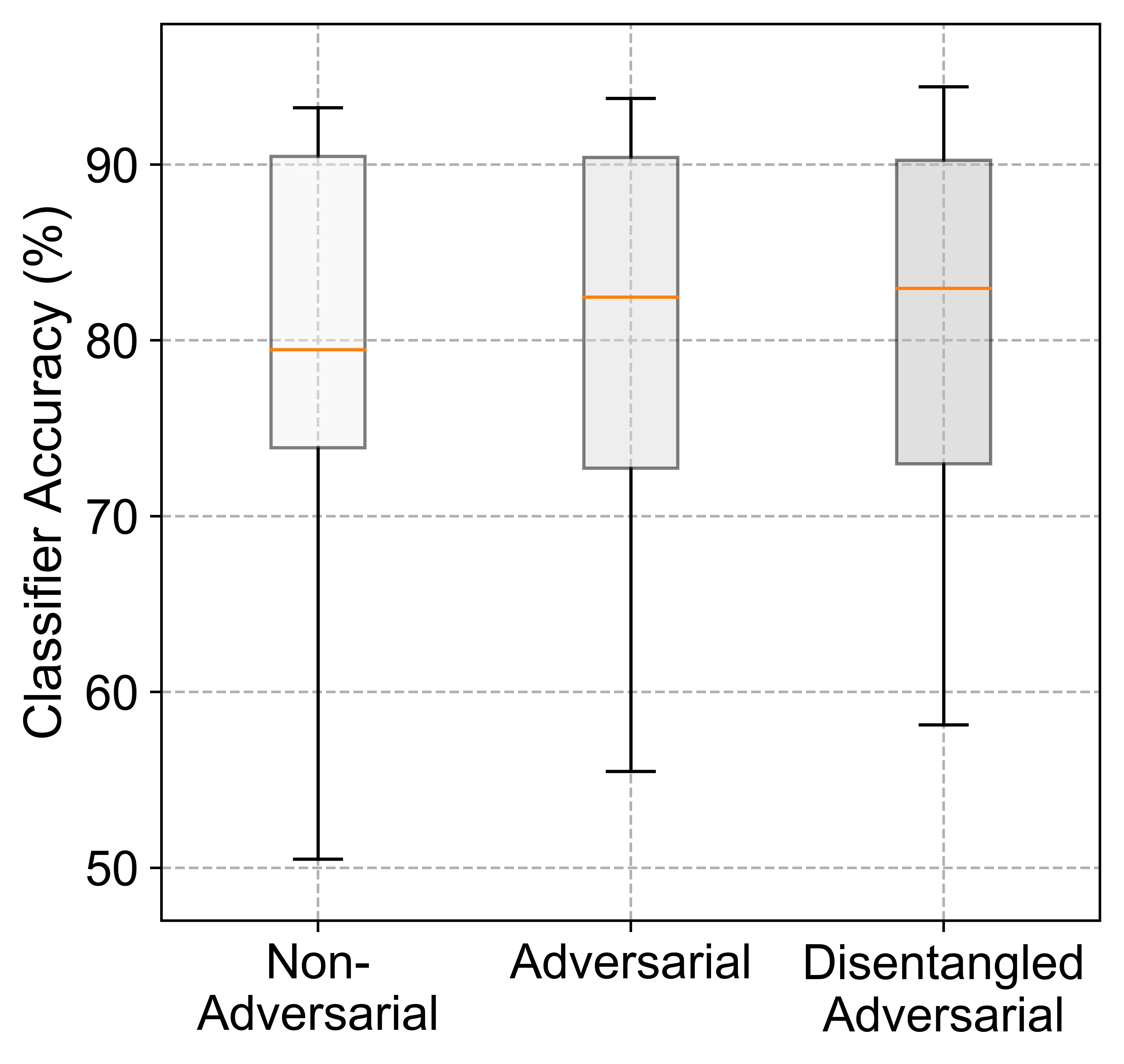
Recent developments in wearable sensors demonstrate promising results for monitoring physiological status in effective and comfortable ways. One major challenge of physiological status assessment is the problem of transfer learning caused by the domain inconsistency of biosignals across users or different recording sessions from the same user. We propose an adversarial inference approach for transfer learning to extract disentangled nuisance-robust representations from physiological biosignal data in stress status level assessment. We exploit the trade-off between task-related features and person-discriminative information by using both an adversary network and a nuisance network to jointly manipulate and disentangle the learned latent representations by the encoder, which are then input to a discriminative classifier. Results on cross-subjects transfer evaluations demonstrate the benefits of the proposed adversarial framework, and thus show its capabilities to adapt to a broader range of subjects. Finally we highlight that our proposed adversarial transfer learning approach is also applicable to other deep feature learning frameworks.
💡 Research Summary
The paper addresses the challenge of transferring physiological stress‑level models across users and recording sessions, a problem that arises because biosignals collected with wearable devices exhibit substantial inter‑subject variability. To mitigate this domain shift, the authors propose a Disentangled Adversarial Transfer Learning (DATL) framework that explicitly splits the latent representation learned by an encoder into two complementary parts: a task‑focused component (zₐ) and a subject‑specific component (zₙ).
The encoder g(·;θ) maps a multivariate time‑series X∈ℝ^{C×T} (C = 7 channels, T = 300 samples) to a 100‑dimensional vector z, which is partitioned according to a nuisance ratio r_N (e.g., 0.2). The task‑focused part zₐ is fed to an adversary network q_φ(s|zₐ) that attempts to predict the subject ID s. During training, a gradient‑reversal layer forces the encoder to minimize this adversary loss, thereby removing subject information from zₐ. Conversely, zₙ is supplied to a nuisance network q_ψ(s|zₙ) that is trained to correctly identify the subject, encouraging zₙ to retain subject‑specific cues.
Both zₐ and zₙ (concatenated as z) are then passed to a main classifier q_γ(y|z, s) that predicts the stress level y (four classes). The overall objective is
max_{θ,γ,ψ} min_{φ} E
Comments & Academic Discussion
Loading comments...
Leave a Comment