Nonlocal KdV Equations
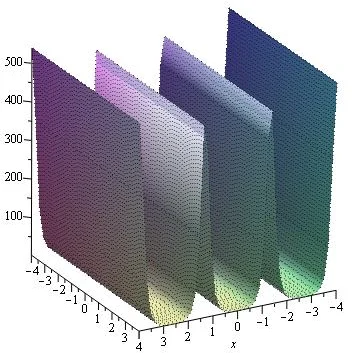
Writing the Hirota-Satsuma (HS) system of equations in a symmetrical form we find its local and new nonlocal reductions. It turns out that all reductions of the HS system are Korteweg-de Vries (KdV), complex KdV, and new nonlocal KdV equations. We obtain one-soliton solutions of these KdV equations by using the method of Hirota bilinearization.
💡 Research Summary
The paper investigates new nonlocal reductions of the Hirota‑Satsuma (HS) system and demonstrates that all such reductions lead to variants of the Korteweg‑de Vries (KdV) equation, including the standard real KdV, a complex‑valued KdV, and several novel nonlocal KdV equations. The authors first rewrite the original HS system, which is given in terms of variables p and q, into a symmetric form using the linear transformation p = ½(u + v), q = γ(u − v) with γ² = ¼. This yields the coupled equations (1.4)–(1.5) for u(x,t) and v(x,t), which are more amenable to consistent reductions.
Three classes of reductions are explored.
-
Local real reduction: Setting v = k u with k = 1 and a real constant a reduces the system to the classic KdV equation a u_t = 2 u_{xxx}+12 u u_x.
-
Local complex reduction: Imposing v = k \bar u (k real) and requiring a = \bar a leads to a complex KdV equation a u_t = −u_{xxx}+3 \bar u_{xxx}−6 u u_x+6 \bar u u_x+12 u \bar u_x. This equation preserves a complex‑conjugate symmetry and belongs to the family of integrable nonlocal equations studied in recent literature.
-
Nonlocal reductions: Two families are identified.
- Real nonlocal reduction: v(x,t) = k u(ε₁x,ε₂t) with ε₁² = ε₂² = 1. Consistency forces k = 1 and ε₁ = ε₂ = −1, yielding a space‑time reversal (ST‑reversal) nonlocal KdV equation a u_t(x,t)=−u_{xxx}(x,t)+3 u_{xxx}(−x,−t)−6 u(x,t)u_x(x,t)+6 u(−x,−t)u_x(x,t)+12 u_x(−x,−t)u(x,t). This equation cannot be obtained from the AKNS hierarchy and represents a genuinely new nonlocal integrable model.
- Complex nonlocal reduction: v(x,t) = k \bar u(ε₁x,ε₂t). Depending on the choice of (ε₁,ε₂) ∈ {(−1,1),(1,−1),(−1,−1)} one obtains three distinct nonlocal complex KdV equations, referred to as S‑reversal, T‑reversal, and ST‑reversal, respectively. The parameter a must be pure imaginary for S‑ and T‑reversal, while it remains real for the ST‑reversal case.
To construct explicit solutions, the authors apply Hirota’s bilinear method to the symmetric HS system. By introducing the dependent variables f and g through u = u₀+2(ln f){xx}+g f and v = v₀+2(ln f){xx}−g f, the system is transformed into the bilinear equations (1.6) and (1.7). An ε‑expansion (g = ε g₁, f = 1+ε² f₂) yields the dispersion relation ω₁ = −4k₁³+(6v₀−18u₀)k₁/a and determines f₂. The resulting one‑soliton expressions for u and v are given in (2.7)–(2.8).
Applying the reduction constraints to these one‑soliton forms produces explicit solutions for each reduced equation. For the real KdV, the reduction v = u forces u₀ = v₀ and c = 0, leading to the familiar sech² soliton u(x,t)=u₀+2A₁k₂² sech²
Comments & Academic Discussion
Loading comments...
Leave a Comment