Local digital algorithms applied to Boolean models
We investigate the estimation of specific intrinsic volumes of stationary Boolean models by local digital algorithms; that is, by weighted sums of $n \times\ldots \times n$ configuration counts. We show that asymptotically unbiased estimators for the…
Authors: Julia H"orrmann, Anne Marie Svane
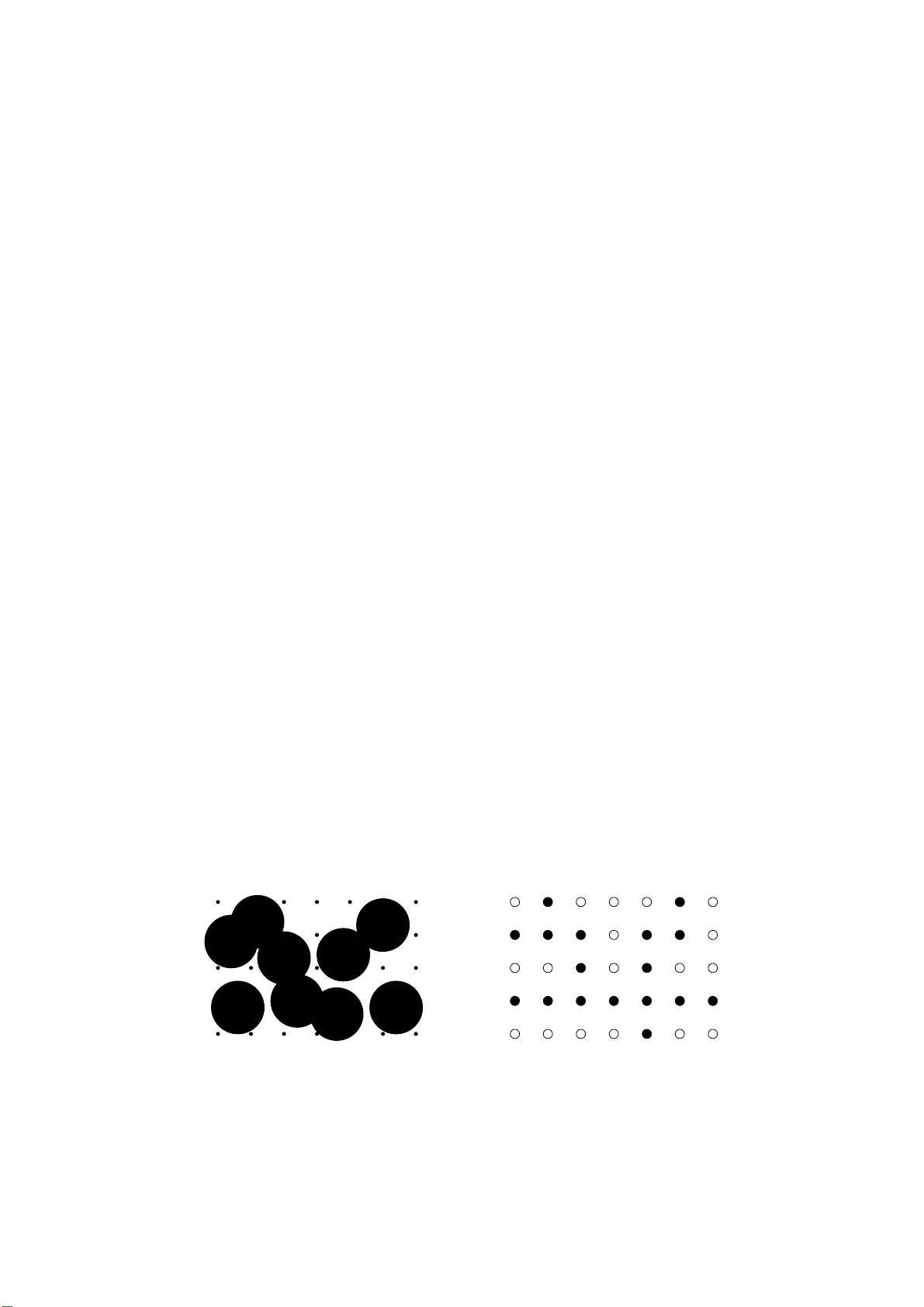
Lo cal digital algorithms applied to B o olean mo dels Julia H¨ orrmann, Anne Marie Sv ane Dedicated to Ev a B. V edel Jensen on the o ccasion of her 65th birthda y Abstract W e inv estigate the estimation of sp ecific intrinsic v olumes of sta- tionary Bo olean models by lo cal digital a lg orithms; that is, by w eighted sums o f n × . . . × n configura tion counts. W e show that asymptotica lly un biased estimato rs for the sp ecific surface area or integrated mean curv a ture do not exist if the dimension is at leas t tw o or three, r e- sp ectively . F o r 3-dimensional stationary , isotropic Bo olean mo dels, we derive asymptotically unbiased estimator s for the sp ecific surfac e area and integrated mean c ur v a ture. F or a B o olean mo del with ba lls as grains we even obta in a n as y mptotically unbiased estimator for the sp ecific Euler characteristic. This solves an op en problem from [18]. AMS sub ject classification (2010). 60D05 ; 28A75; 68U10; 62H35 . Keyw ords. Digital image; lo cal algorithm; Bo olean mo del; sp ecific in - trinsic v olume; Miles formulas. 1 In tro duction Let Z ⊆ R d b e a geometric ob ject. W e mo del a blac k-and-white digital image of Z as the set Z ∩ L wh er e L is some observ ation lattice. The set Z ∩ L can b e thought of as the set of foreground or black p ixels (vo xels), while L \ Z corresp onds to the backg round or wh ite pixels (v o xels). This is illustrated in Figure 1. Giv en this inform ation, w e wan t to derive geometric information ab out Z . Of particular int erest are the intrinsic v olumes of Z , in clud ing such natural q u an tities as vol ume, su rface area, integ rated mean curv ature, and Euler charact eristic. A v ariety of algorithms for their estimation h as b een suggested in the literature, see e.g. [11, 12, 13, 16, 18]. Man y of these algorithms are of lo cal t yp e, dep ending only on the lo cal configur ations of blac k and white p oin ts o ccurrin g in the image. Suc h lo cal algorithms are often c hosen in practice b ecause they are in tuitiv e and s im p le to write do wn 1 explicitly . Moreo ve r, their compu tation time is only linear in the num b er of v o xels, see [16] for more inf ormation on implemen tations. Lo cal algorithms ha v e b een studied theoretically in th e design based setting where Z is a dete rministic set and L is stationary random. With the exception of vo lume and Euler c haracteristic, resu lts show that they are almost alw a ys biased [7, 25, 26 ], ev en asymptoticall y when the resolution go es to infinit y . In this p ap er w e study lo cal algorithms when app lied to a r an d om set, more precisely a Bo olean mo d el. Bo olean mo dels are the b asic mo dels from sto c hastic geometry for th e description of p orous str u ctures, e.g. in physic s, material science, or biology . Th ere exist several monographs that treat Bo olean m o dels; [20] contai ns the mathematical theory fr om s to c hastic ge- ometry , [1] also presents many applications, and [15] p uts an emphasizes on a v ailable statistical metho ds. W e co mpare the mean estimates of the specific intrinsic vol umes of a Bo olean mo del to the true v alue. Results from sto c hastic geometry allo w us a m ore exp licit quan tification of the bias than in the d eterministic case. The idea was already outlined in [18] wh en Z is a stationary isotropic Bo olean mo del, and the auth ors use it to compu te the asymptotic bias of a sp ecific 3D algorithm as the grid width go es to zero. In [23], the app roac h of [18] is used in 2D not only to compare kno wn algorithms but also to d eriv e general form ulas for the bias in high resolution and to give an optimal algorithm. W e are going to generalise this approac h to 3D. W e start by considering a stationary , but n ot necessarily isotropic, Bo olean mo del and deriv e formulas for the mean digital estimators up to second or- der in the grid width. The f ou n dation f or th is is an asymptotic form ula as the grid width a go es to zero f or th e hit-and-miss probabilities P ( aB ⊆ Z , aW ⊆ R d \ Z ) , where Z is a stationary Bo olean mo del in R d with compact con v ex grains and B , W ⊆ R d are fi nite sets. The resulting form ulas for the mean digital estimators generalise the form ulas of [18] and [2 3] to n on-isotropic g rain distributions. They h a v e a resem blance to th e Miles f ormulas [14] for sp ecific in trinsic vo lumes, but con tain a rotatio n bias. The first order asymptotics are similar to the cor- resp ond ing resu lt in t he design based setting with the difference th at th e deterministic set is r ep laced b y the Blasc h k e bo d y asso ciate d with Z . In con trast to this, a new term sho ws up in the second order f ormulas due to the underlying rand omness. The formulas lead to the first main result. Theorem. L e t Z ⊆ R d b e a stationary Bo ole an mo del satisfying Condi- tion 3.2. Then, ther e exists no asymptotic al ly unbiase d estima tor for the sp e c ific surfac e ar e a or inte gr ate d me an curvatur e b ase d on n × . . . × n - c onfigur at ion c ounts if the dimension is at le ast two or thr e e, r esp e ctively. 2 Next, we concen trate on Bo olean mo dels that are also isotropic. Sp e- cializing to three dimensions and 2 × 2 × 2-configuration coun ts, we obtain the follo w ing r esult. Theorem. L et Z ⊆ R 3 b e a stationary, isotr opic Bo ole an mo del satisfy- ing Condition 3.2. Then, ther e exist asymptot ic al ly unbi ase d estimators for the sp e cific surfac e ar e a and inte gr ate d me an curvatur e b ase d on 2 × 2 × 2 - c onfigur at ion c ounts. Possible weights ar e given in T able 5. In the case of a 3D Bo olean m o del wh er e th e grains are b alls of a rand om radius w hic h is almost su rely b ounded from b elo w, results of [8] allo w u s a more detailed analysis. Th us, w e can derive th ird ord er form ulas f or th e mean estimators. Thereb y , we can describ e the asymptotic mean v al ues for the full set of estimators in 3D. In particular, we obtain an asymptoticall y unbiase d estimator for the sp ecific Euler c haracteristic, wh ic h solv es an op en problem from [18]. Theorem. L et Z ⊆ R 3 b e a Bo ole an mo del with b al ls as g r ains. Then, ther e exists an asymptotic al ly unbi ase d estimator for the sp e cific Euler char acter- istic b ase d on 2 × 2 × 2 -c onfigur atio n c ounts. Possible weights ar e given in T able 5. Applying our r esults to the algorithms s u ggested in [18], w e can ev en sho w that they all ha v e a b ias already in the second order terms. Instead, our algorithms based on the weigh ts in T able 5 are optimal up to th ir d order. The p ap er is stru ctured as follo w s: W e start by collec ting some back- ground material in S ection 2. Then w e compute asymptotic formulas for the hit-and-miss probabilities in Section 3. In Section 4, local algorithms are defined f ormally . Then the results of Section 3 are u sed to d ra w conclusions ab out the estimato rs. In Secti on 5 w e sp ecialise to th e case of isotropic Bo olean mo d els. The sp ecial case of Bo olean mo dels with balls as grains is studied m ore deeply in S ection 6, leading to an optimal algorithm giv en in Subsection 6.2. Figure 1: Dig ital image of a Bo olean m o del with b alls as grains. 3 2 Preliminaries By a Bo olean mo d el Z w e shall alw a ys m ean a stationary Bo olean mo d el in R d with compact con v ex grains of common distribution Q and in tensit y γ > 0. T hat is, Z = ∞ [ i =1 ( ξ i + K i ) where { ξ 1 , ξ 2 , . . . } is a stationary Poisson pro cess in R d with inte nsit y γ and K 1 , K 2 , . . . is a sequen ce of i.i.d. random compact con v ex s u bsets (conv ex b o d ies) of R d with d istribution Q indep endent of { ξ 1 , ξ 2 , . . . } and satisfying the in tegrabilit y condition Z V d ( K ⊕ B d ) Q ( dK ) < ∞ . (1) Here B d is th e u nit ball in R d , ⊕ is the Minko ws k i addition and V d is the d -dimensional v olume. The int rinsic volumes are imp ortan t functionals of conv ex geometry , see [19]. They are the un ique functionals V q , q = 0 , . . . , d on the sp ace of con v ex b o d ies which fu lfi ll the Steiner formula V d ( K ⊕ ǫB d ) = d X q =0 ǫ d − q κ d − q V q ( K ) , (2) where K is a con v ex b o dy , ǫ > 0 and κ q := π q/ 2 Γ(1+ q 2 ) is the v olume of B q . In particular V d is the vo lume, 2 V d − 1 is the ( d − 1)-dimensional su rface area, 2 π ( d − 1) − 1 V d − 2 is the integrate d mean curv ature and V 0 is the E u ler c haracteristic . In sto chastic geometry it has pro v en us efu l to consider spatial and p rob- abilistic a v erag es, so called sp ecific intrinsic v olumes, see [20]. The s p ecific in trinsic vo lumes of Z are defined by V q ( Z ) = lim r →∞ E V q ( Z ∩ r A ) V d ( r A ) (3) where V q , q = 0 , . . . , d and A is a compact conv ex wind o w with non-empt y in terior. A n alternativ e d escrip tion is V q ( Z ) = E V q ( Z ∩ [0 , 1] d ) − E V q ( Z ∩ ∂ + [0 , 1] d ) (4) where ∂ + [0 , 1] d = [0 , 1] d \ [0 , 1) d . The effect of b oth, the limit in (3) and the subtraction in (4), is that the contributions to V q coming from the b oundary of th e window are remov ed. 4 W e shall mainly b e intereste d in th e cases q = d, d − 1 , d − 2. Let V d − 1 ,d − 1 denote th e mixed functional of translativ e integ ral geometry , c.f. [20, Sections 5.2 and 6.4], which is defined via the translativ e integ ral formula Z R d V d − 2 ( K 1 ∩ ( K 2 + x )) dx = V d ( K 1 ) V d − 2 ( K 2 ) + V d ( K 2 ) V d − 1 ( K 1 ) + V d − 1 ,d − 1 ( K 1 , K 2 ) for conv ex b o d ies K 1 , K 2 . By K we den ote the typical grain, i.e. th e rand om con v ex b o d y with distribu tion Q . Let K 1 and K 2 b e t w o indep end en t copies of K . The sp ecific in trinsic v olumes in the cases q = d, d − 1 , d − 2 can n o w b e exp r essed in terms of mean in trinsic vol umes of K an d the mean mixed functional of K 1 and K 2 , n amely it holds by [20, T heorem 9.1.5]: V d ( Z ) = 1 − e − γ E V d ( K ) (5) V d − 1 ( Z ) = e − γ E V d ( K ) γ E V d − 1 ( K ) V d − 2 ( Z ) = e − γ E V d ( K ) γ E V d − 2 ( K ) − γ 2 2 E V d − 1 ,d − 1 ( K 1 , K 2 ) . If the grain distribu tion is isotropic, then E V d − 1 ,d − 1 ( K 1 , K 2 ) = ( d − 1) κ 2 d − 1 dκ d κ d − 2 E V d − 1 ( K ) 2 b y the principal kinematic formula [9 , Theorem 2.2]. In th e sp ecial case of a stationary Bo olean mo d el w ith isotropic grain distribution in 3D, the s p ecific intrinsic volumes are giv en by the Miles form ulas [14] or [20, Theorem 9.14]: V 3 ( Z ) = 1 − e − γ E V 3 ( K ) (6) V 2 ( Z ) = e − γ E V 3 ( K ) γ E V 2 ( K ) V 1 ( Z ) = e − γ E V 3 ( K ) γ E V 1 ( K ) − γ 2 π 8 E V 2 ( K ) 2 V 0 ( Z ) = e − γ E V 3 ( K ) γ E V 0 ( K ) − γ 2 2 E V 2 ( K ) E V 1 ( K ) + γ 3 π 48 E V 2 ( K ) 3 . 3 Hit-and-miss p robabilities for stationary Bo olean mo dels In this s ection we d eriv e the theoretical r esults for hit-and-miss p robabilities whic h we will need in later sections f or the s tudy of d igital algorithms applied to Bo olean mo d els. 5 Let B , W ⊆ R d b e t w o finite sets that are not b oth empty . W e consider the hit-and-miss pr obabilities P ( aB ⊆ Z , aW ⊆ R d \ Z ) when a > 0 is small. By the inclusion-exclusion principle, P ( B ⊆ Z , W ⊆ R d \ Z ) = P ( W ⊆ R d \ Z ) − P [ b ∈ B {{ b } ∪ W ⊆ R d \ Z } = P ( W ⊆ R d \ Z ) + X ∅6 = S ⊆ B ( − 1) | S | P ( S ∪ W ⊆ R d \ Z ) = X S ⊆ B ( − 1) | S | P ( S ∪ W ⊆ R d \ Z ) . (7) F or a compact set C ⊆ R d it is w ell kno wn, see e.g. [20, (9.3) and (9.4)], that P ( aC ⊆ R d \ Z ) = e − γ E V d ( K ⊕ a ˇ C ) (8) where ˇ C = {− c | c ∈ C } . T o describ e E V d ( K ⊕ a ˇ C ) as a → 0, w e need t w o inte grabilit y conditions, whic h we formulate here for later reference. T o state them, we recall that a compact set X ⊆ R d is called ε -regular if for eve ry x ∈ ∂ X , there exist t w o balls B i , B o ⊆ R d of radius ε suc h that x ∈ B i ∩ B o , B i ⊆ X and in t( B o ) ⊆ R d \ X . Condition 3.1 . The grain d istribution Q satisfies E d iam( K ) d − 1 < ∞ and there is an ε > 0 such that the grains con ta in a.s. a ball of radius ε . Condition 3.2 . Th e grain distribu tion Q satisfies E diam( K ) d < ∞ and there is an ε > 0 suc h that the grains are a.s. ε -regular. Lemma 3.3. Su pp ose that C ⊆ R d is c om p act and Q satisfies Co ndition 3.1. Th en ther e is an M 1 > 0 which is i ndep endent of a such that f or a < 1 , 0 ≤ E V d ( K ⊕ a con v( C )) − E V d ( K ⊕ aC ) ≤ M 1 a 2 . If Q satisfies Condition 3.2 , then ther e is an M 2 > 0 which is indep endent of a such that for a < 1 , 0 ≤ E V d ( K ⊕ a con v( C )) − E V d ( K ⊕ aC ) ≤ M 2 a 3 . Pr o of. If L is con v ex with t wice different iable sup p ort f u nction and conta ins a ball of radius ε , then [6, Lemma 12] sho ws that there is an M ′ 1 > 0 dep end ing only on d and C suc h that 0 ≤ V d ( L ⊕ a conv( C )) − V d ( L ⊕ aC ) ≤ M ′ 1 diam( L ) d − 1 ∨ 1 ε a 2 . 6 By [19, Theorem 3.3.1], an arbitrary compact conv ex b o dy K can b e ap- pro ximated by a sequence L n of con v ex b o dies with smo oth s upp ort fu nc- tions. W e ma y assume that L n con tains a ball of radius ε − 1 n . Th e m ap L 7→ V d ( L ⊕ aC ) is con tin uous on the sp ace of compact con v ex sets w ith in terior p oints, see [6, Lemma 10], so by con tin uit y of the d iameter function, the same inequalit y holds for L replaced b y K . The assum p tions o f the lemma allo w us to tak e the mean v alue. Similarly , [6 , Lemma 17] shows that if L is ε -regular with t wice differen- tiable supp ort fun ction, then ther e is an M ′ 2 > 0 su c h that 0 ≤ V d ( L ⊕ a conv( C )) − V d ( L ⊕ aC ) ≤ M ′ 2 diam( L ) d ∨ 1 ε 3 a 3 . If K is ε -regular we ma y write K = K ′ ⊕ εB d [19, Theorem 3.2.2] where K ′ is also con v ex. Ap pro ximating K ′ as ab o v e yields the claim in this situation as w ell. F or con v ex sets C , K ⊆ R d , V d ( K ⊕ a ˇ C ) = d X m =0 d m a m V ( ˇ C [ m ] , K [ d − m ]) (9) with nonnegativ e num b ers V ( ˇ C [ m ] , K [ d − m ]) which are the so-called mixed v olumes, see [19, Theorem 5.1.7]. The in tegrabilit y condition (1) ensures that E V ( ˇ C [ m ] , K [ d − m ]) < ∞ for all m . Com bining this with (8) and L emm a 3.3, w e obtain: Prop osition 3.4. L et C ⊆ R d b e a non-empty c omp act set. If the gr ain distribution satisfies Condition 3.1 , then for a sufficiently smal l P ( aC ⊆ R d \ Z ) = e − γ E V d ( K ) (1 − adγ E V (con v ( ˇ C )[1] , K [ d − 1])) + O ( a 2 ) . If the gr ain distribution satisfies Condition 3.2, then for a sufficie ntly smal l P ( aC ⊆ R d \ Z ) = e − γ E V d ( K ) − adγ e − γ E V d ( K ) E V (con v( ˇ C )[1] , K [ d − 1]) − a 2 e − γ E V d ( K ) d ( d − 1) 2 γ E V (con v( ˇ C )[2] , K [ d − 2]) − d 2 2 γ 2 ( E V (con v( ˇ C )[1] , K [ d − 1])) 2 + O ( a 3 ) . Next w e try to obtain a m ore explicit expression f or the mixed vo lumes in P r op osition 3.4 . F or con v ex b o dies C, K it is well known, see [19, (5.19)], that V ( ˇ C [1] , K [ d − 1]) = 1 d Z S d − 1 h ( ˇ C , u ) S d − 1 ( K, du ) . (10) Here S d − 1 ( K, · ) is th e ( d − 1)th surface area measure of K on S d − 1 and h ( C, u ) = sup {h c, u i , c ∈ C } is th e supp ort function of C . T h is yields: 7 Prop osition 3.5. L et B , W ⊆ R d b e tw o finite no n-empty sets. Supp ose that the gr ain d istribution satisfies Condition 3.1. Then for a sufficiently smal l, P ( aB ⊆ Z , aW ⊆ R d \ Z ) = aγ e − γ E V d ( K ) E Z S d − 1 ( − h ( B ⊕ ˇ W , u )) + S d − 1 ( K, du ) + O ( a 2 ) , (11) P ( aB ⊆ Z ) = 1 − e − γ E V d ( K ) + aγ e − γ E V d ( K ) E Z S d − 1 h ( B , u ) S d − 1 ( K, du ) + O ( a 2 ) . Prop osition 3.5 is also derived in [10, Theorem 4] with a d ifferent ap- proac h using geometric measure theory . Pr o of. W e consider only the fir st formula. The second one is similar, only simpler. F rom (7 ) and Prop osition 3.4, we obtain: P ( aB ⊆ Z , aW ⊆ R d \ Z ) = X S ⊆ B ( − 1) | S | P ( a ( S ∪ W ) ⊆ R d \ Z ) = e − γ E V d ( K ) X S ⊆ B ( − 1) | S | (1 − aγ dE V (con v ( ˇ S ∪ ˇ W )[1] , K [ d − 1])) + O ( a 2 ) = − aγ e − γ E V d ( K ) X S ⊆ B ( − 1) | S | E Z S d − 1 h ( ˇ S ∪ ˇ W , u ) S d − 1 ( K, du ) + O ( a 2 ) . Consider a fixed u ∈ S d − 1 and let B 1 ⊆ B b e the s et { b ∈ B | −h b, u i > h ( ˇ W , u ) } . Then w e ma y compute: X S ⊆ B ( − 1) | S | h ( ˇ S ∪ ˇ W , u ) = X ∅6 = S ⊆ B ( − 1) | S | max { h ( ˇ S , u ) , h ( ˇ W , u ) } + h ( ˇ W , u ) (12) = X ∅6 = S ⊆ B ,S ∩ B 1 6 = ∅ ( − 1) | S | h ( ˇ S , u ) + X ∅6 = S ⊆ B \ B 1 ( − 1) | S | h ( ˇ W , u ) + h ( ˇ W , u ) = X ∅6 = S ⊆ B ( − 1) | S | h ( ˇ S , u ) − X ∅6 = S ⊆ B \ B 1 ( − 1) | S | h ( ˇ S , u ) + h ( ˇ W , u ) 1 { B = B 1 } . Using the inclusion-exclusion pr inciple for maxima max { x 1 , . . . , x k } = X ∅6 = I ⊆{ 1 ,...,k } ( − 1) | I | +1 min { x i , i ∈ I } , w e find that h ( B , u ) = X ∅6 = S ⊆ B ( − 1) | S | h ( ˇ S , u ) . 8 Th us X ∅6 = S ⊆ B ( − 1) | S | h ( ˇ S , u ) − X ∅6 = S ⊆ B \ B 1 ( − 1) | S | h ( ˇ S , u ) = h ( B , u ) − h ( B \ B 1 , u ) 1 { B 6 = B 1 } = h ( B , u ) 1 { B = B 1 } . The situation B = B 1 is equiv alent to h ( B , u ) < − h ( ˇ W , u ), so (12) equals − ( − h ( B ⊕ ˇ W , u )) + . R emark 3.6 . The form ula (11) resem bles the v olumes of hit-and-miss trans- forms in the design based s etting. These are given in [10, Theorem 5] for a deterministic set X by V d ( z ∈ R d | z + aB ⊆ X , z + aW ⊆ R d \ X ) = a Z S d − 1 ( − h ( B ⊕ ˇ W , u )) + S d − 1 ( X, du ) + O ( a 2 ) . In (11), X is r eplaced by the Blasc hk e b o dy B ( Z ) asso ciated with Z . This is the con v ex b o dy w ith sur face area measure S d − 1 ( B ( Z ) , · ) = γ E S d − 1 ( K, · ), i.e. a sort of a v erage b o dy , see [20, Section 4.6]. Thus, w e ha v e γ E Z S d − 1 ( − h ( B ⊕ ˇ W , u )) + S d − 1 ( K, du ) = Z S d − 1 ( − h ( B ⊕ ˇ W , u )) + S d − 1 ( B ( Z ) , du ) . T o describ e V ( ˇ C [2] , K [ d − 2]), w e introd uce a bit more n otation. F or ε -regular K , let u ( x ) b e the u niquely determined outw ard p ointing normal at x ∈ ∂ K . T he principal directions and prin cipal cu r v atures are defi ned at almost all x ∈ ∂ K , c.f. [2], allo w ing us to define the second fund amental form II x . F or s ∈ R d w e let II x ( s ) denote II x ( π x s, π x s ) where π x : R d → T x ∂ K is the orthogonal pro jection. F or a compact set P , we let II − x ( P ) = in f { II x ( p ) | p ∈ F ( ˇ P , u ( x )) } II + x ( P ) = su p { II x ( p ) | p ∈ F ( P , u ( x )) } . where F ( P , u ) is the supp ort set { p ∈ P | h ( P , u ) = h p, u i} . Let H k denote the k -dimensional Hausdorff measur e. Prop osition 3.7. Supp ose K ⊆ R d is a c onvex ε -r e gular set and P ⊆ R d is a c onvex p olytop e with vertex set P 0 . Then V ( ˇ P [2] , K [ d − 2]) = 1 d ( d − 1) Z ∂ K ( h ( ˇ P 0 , u ( x )) 2 T r II x − II − x ( P 0 )) H d − 1 ( dx ) . 9 The pro of b elo w is based on [24], but see also [3, T heorem 4.6]. Pr o of. By (9) and Lemma 3.3, V ( ˇ P [2] , K [ d − 2]) = d 2 da 2 + 1 d ( d − 1) V d ( K ⊕ a ˇ P ) = d 2 da 2 + 1 d ( d − 1) V d ( K ⊕ a ˇ P 0 ) where d 2 da 2 + is the second order r igh t deriv ativ e at ze ro. A formula for V d ( K ⊖ a ˇ B ) \ ( K ⊕ a ˇ W ) where ⊖ is the Mink owski subtraction is com- puted in [24, Theorem 4.1]. As a sp ecial case we hav e th at d 2 da 2 + V d K \ ( K ⊕ a ˇ P 0 ) = Z ∂ K ( II − x ( P 0 ) − h ( ˇ P 0 , u ) 2 T r II x ) 1 { h ( ˇ P 0 ,u ) < 0 } + ( II − x ( P 0 )) + 1 { h ( ˇ P 0 ,u )=0 } d H d − 1 . By exactly the same line of p ro of as in [24, T h eorem 4.1], one could pr o v e a form ula for V d ( K ⊕ a ˇ W ) \ ( K ⊖ a ˇ B ) . Th is amount s to switc hing the r oles of t + ( aB ) and t − ( aW ) in [24, (20)] and replacing the indicator function τ B ,W b y 1 − τ B ,W . F rom th er e, all argument s of the pro of carry ov er. As a sp ecial case, one fin d s d 2 da 2 + V d ( K ⊕ a ˇ P 0 ) \ K = Z ∂ K ( h ( ˇ P 0 , u ) 2 T r II x − II − x ( P 0 )) 1 { h ( ˇ P 0 ,u ) > 0 } − ( II − x ( P 0 )) − 1 { h ( ˇ P 0 ,u )=0 } d H d − 1 , and the claim follo ws. W riting Q ( K, B , W ) = 1 2 Z ∂ K (( h ( B , u ) 2 − h ( ˇ W , u ) 2 ) T r II − II + ( B ) + II − ( W )) × 1 { h ( B ⊕ ˇ W ,u ) < 0 } + ( II − ( W ) − II + ( B )) + 1 { h ( B ⊕ ˇ W ,u )=0 } d H d − 1 for simplicit y , we d eriv e: Prop osition 3.8. Supp ose K ⊆ R d is c onvex ε -r e gular and B , W ⊆ R d ar e non-empty finite sets. Then X S ⊆ B ( − 1) | S | V (con v( ˇ S ∪ ˇ W )[2] , K [ d − 2]) = − d 2 − 1 Q ( K, B , W ) , X ∅6 = S ⊆ B ( − 1) | S | V (con v( ˇ S )[2] , K [ d − 2]) = − d 2 − 1 Z ∂ K ( h ( B , u ( x )) 2 T r II x − II + x ( B )) H d − 1 ( dx ) . 10 R emark 3.9 . By Equ ation (7), Pr op osition 3.4, (10) and Pr op osition 3.8 , d 2 da 2 + P ( aB ⊆ Z, aW ⊆ R d \ Z ) = e − γ E V d ( K ) 2 γ Q ( K, B , W ) + X S ⊆ B ( − 1) | S | γ 2 E Z S d − 1 h ( ˇ S ∪ ˇ W , u ) S d − 1 ( K, du ) 2 . (13) The first term is similar to what we see for a deterministic set [24, Th eorem 4.1], whereas th e second term is new and must originate f rom the underlyin g distribution. T h is is, h o w ev er, desirable, since it corresp onds to the second term in the formula for V d − 2 ( Z ) in (5). The su m in (13) do es not seem to reduce to anything simple. I n particula r, T able 4 shows that it do es n ot need to v anish if h ( B ⊕ ˇ W , u ) ≥ 0 for all u ∈ S d − 1 , that is, if ( B , W ) cannot b e sep arated by a h yp erplane. This is ve ry different from the design based setting where such configurations do not con tribute to the second ord er form ulas. It is a consequence of the fact that w e allo w grains to o verla p in t he Boolean mo del, otherwise suc h confi gurations w ould not occur for sufficien tly small a . Pr o of. W e only consider the first equalit y . T he second is sh own similarly . By Prop osition 3.7 we must consid er X S ⊆ B ( − 1) | S | Z ∂ K ( h ( ˇ S ∪ ˇ W , u ( x )) 2 T r II x − II − x ( S ∪ W )) H d − 1 ( dx ) . The same argumen t as in the pro of of Prop osition 3.5, no w using the relation max { x 1 , . . . , x k } 2 = X ∅6 = I ⊆{ 1 ,...,k } ( − 1) | I | +1 min { x i , i ∈ I } 2 , sho ws that X S ⊆ B ( − 1) | S | +1 h ( ˇ S ∪ ˇ W , u ) 2 = ( h ( B , u ) 2 − h ( ˇ W , u ) 2 ) 1 { h ( B ⊕ ˇ W ,u ) < 0 } . Fix x ∈ ∂ K and let u = u ( x ). W rite B as a disj oint union B 1 ∪ · · · ∪ B k of non-empt y sets such that there a re real num b ers s 1 > · · · > s k with h b, u i = s i for all b ∈ B i . Then X S ⊆ B ( − 1) | S | II − x ( S ∪ W ) = II − x ( W ) + k X m =1 m − 1 Y i =1 X S i ⊆ B i ( − 1) | S i | × X ∅6 = S m ⊆ B m ( − 1) | S m | II − x ( S m ∪ W ) . 11 Note th at all terms with m > 1 v anish b ecause P S 1 ⊆ B 1 ( − 1) | S 1 | = 0. Hence X S ⊆ B ( − 1) | S | II − x ( S ∪ W ) = X S ⊆ B 1 ( − 1) | S | II − x ( S ∪ W ) . There are now three p ossib ilities: h ( ˇ W , u ) < − h ( B , u ), h ( ˇ W , u ) > − h ( B , u ), and h ( ˇ W , u ) = − h ( B , u ). The first inequalit y means th at F ( ˇ B 1 ∪ ˇ W , u ) = F ( ˇ B 1 , u ). In this case: X S ⊆ B 1 ( − 1) | S | II − x ( S ∪ W ) = II − x ( W ) − X ∅6 = S ⊆ B 1 ( − 1) | S | +1 II − x ( S ) = II − x ( W ) − max { II x ( b ) | b ∈ B 1 } = II − x ( W ) − II + x ( B ) . In the second case, F ( ˇ B 1 ∪ ˇ W , u ) = F ( ˇ W , u ). Hence X S ⊆ B ( − 1) | S | II − x ( S ∪ W ) = X S ⊆ B 1 ( − 1) | S | II − x ( W ) = 0 . F or the thir d case, let B 0 1 = { b ∈ B 1 | II x ( b ) ≤ II − x ( W ) } . Th en X S ⊆ B 1 ( − 1) | S | II − x ( S ∪ W ) = X S ⊆ B 1 \ B 0 1 ( − 1) | S | II − x ( W ) + X S ∩ B 0 1 6 = ∅ ( − 1) | S | II − x ( S ) = II − x ( W ) 1 { B 1 = B 0 1 } + X ∅6 = S ⊆ B 1 ( − 1) | S | II − x ( S ) − X ∅6 = S ⊆ B 1 \ B 0 1 ( − 1) | S | II − x ( S ) = II − x ( W ) 1 { B 1 = B 0 1 } − II + x ( B ) + II + x ( B ) 1 { B 1 6 = B 0 1 } = ( II − x ( W ) − II + x ( B )) + , since B 1 = B 0 1 is equiv al en t to II + x ( B ) ≤ II − x ( W ). In man y cases, the expression for Q ( K, B , W ) can b e sim p lified, since: Pr o of. T h e set { x ∈ ∂ K | h ( B ⊕ ˇ W , u ( x )) = 0 } is conta ined in the union [ b ∈ B ,w ∈ W D b,w where D b,w = { x ∈ ∂ K | h b − w , u ( x ) i = 0 } . Let b ∈ B a nd w ∈ W b e fi xed. The function g : ∂ K → R giv en b y g ( x ) = h b − w , u ( x ) i is almost everywhere contin u ously differentia ble, see [2]. A critical p oin t of g is a p oin t x ∈ ∂ K with dg x ( v ) = h b − w , du x ( v ) i = 0 for all v ∈ T x ∂ K = u ( x ) ⊥ . 12 If ∂ K is C 2 , the implicit function theorem s ays that ev ery non-critical p oint of g in g − 1 (0) = D b,w has a n eigh b orho o d in wh ic h g − 1 (0) constitutes a ( d − 2)-dimensional C 1 -manifold. Thus, it follo ws that the set of n on-critical p oints of g in D b,w has H d − 1 -measure 0. Supp ose that x ∈ D b,w , II − x ( W ) = II x ( w ), II + x ( B ) = II x ( b ), and that x is a critical p oin t of g . Then either b = w or b − w is a p rincipal direction at x with principal curv ature 0. Hence II x ( b ) − II x ( w ) = II x ( π ( b )) − II x ( π ( w )) = 0 (14) where π is the pro jection on to ( b − w ) ⊥ ∩ T x ∂ K so that π ( b ) = π ( w ). Hence II − x ( W ) = II + x ( B ). In the con v ex case, D b,w is con tained in the b oundary of the cylinder π ( b − w ) ⊥ ( K ) × span( b − w ), where π ( b − w ) ⊥ : R d → ( b − w ) ⊥ is the pro jection. Clearly , any x ∈ D b,w is either the only p oin t on the line through x parallel to b − w , or b − w is a p rincipal dir ection at x with p rincipal cur v ature 0. Th us w e can use Equation (14) ab o v e to obtain H d − 1 ( D b,w ∩ { II ( w ) 6 = II ( b ) } ) = Z π ( b − w ) ⊥ ( D b,w ) Z span( b − w ) 1 ∂ K ( x + y ) 1 { II x + y ( b ) 6 = II x + y ( w ) } dx H d − 1 ( dy ) = 0 . 4 Applications to digital images In this section we introduce our mo d el for digital images and d efine lo cal algorithms. W e then apply the form ulas o f Section 3 to determin e their mean v alues wh en app lied to Bo olean mo d els. 4.1 Lo cal algorithms Let L b e a lattice in R d spanned b y linearly ind ep endent vec tors v 1 , . . . , v d . W e d en ote b y C n 0 the n × · · · × n f u ndamenta l cell C n 0 = L i [0 , nv i ) and by C n 0 , 0 = C n 0 ∩ L the set of lattice p oints lyin g in this set. Their resp ectiv e translations by z ∈ R d are denoted by C n z = z + C n 0 and C n z , 0 = z + C n 0 , 0 . Let Z b e a s tationary Bo olean mo del and consider a digital blac k-and- white image of Z in a compact conv ex ob s erv ation w indo w A . This is mo d- eled as Z ∩ A ∩ L . W e c hange the resolution by multiplying L by a factor a > 0. F rom th e information Z ∩ A ∩ a L , w e w an t to estimate the sp ecific in trinsic vol umes V q ( Z ). A so-call ed lo cal algorithm for this is defined as follo ws: 13 Consider th e set of n × · · · × n configurations. These are p airs ( B , W ) with B ∪ W = C n 0 , 0 and B ∩ W = ∅ . W e en umerate th e elemen ts of C n 0 , 0 in the follo wing wa y . F or x = P d k =1 λ k v k ∈ C n 0 , 0 with λ k ∈ { 0 , . . . , n − 1 } wr ite x = x i where i = d X k =1 λ k n k − 1 . There a re 2 n d p ossible configurations. W e denote these by ( B l , W l ), l = 0 , . . . , 2 n d − 1, where l = n d − 1 X i =0 2 i 1 { x i ∈ B } . A lo cal algorithm for V q is an algorithm of the form ˆ V q ( Z ∩ A ) = a q − d 2 n d − 1 X l =0 w ( q ) l N l ( Z ∩ A ∩ a L ) N ( A ) (15) where N l ( Z ∩ A ∩ a L ) = X z ∈ a L ∩ ( A ⊖ a ˇ C n 0 , 0 ) 1 { z + aB l ⊆ Z , z + aW l ⊆ R d \ Z } (16) is the num ber of o ccurrences of the configur ation ( B l , W l ) in side A . This is w eigh ted by the w eigh t w ( q ) l ∈ R . Moreo v er, A ⊖ ˇ C n 0 , 0 = { x ∈ R d | x + C n 0 , 0 ⊆ A } , and N ( A ) denotes t he cardinalit y of a L ∩ ( A ⊖ a ˇ C n 0 , 0 ), i.e. the total n um b er of configurations in A . Recall that in th e d efi nition of sp ecific in trinsic vol umes (3) and (4) w e remo v e the con tribution to V q ( Z ∩ A ) coming from the b oundary of the observ ation window. F or this r eason, we coun t in (16) only configurations lying completely in the inte rior of A . The mean v alue of (16) is E N l ( Z ∩ A ∩ a L ) = X z ∈ a L ∩ ( A ⊖ a ˇ C n 0 , 0 ) P ( z + aB l ⊆ Z, z + aW l ⊆ R d \ Z ) = N ( A ) P ( aB l ⊆ Z, aW l ⊆ R d \ Z ) , and hence E ˆ V q ( Z ∩ A ) = a q − d 2 n d − 1 X l =0 w ( q ) l P ( aB l ⊆ Z, aW l ⊆ R d \ Z ) . (1 7) 14 4.2 Asymptotic formulas for the mean digital estimators The formulas of Section 3 yield asym p totic expr essions for (17) as the grid width a goes to zero. First we consider estimators for the sp ecific v olume ˆ V d ( Z ∩ A ). Theorem 4.1. F or any Bo ole an mo del, E ˆ V d ( Z ∩ A ) = w ( d ) 0 e − γ E V d ( K ) + w ( d ) 2 n d − 1 (1 − e − γ E V d ( K ) ) + O ( a ) . In p articular, ˆ V d is asymptot ic al ly unbi ase d iff w ( d ) 0 = 0 and w ( d ) 2 n d − 1 = 1 . Pr o of. T h e result follo ws f r om an application of Pr op osition 3.4 and Prop o- sition 3.5 to (17). R emark 4.2 . In fact, it is we ll kno wn that the estimator b ased on 1 × · · · × 1 configurations with w ( d ) 0 = 0 and w ( d ) 1 = 1 is un biased, ev en for fixed a . This is the natural estimator giv en by counting lattic e p oints in Z ∩ A . Hence we will not discuss vo lume estimation f urther. Next w e consider surface estimators. Theorem 4.3. F or any stationa ry Bo ole an mo del satisfying Condition 3.1, lim a → 0 E ˆ V d − 1 ( Z ∩ A ) exists if and only if w ( d − 1) 0 = w ( d − 1) 2 n d − 1 = 0 . In this c ase, E ˆ V d − 1 ( Z ∩ A ) = γ e − γ E V d ( K ) 2 n d − 2 X l =1 w ( d − 1) l E Z S d − 1 ( − h ( B l ⊕ ˇ W l , u )) + S d − 1 ( K, du )+ O ( a ) . If Condition 3.2 i s satisfie d, E ˆ V d − 1 ( Z ∩ A ) − lim a → 0 E ˆ V d − 1 ( Z ∩ A ) = ae − γ E V d ( K ) 2 n d − 2 X l =1 w ( d − 1) l γ E Q ( K, B l , W l ) + γ 2 2 X S ⊆ B l ( − 1) | S | E Z S d − 1 h ( ˇ S ∪ ˇ W l , u ) S d − 1 ( K, du ) 2 + O ( a 2 ) . Pr o of. Un d er Cond ition 3.1 th e result follo ws b y applying Prop osition 3.4 and Pr op osition 3.5 to (17). Under Condition 3.2 w e use additionally Re- mark 3.9. Finally w e consider estimators for the in tegrate d mean cur v ature. 15 Theorem 4.4. F or any stationa ry Bo ole an mo del satisfying Condition 3.2, lim a → 0 E ˆ V d − 2 ( Z ∩ A ) exists if and only if w ( d − 2) 0 = w ( d − 2) 2 n d − 1 = 0 and 2 n d − 2 X l =1 w ( d − 2) l E Z S d − 1 ( − h ( B l ⊕ ˇ W l , u )) + S d − 1 ( K, du ) = 0 . (18) In this c ase, E ˆ V d − 2 ( Z ∩ A ) = e − γ E V d ( K ) 2 n d − 2 X l =1 w ( d − 2) l γ E Q ( K, B l , W l ) + γ 2 2 X S ⊆ B l ( − 1) | S | E Z S d − 1 h ( ˇ S ∪ ˇ W l , u ) dS d − 1 ( K, du ) 2 + O ( a ) . Pr o of. T h e statemen t is obtained by applying Pr op osition 3.4, Pr op osition 3.5 and Remark 3.9 to (17). W e obtain the f ollo wing corolla ry . Corollary 4.5. Ther e exists no lo c al estimator b ase d on n × · · · × n c on- figur ations for V d − 1 ( Z ) if d ≥ 2 or for V d − 2 ( Z ) if d ≥ 3 such that it is asymptot ic al ly unbiase d for al l stationary Bo ole an mo dels satisfying Condi- tion 3.1 or 3.2, r e sp e ctively. Pr o of. W e consider a Bo olean mo del with a fixed grain equal to some conv ex b o d y K 0 . By ˆ V d − 1 ( K 0 ) w e mean the digital estimator of V d − 1 ( K 0 ) in the designed based setting (i.e. based on a stationary r andom lattice) w ith the same w eigh ts as in th e defin ition of ˆ V d − 1 ( Z ∩ A ). Then Th eorem 4.3 and [25, Theorem 4.1] (or originally [10, Theorem 5]) imp ly lim a → 0 E ˆ V d − 1 ( Z ∩ A ) = γ e γ E V d ( K 0 ) lim a → 0 E ˆ V d − 1 ( K 0 ) . By (5) the estimator ˆ V d − 1 ( Z ∩ A ) is asymptotically un biased if lim a → 0 E ˆ V d − 1 ( K 0 ) = V d − 1 ( K 0 ) . This is not the case if w e choose K 0 as one of the count erexamples in [25, T heorem 1.4]. Note that the counterexamples are c hosen conv ex in the pro of. In the same wa y denote b y ˆ V d − 2 ( K 0 ) the digital estimator of V d − 2 ( K 0 ) in t he desig n based setting with th e same w eig h ts as in the defin ition of ˆ V d − 2 ( Z ∩ A ). Then, by [25, Theorem 4.2] (originally sh o wn in [24]) it holds lim a → 0 E ˆ V d − 2 ( Z ∩ A ) = e − γ V d ( K 0 ) γ lim a → 0 E ˆ V d − 2 ( K 0 ) + γ 2 2 2 n d − 2 X l =1 w ( d − 2) l X S ⊆ B l ( − 1) | S | Z S d − 1 h ( ˇ S ∪ ˇ W l , u ) dS d − 1 ( K 0 , du ) 2 16 Comparing the coefficient of γ with the one in th e corresp onding formula in (5) we obtain that the estimator ˆ V d − 2 ( Z ∩ A ) can only b e asymptotically unbiase d if lim a → 0 E ˆ V d − 2 ( K 0 ) = V d − 2 ( K 0 ). Again this is n ot the c ase if we c ho ose K 0 as one of the counterexamples in [25, Th eorem 1.4]. Th is yields the assertion. 5 Optimal estimators for isotropic Bo olean mo dels W e no w sp ecialise to the case where Z is stationary and the grain distrib u - tion Q is rotation inv arian t. Theorem 5.1. L et Z b e a stationary, isotr opic Bo ole an mo del. If Condition 3.1 is satisfie d and w ( d − 1) 0 = w ( d − 1) 2 n d − 1 = 0 , then E ˆ V d − 1 ( Z ∩ A ) = γ e − γ E V d ( K ) 2 n d − 2 X l =1 w ( d − 1) l c 1 ( B l , W l ) E V d − 1 ( K ) + O ( a ) , wher e c 1 ( B l , W l ) is a c onstan t. If Condition 3.2, w ( d − 2) 0 = w ( d − 2) 2 n d − 1 = 0 and (18) ar e satisfie d, then E ˆ V d − 2 ( Z ∩ A ) = e − γ E V d ( K ) 2 n d − 2 X l =1 w ( d − 2) l γ c 2 ( B l , W l ) E V d − 2 ( K ) + γ 2 2 c 3 ( B l , W l ) ( E V d − 1 ( K )) 2 + O ( a ) , wher e c 2 ( B l , W l ) and c 3 ( B l , W l ) ar e c onstants. Pr o of. Let l ∈ { 1 , . . . , 2 n d − 2 } . Then by T onelli’s theorem E Z S d − 1 ( − h ( B l ⊕ ˇ W l , u )) + S d − 1 ( K, du ) = E Z S O ( d ) Z S d − 1 ( − h ( B l ⊕ ˇ W l , u )) + S d − 1 ( RK, du ) dR = 2 E V d − 1 ( K )( dκ d ) − 1 Z S d − 1 ( − h ( B l ⊕ ˇ W l , u )) + H d − 1 ( du ) = c 1 ( B l , W l ) E V d − 1 ( K ) where c 1 ( B l , W l ) is a constan t. By F ubini’s theorem and [24, S ection 5] E Q ( K, B l , W l ) = c 2 ( B l , W l ) E V d − 2 ( K ) 17 where c 2 ( B l , W l ) is a constan t. Similarly , X S ⊆ B l ( − 1) | S | E Z S d − 1 h ( ˇ S ∪ ˇ W l , u ) S d − 1 ( K, du ) 2 = 4 ( E V d − 1 ( K )) 2 ( dκ d ) − 2 X S ⊆ B l ( − 1) | S | Z S d − 1 h ( ˇ S ∪ ˇ W l , u ) H d − 1 ( du ) 2 = c 3 ( B l , W l ) ( E V d − 1 ( K )) 2 where c 3 ( B l , W l ) is a constant. Inserting this in Theorem 4.3 and 4.4 yields the assertion. Comparing Theorem 5.1 w ith the Miles formulas (5) we see that an estimator for V d − 1 ( Z ) or V d − 2 ( Z ) is asymp toticall y unbiased exactly if th e w eigh ts satisfy a set of linear equations in v olving the constan ts c k ( B l , W l ), k = 1 , 2 , 3. In 2D these equations w ere determined and the full solution w as giv en in [23]. In the follo wing sections, w e determine the constants and the corresp ondin g equations in 3D. 5.1 The 3D situation F or the remainder of this section we sp ecialise to the situation d = 3 and to 2 × 2 × 2 configurations on a squ are grid Z 3 ⊆ R 3 . Let R b e a rigid motion. I f RS = S ′ then P ( aS ⊆ R 3 \ Z ) = P ( aS ′ ⊆ R 3 \ Z ). Th us, the isotrop y allo w s u s to r educe th e num b er of confi gu r ations in the follo wing wa y . There are 22 m otion equiv alence classes of sub sets of C 2 0 , 0 . W e denote these by η j . Let η 22 = {∅} and for j 6 = 22 let η j b e the class w ith the corresp onding set of w hite p oints in Figure 2 as represent ativ e. Since Z is isotropic, w e ma y as w ell let the w eigh ts b e motion ind ep endent, i.e. f or all configurations ( B l , W l ) with W l ∈ η j w e c ho ose the weigh t w ( q ) l equal to some w eigh t ˜ w ( q ) j dep end ing only on j , see [23] for a justification. By (17) and Prop osition 3.5 w e m ust set ˜ w ( q ) 22 = 0 for all q < d in order to obtain con v ergen t algorithms. Th us (15 ) simplifies to ˆ V q ( Z ∩ A ) = a q − d 21 X j =1 ˜ w ( q ) j X l : W l ∈ η j N l ( Z ∩ A ∩ a L ) N ( A ) . Let D ∈ R 21 × 21 b e the diagonal matrix with D ii = | η i | , 1 ≤ i ≤ 21 (see T able 3) and let ( B l j , W l j ) b e a 2 × 2 × 2 confi gu r ation b elonging to the equiv alence class η j . Moreo v er , let w ( q ) = ( ˜ w ( q ) 1 , . . . , ˜ w ( q ) 21 ) and c q = ( c q ( B l 1 , W l 1 ) , . . . , c q ( B l 21 , W l 21 )), 1 ≤ q ≤ 3. Then, Theorem 5.1 imp lies E ˆ V 2 ( Z ∩ A ) = γ e − γ E V 3 ( K ) w (2) D c ⊤ 1 E V 2 ( K ) + O ( a ) (19) 18 η 1 η 2 η 3 η 4 η 5 η 6 η 7 η 8 η 9 η 10 η 11 η 12 η 13 η 14 η 15 η 16 η 17 η 18 η 19 η 20 η 21 t ❞ ❞ t ❞ ❞ t ❞ t t t t ❞ ❞ ❞ ❞ t t t ❞ t ❞ ❞ ❞ t t ❞ ❞ ❞ t ❞ t t t ❞ ❞ ❞ ❞ t t ❞ t t ❞ t ❞ ❞ t t t t ❞ ❞ ❞ ❞ t t ❞ ❞ t t t t ❞ ❞ ❞ t t t t ❞ t t t t ❞ t t ❞ ❞ ❞ t t t t t t ❞ ❞ t t ❞ t t t t t t t t t t ❞ ❞ t t t t t t t ❞ ❞ ❞ ❞ ❞ ❞ ❞ ❞ ❞ t ❞ ❞ ❞ ❞ ❞ ❞ ❞ t t ❞ ❞ ❞ ❞ ❞ ❞ t ❞ ❞ t ❞ ❞ ❞ ❞ t ❞ ❞ ❞ ❞ ❞ ❞ t t t t ❞ ❞ ❞ ❞ ❞ t t ❞ ❞ ❞ ❞ ❞ t Figure 2: Rep resen tativ es for the motion equiv al ence classes η j , j = 1 , . . . , 21 sho wn in white. and und er condition (18) E ˆ V 1 ( Z ∩ A ) = e − γ E V 3 ( K ) w (1) D γ c ⊤ 2 E V 1 ( K ) + γ 2 2 c ⊤ 3 ( E V 2 ( K )) 2 + O ( a ) . (20) Since the constan ts c k ( B l , W l ) are indep enden t of the grain d istribution and a Bo olean mo del with balls as grains is a sp ecial case of an isotropic Bo olean mo del, it is enough to consider this situation in order to determine the constan ts c k ( B l , W l ). W e study this c hoice in detail in the next section. F urthermore if the t ypical grain is a ball with random r adius r equation (27) whic h is sho wn in the n ext s ection implies E ˆ V q ( Z ∩ A ) = a q − 3 w ( q ) D Qv ( a ) ⊤ + O ( a q +1 ) , where the matrix Q ∈ R 21 × 8 is defined in (26 ) (see also T able 4) and v ( a ) ∈ R 21 in (23). Comparin g th e summand indep enden t of a with (19) resp ectiv ely (20) w e obtain − Q j 4 γ 2 E r + Q j 5 1 2 γ 2 π 2 ( E r 2 ) 2 = γ c j 2 4 E r + 1 2 γ 2 c j 3 4 π 2 ( E r 2 ) 2 and − Q j 3 γ E r 2 π = γ c j 1 2 π E r 2 . Th us c 1 ( B l j , W l j ) = − 1 2 Q j 3 , c 2 ( B l j , W l j ) = − 1 2 Q j 4 and c 3 ( B l j , W l j ) = 1 4 Q j 5 . F or k = 1 , 3, c k ( B l , W l ) w ere also computed directly in [24]. Inserting this in Theorem 5.1 we obtain the follo wing corolla ry . 19 Corollary 5.2. L et Z b e a st ationary, isotr opic Bo ole an mo del in R 3 . If Condition 3.1 is satisfie d and w (2) 1 = w (2) 22 = 0 , then E ˆ V 2 ( Z ∩ A ) = − 1 2 w (2) D γ e − γ E V 3 ( K ) Q 3 E V 2 ( K ) + O ( a ) . If Condition 3.2 i s satisfie d, w (1) 1 = w (1) 22 = 0 and w (1) D Q 3 = 0 , then ˆ V 1 ( Z ∩ A ) = w (1) D e − γ E V 3 ( K ) − γ 2 Q 4 E V 1 ( K ) + γ 2 8 Q 5 ( E V 2 ( K )) 2 + O ( a ) . No w w e obtain conditions on optimal weig h ts of lo cal algorithms for th e estimation of V 2 ( Z ) and V 1 ( Z ). Theorem 5.3. L et Z b e a stationary, isotr opic Bo ole an mo del in R 3 . L et Condition 3.1 b e satisfie d. Then, ˆ V 2 ( Z ∩ A ) is an asymptot ic al ly unbiase d estimator of V 2 ( Z ) if w (2) D Q 3 = − 2 and w (2) 1 = w (2) 22 = 0 . L et Condition 3.2 b e satisfie d. Then ˆ V 1 ( Z ∩ A ) is an asymptotic al ly unbiase d estimator of V 1 ( Z ) if w (1) D Q 4 = − 2 , w (1) D Q 5 = − π and w (1) D Q 3 = w (1) 1 = w (1) 22 = 0 . This is satisfie d by the weights in T able 5. Pr o of. T h e assertion follo ws from a comparison of Corollary 5.2 with th e Miles form ulas (6). The w eigh ts in T able 5 fulfill the asserted condition since they fulfill (29) and Q 1 , . . . , Q 8 are th e columns of the matrix Q . The w eigh ts w (1) from T able 5 are also optimal based on the results of [24] for the design based setting w here an r -regular set is observed on a randomly translated and rotated lattice. This follo ws since w (1) D Q 3 = 0 and w (1) 1 = 0 imply the first condition on the weig ht s in [24, Cor. 5 .1 (9)] and hence the con v ergence of the estimator, and w (1) D Q 4 = − 2 implies the second cond ition of [24, C or. 5.1 (9)] and h en ce that the estimator in th e same theorem is unbiased. Thus, the wei gh ts in T able 5 are an optimal choic e for isotropic Bo olean mo dels in R 3 with compact conv ex grains satisfying Condition 3.2. But in p articular, th ey are also optimal b ased on the resu lts of [24] for the design based setting where an r -regular set is observe d on a randomly translated and r otated lattice. 20 6 Optimal algorithms for 3 D Bo olean mo dels with balls as grains W e n ow consider a stationary Boolean mo del whose grains are a.s. rand om balls of radius r ≥ ε for some fixed ε > 0. The choic e of b alls as grains is also the situation s tu died in [18]. In this situation we can s h o w a refined third ord er v ersion of Lemma 3.3 with K replaced b y a ball using intrinsic p ow er volumes. This third order expansion will allo w us to strengthen the previous results. 6.1 In trinsic p ow er vol umes The intrinsic p o w er volumes V ( m ) j are p ositiv e and m -h omogeneous func- tionals on finite sub sets of R d in tro duced in [8]. The key ingredien t for the refinement of Lemma 3.3 is the f ollo wing resu lt of [8, Corollary 6]: V 3 (con v( F ) ⊕ r B 3 ) − V 3 ( F ⊕ r B 3 ) = π V (3) 1 ( F ) + 2 ∞ X n =1 (2 n − 3)!! 2 n !! V (2 n +2) 2 ( F ) r − (2 n − 1) (21) whic h h olds wh enev er F is a fi nite set satisfying Condition (A) of that pap er and r is sufficient ly large. Let F ⊆ C 2 0 , 0 b e nonempt y . Then F is the v ertex set of con v ( F ) and no three p oints in F form a triangle w ith a strictly obtuse angle. Thus Condition (A) of [8] is s atisfied for F as explained in this pap er. Moreo v er, V (3) 1 is giv en b y the follo wing formula [8, Equ ation (17)]: V (3) 1 ( F ) = 1 12 X H ∈F 1 (con v ( F )) γ (con v( F ) , H ) V 1 ( H ) 3 . Here F 1 (con v( F )) is the set of 1-faces in conv( F ) and γ (con v ( F ) , H ) is the exterior angle, see [8, Equation (3.2)]. No w, for sufficiently large r a an application of (21 ) implies V 3 ( a conv( F ) ⊕ r B 3 ) − V 3 ( aF ⊕ r B 3 ) = π V (3) 1 ( aF ) + 2 ∞ X n =1 (2 n − 3)!! 2 n !! V (2 n +2) 2 ( aF ) r − (2 n − 1) = a 3 π V (3) 1 ( F ) + 2 ∞ X n =1 (2 n − 3)!! 2 n !! V (2 n +2) 2 ( F ) a 2 n +2 r − (2 n − 1) . Since r a ≥ ε a a.s. and all co efficien ts are p ositiv e, E V 3 ( a conv( F ) ⊕ r B 3 ) − E V 3 ( aF ⊕ r B 3 ) (22) = a 3 π V (3) 1 ( F ) + 2 ∞ X n =1 (2 n − 3)!! 2 n !! V (2 n +2) 2 ( F ) a 2 n +2 E ( r − (2 n − 1) ) 21 for sufficientl y small a . Th e form ulas for the intrinsic p o w er volumes V (2 n +2) 2 are rather in v olv ed, so the ab ov e formula is not suitable for general compu- tations. Ho wev er, w e obtain E V 3 ( a conv( F ) ⊕ r B 3 ) − E V 3 ( aF ⊕ r B 3 ) − a 3 π V (3) 1 ( F ) ∈ O ( a 4 ) . No w (8), (22) an d the S teiner formula (2) yield P ( aF ⊆ R 3 \ Z ) = exp − γ h 4 3 π E r 3 + aV 1 (con v F ) E r 2 π + a 2 V 2 (con v F )2 E r + a 3 V 3 (con v F ) − π V (3) 1 ( F ) + O ( a 4 ) i . A devel opment of the exp onential function implies the third order expansion P ( aF ⊆ R 3 \ Z ) = exp( − γ 4 3 π E r 3 ) 1 − aγ π E r 2 V 1 (con v F ) + a 2 γ 2 π 2 ( E r 2 ) 2 2 V 1 (con v F ) 2 − a 3 γ 3 π 3 ( E r 2 ) 3 6 V 1 (con v F ) 3 + a 3 2 γ 2 π E r E r 2 V 1 (con v F ) V 2 (con v F ) − a 2 γ 2 E r V 2 (con v F ) − a 3 γ V 3 (con v F ) + a 3 γ π V (3) 1 ( F ) . No w define v ( a ) = e − γ 4 3 π E r 3 e γ 4 3 π E r 3 , 1 , − aγ E r 2 π , − a 2 γ 2 E r , a 2 γ 2 π 2 ( E r 2 ) 2 2 , − a 3 γ , a 3 γ 2 2 π E r E r 2 , − a 3 γ 3 6 π 3 ( E r 2 ) 3 . (23) F or 1 ≤ i ≤ 21 and S ∈ η i w e define p i = P ( aS ⊆ R 3 \ Z ). Let P i = ( P i 1 , . . . , P i 8 ) b e the ve ctor P i = (0 , 1 , V 1 (con v S ) , V 2 (con v S ) , V 1 (con v S ) 2 , V 3 (con v S ) − π V (3) 1 ( S ) , V 1 (con v S ) V 2 (con v S ) , V 1 (con v S ) 3 ) . Then p i = P i v ( a ) T + O ( a 4 ) . (24) The v alues n eeded to compute P i for i 6 = 21 are giv en in T able 3 in th e app end ix, see also [18, T able 4] for the first th ree columns. F or W l i ∈ η i , the configuration ( B l i , W l i ) satisfies b y (7) and (24) the relation P ( aB l i ⊆ Z, aW l i ⊆ R 3 \ Z ) = 21 X j =1 X S ⊆ B l i ( − 1) | S | p j 1 { W l i ∪ S ∈ η j } = 21 X j =1 X S ⊆ B l i ( − 1) | S | P j 1 { W l i ∪ S ∈ η j } · v ( a ) T + O ( a 4 ) = Q i · v ( a ) T + O ( a 4 ) (25) 22 where Q i = ( Q i 1 , . . . , Q i 8 ) = 21 X j =1 X S ⊆ B l i ( − 1) | S | 1 { W l i ∪ S ∈ η j } P j . (26) W riting Q = Q 1 . . . Q 21 and P = P 1 . . . P 21 , we thus get a matrix M s u c h that Q = M P where the en tries of M are give n b y ( M ) ij = X S ⊆ B l i ( − 1) | S | 1 { W l i ∪ S ∈ η j } . The matrix M is shown in T able 2 in the app end ix. Clearly , Q j 1 = 1 { j =1 } − 1 { j =22 } and Q j 2 = 1 { j =22 } . The v alues of ( Q j 3 , . . . , Q j 6 ) are give n in the app end ix T able 4. Let w ( q ) = ( ˜ w ( q ) 1 , . . . , ˜ w ( q ) 21 ). B y (17) and s ince the configurations of one motion equiv ale nce class all ha v e th e same weig h t, the mean of a lo cal algorithm is thus giv en by E ˆ V q ( Z ∩ A ) = a q − 3 21 X j =1 ˜ w ( q ) j |{ l : W l ∈ η j }| P ( aB l j ⊆ Z, aW l j ⊆ R d \ Z ) . No w it follo ws from (25) that E ˆ V q ( Z ∩ A ) = a q − 3 w ( q ) D Qv ( a ) ⊤ + O ( a q +1 ) . (27) Note that u s ing V 0 ( r B 3 ) = 1, V 1 ( r B 3 ) = 4 r , V 2 ( r B 3 ) = 2 π r 2 and V 3 ( r B 3 ) = 4 3 π r 3 , the Miles formulas (6) can b e written as V q ( Z ) = a q − 3 v ( a ) b T q , where 0 ≤ q ≤ 3 and b 3 = (1 , − 1 , 0 , 0 , 0 , 0 , 0 , 0) (28) b 2 = (0 , 0 , − 2 , 0 , 0 , 0 , 0 , 0) b 1 = (0 , 0 , 0 , − 2 , − π , 0 , 0 , 0) b 0 = (0 , 0 , 0 , 0 , 0 , − 1 , − 2 , − π ) . In p articular, the b est p ossible lo cal algorithm for V q ( Z ) based on the computations of this section would b e on e that satisfies w ( q ) D Q = b q . (29) This can b e used to chec k how well suited an established algorithm is for Bo olean mo d els, as w e shall s ee in the next section. 23 V i Adjacency system w ( q ) D Q V 2 All 0 0 -2 0 -2.7798 0.5253 -0.0015 -4.0161 V 1 All 0 0 0 -2 -3.6096 0 -3.9733 - 11.7843 V 0 ( F 6 , F 26 ) 0 0 0 0 -0.013 1 -1 -2.1895 -3.6284 (-0.0130) (-2,19) (3,62) V 0 ( F 14 . 1 , F 14 . 1 ) 0 0 0 0 -0.039 9 -1 -2.6286 -4.9038 (-0.0399) (-0,42) (-4.90 ) V 0 ( F 14 . 2 , F 14 . 2 ) 0 0 0 0 -0.046 0 -1 -2.6461 -4.9786 (-0.105) (-0,44) (-5.34 ) V 0 ( F 26 , F 6 ) 0 0 0 0 0 -1 -3 -6 (0) (-3) (-6) T able 1 : Mean of the algorithms suggested in [18]. This should b e com- pared to the true v alues (28). T he v alues computed in [ 18] are sho wn in paren thesis. 6.2 Application t o algorithms In [18, T able 1] a set of weigh ts is suggested b ased on a discretisation of the C r ofton formula, using an approxi mation of Z by 4 d ifferen t adjacency systems. F or eac h algorithm, w e apply the ab o v e to compute the left hand side of (29). The outcomes are shown as ro w v ectors in T able 1. These should b e compared to th e op timal v alues b q . The computations of the asymptotic bias are also made in [18] u p to second order. The third order term is appr o ximated by lea ving out the unknown contribution fr om V (3) 1 . Sur prisingly , w e see that these terms d o not con tribute. The V 2 estimator is asymptotically u nbiased, but there is a bias of ord er a . The estimator for V 1 is biased an d th e estimators for V 0 do not ev en conv erge when a → 0 except for one of th em, whic h instead h as a large bias. This was already observed in [18]. W e remark here that the constan ts in T able 1 d iffer from those in [18, T able 4], whic h are again different from those computed in [17 , T able 1]. While most of th e n umbers agree for three of the algorithms for V 0 , they are far off for one of them. W e h a v e n ot b een able to find an explanation for this. W e suggest in stead to estimate V q b y means of an algorithm that satisfies (29) since this will not only b e asymptotically u n biased b u t in fi nite r eso- lution th e b ias will only b e of order O ( a 3 − q +1 ). A set of weigh ts satisfying (29) is giv en b y T able 5. Of course, adding an y solution to the homogeneous system w ( q ) D Q = 0 yields another set of w eigh ts that ma y b e just as go o d asymptotically . App endix In this app endix, we collect s ome tables of v alues compu ted in the pap er. 24 1 0 0 0 0 0 0 0 0 0 0 0 0 0 0 0 0 0 0 0 0 -1 1 0 0 0 0 0 0 0 0 0 0 0 0 0 0 0 0 0 0 0 1 -2 1 0 0 0 0 0 0 0 0 0 0 0 0 0 0 0 0 0 0 1 -2 0 1 0 0 0 0 0 0 0 0 0 0 0 0 0 0 0 0 0 1 -2 0 0 1 0 0 0 0 0 0 0 0 0 0 0 0 0 0 0 0 -1 3 -2-1 0 1 0 0 0 0 0 0 0 0 0 0 0 0 0 0 0 - 1 3 -1-1-1 0 1 0 0 0 0 0 0 0 0 0 0 0 0 0 0 -1 3 0 -3 0 0 0 1 0 0 0 0 0 0 0 0 0 0 0 0 0 1 -4 4 2 0 - 4 0 0 1 0 0 0 0 0 0 0 0 0 0 0 0 1 -4 3 3 0 - 3 0 -1 0 1 0 0 0 0 0 0 0 0 0 0 0 1 -4 3 2 1 - 2 -2 0 0 0 1 0 0 0 0 0 0 0 0 0 0 1 -4 2 2 2 0 -4 0 0 0 0 1 0 0 0 0 0 0 0 0 0 1 -4 0 6 0 0 0 -4 0 0 0 0 1 0 0 0 0 0 0 0 0 1 -4 2 3 1 - 1 -2 -1 0 0 0 0 0 1 0 0 0 0 0 0 0 -1 5 -3-6-1 3 3 4 0 -1 0 0 -1 -3 1 0 0 0 0 0 0 -1 5 -4-4-2 3 6 1 0 0 -2 -1 0 -2 0 1 0 0 0 0 0 -1 5 -5-4-1 6 3 1 -1-1 -2 0 0 -1 0 0 1 0 0 0 0 1 -6 6 6 3 - 6 -12-2 0 0 6 3 0 6 0 -6 0 1 0 0 0 1 -6 6 7 2 - 8 -8 -4 1 2 4 1 1 6 -2-2-2 0 1 0 0 1 -6 7 6 2 -10 -8 -2 2 2 6 1 0 4 0 -2-4 0 0 1 0 -1 7 -9-9-3 15 15 5 -3-4-12-3-1-12 3 9 9 -1-3-31 T able 2: The m atrix M . η V 3 ( F ) V 2 ( F ) V 1 ( F ) 24 V (3) 1 ( F ) D j j η 1 1 3 3 3 1 η 2 5 6 9 4 + √ 3 4 9 4 + 3 √ 2 ξ 9 4 + 6 √ 2 ξ 8 η 3 1 2 3 2 + √ 2 2 2 + √ 2 2 2 + √ 2 12 η 4 2 3 3 2 + √ 3 2 3 2 + 6 √ 2 ξ 3 2 + 12 √ 2 ξ 12 η 5 2 3 3 2 + √ 3 2 3 2 + 6 √ 2 ξ 3 2 + 12 √ 2 ξ 4 η 6 1 3 1 + √ 2 2 3 2 + √ 2 2 + √ 3 6 3 2 + √ 2 + √ 3 2 24 η 7 1 3 3 4 + √ 2 2 + √ 3 4 5 4 + √ 2 2 + 3 √ 2 ξ 5 4 + √ 2 + 6 √ 2 ξ 24 η 8 1 2 3 4 + 3 √ 3 4 3 4 + 9 √ 2 ξ 3 4 + 18 √ 2 ξ 8 η 9 0 1 2 2 6 η 10 1 6 3 4 + √ 3 4 3 4 + 3 √ 2 2 − 3 √ 2 ξ 3 4 + 3 √ 2 − 6 √ 2 ξ 8 η 11 1 6 1 2 + √ 2 2 1 + √ 2 2 + √ 3 3 1 + √ 2 + √ 3 24 η 12 0 √ 2 1 + √ 2 1 + 2 √ 2 6 η 13 1 3 √ 3 12 √ 2 ξ 24 √ 2 ξ 2 η 14 1 6 1 4 + √ 2 2 + √ 3 4 3 4 + √ 2 2 + √ 3 6 + 3 √ 2 ξ 3 4 + √ 2 + √ 3 2 + 6 √ 2 ξ 24 η 15 0 √ 3 2 3 √ 2 2 3 √ 2 8 η 16 0 √ 2 2 1 2 + √ 2 2 + √ 3 2 1 2 + √ 2 + 3 √ 3 2 24 η 17 0 1 2 1 + √ 2 2 1 + √ 2 24 η 18 0 0 √ 3 3 √ 3 4 η 19 0 0 √ 2 2 √ 2 12 η 20 0 0 1 1 12 η 21 0 0 0 0 8 T able 3: List of V q ( F ) an d V (3) 1 ( F ) f or F ∈ η j . Here ξ = arctan( √ 2) 2 π . 25 j Q j 3 Q j 4 Q j 5 Q j 6 1 3 3 9 1 − π 8 2 − 3 4 + 3 √ 2 ξ √ 3 − 3 4 -0.6186 − 4+ π ( − 3 4 +6 √ 2 ξ ) 24 3 1 2 − 6 √ 2 ξ + √ 2 2 √ 2 − √ 3 2 -0.4344 − 4+ π ( 1 2 − 12 √ 2 ξ + √ 2) 24 4 0 0 0.02203 0 5 0 0 0.02203 0 6 − 1 4 − √ 2 2 + 3 √ 2 ξ + √ 3 6 1 − 2 √ 2+ √ 3 4 -0.06855 4 − π ( − 1 4 − √ 2+6 √ 2 ξ + √ 3 2 ) 24 7 0 0 0.0174 0 8 0 0 0 0 9 1 − 2 √ 3 3 0 -0.5580 − 1 3 − π 24 (1 − 2 √ 3) 10 3 √ 2 2 − 6 √ 2 ξ − √ 3 2 0 - 0.1267 − 4+ π (3 √ 2 − 12 √ 2 ξ − 3 √ 3 2 ) 24 11 0 0 0.03245 0 12 0 0 0.01379 0 13 0 0 0 0 14 0 0 0.004902 0 15 0 0 0.007310 0 16 0 0 0.008850 0 17 − 1 4 − √ 2 2 + 3 √ 2 ξ + √ 3 6 2 √ 2 − √ 3 − 1 4 0.04284 4 − π ( − 1 4 − √ 2+6 √ 2 ξ + √ 3 2 ) 24 18 0 0 0.00328 0 19 0 0 0.04898 0 20 1 2 − 6 √ 2 ξ + √ 2 2 √ 3 − √ 2 2 0.07429 − 4+ π ( 1 2 − 12 √ 2 ξ + √ 2) 24 21 − 3 4 + 3 √ 2 ξ 3 − √ 3 4 0.5730 − 4+ π ( − 3 4 +6 √ 2 ξ ) 24 T able 4: V alues of Q j i . η j ˜ w (2) j ˜ w (1) j ˜ w (0) j η 1 0 0 0 η 2 0.1777 0.4789 0.1535 η 3 0 0 0 η 4 0 0 0 η 5 0 0 0 η 6 0 0 0 η 7 0 0 0 η 8 0 0 0 η 9 2.2019 -0.3769 -0.3024 η 10 0 0 0 η 11 4.7430 1.0450 -0.3830 η 12 0 0 0 η 13 0 0 0 η 14 0 0 0 η 15 0 0 0 η 16 0 0 0 η 17 0.5241 0.0111 - 1.937 η 18 0 0 0 η 19 0 0 0 η 20 -1.4678 0.5583 0.2587 η 21 1.1620 -0.7321 0.0031 η 22 0 0 0 T able 5: Optimal w eigh ts. 26 Ac kno wledgemen ts The first author has b een supp orted b y the German Researc h F oundation (DF G) via the Researc h Group FOR 1548 “Geometry and P hysics of S patial Random Systems”. The second author was funded b y a gran t from the Carlsb erg F oundation. The authors are most thankful to Markus Kiderlen who con tributed man y ideas to this p ap er. References [1] Ch iu, S . N., S to y an, D., Kendall, W. S . & Mec k e, J. (2013). Sto chastic Ge ometry and its Applic ations . 3d ed., Wiley , Chic hester. [2] F ed er er , H. (1959). Cur v ature measures. T r ans. Amer. Math. So c. 93 , 418–4 91. [3] Hug, D. (1999). M e asur es, curvatur es and c urr ents in c onvex ge om etry. Habilitatio nssc hrift, Alb ert-Lu dwigs-Univ ersit¨ at F reiburg. [4] Hug, D., Last, G. & W eil, W. (2004). A lo cal Steiner-t yp e form ula for general closed sets and applications. M ath. Z. 246 , 237–272. [5] H¨ ormann , J ., Hug, D., Klatt, M. & Mec k e K . (2014). Mink o wski tens or densit y form ulas for Bo olean m o dels. A dv. in Appl. Math. 55 , 48–85. [6] Kamp f, J. (2014). Asymptotic order of the parallel v olume difference in Mink o wski spaces. J. Convex A nal. 21 , 925–950 . [7] Kamp f, J. (2014). A limitatio n of the estimation of intrinsic volumes via pixel configuration count s. Mathematika 60 , 485–51 1. [8] Kamp f, J. & Kiderlen, M. (2013). Large parallel vol umes of finite and compact sets in d -dimen s ional Euclidean space. Do c. Math. 18 , 275– 295. [9] Kid erlen, M. (2013). Introd u ction in to integ ral geometry and stereol- ogy . In Sto chas tic ge ometr y, sp atial statistics and r and om fields (ed E. Sp o darev), 21–48. Lecture Notes in Math. 2068 , S p ringer, Heidelb erg. [10] Kiderlen, M. & Rata j, J . (2006). On infi nitesimal increase of vo lumes of m orphological transforms. Mathematika 53 , 103–127 . [11] Klenk, S., Sc hmidt, V. & Sp od arev, E. (2006). A new algorithmic ap- proac h to the computation of Mink o w ski functionals of p olycon vex sets. Comput. Ge om. 34 , 127–148 . [12] Klette, R. & Rosenfeld, A. (200 4). D igital Ge ometr y . Elsevier, San F ran- cisco. 27 [13] Lind blad, J. (2005). S urface area estimation of d igitized 3D ob jects using w eigh ted lo cal configurations. Image Vi s. Comput. 23 , 111–1 22. [14] Miles R. E. (1976). Estimating aggrega te and o v erall characte ristics from thick sections by tr an s mission microscopy . J. M i cr osc. 107 , 227– 233. [15] Molc hano v, I. (1997 ). Statistics of the Bo ole an Mo del for Pr acticioners and M athematicians . Wiley , Chic hester. [16] Oh s er, J. & M ¨ u c klic h , F. (2000). Statistic al Analysis of M icr ostructur e s . Wiley , Chichester. [17] Oh s er, J., Nagel, W. & Schladitz, K. (2003). The Euler num b er of discretised sets – sur prising results in three d imensions. Image An al. Ster e ol . 22 , 11–19. [18] Oh s er, J., Nagel, W. & Sc hladitz, K. (2009). Miles formulae f or Boolean mo dels observe d on lattices. Image Anal. Ster e ol. 28 , 77–92. [19] Schneider, R. (1993). Convex b o dies: The Brunn– Minkowski The ory . Cam bridge Univ ersit y Press, Cambridge. [20] Schneider, R. & W eil, W. (2008). Sto chastic and Inte gr al Ge om etry . Springer, Heidelb erg. [21] Schr¨ oder-T urk, G. E., K apfer, S. C., Breiden bac h, B., Beisbart, C . & Mec k e, K. (2008). T ensorial Mink o wski fun ctionals and anisotropy measures for planar patterns. J. Micr osc. 238, 57–74. [22] Schr¨ oder-T urk, G. E., Mic k el, W., Kapfer, S. C., Sc haller, F. M., Breiden bac h, B., Hug, D., Mec ke , K. (2013): Mink o wski tensors of anisotropic spatial stru ctur e. N ew J . P hys. 15 , (8), 083028. [23] Sv ane, A. M. (2014). Lo cal digital estimators of intrinsic v olumes for Bo olean mo dels and in the design b ased setting. A dv. Appl. Pr ob. 46 , 35–58 . [24] Sv ane, A. M. (2015). Lo cal d igital algorithms for estimating the in te- grated mean curv ature of r -regular sets. D iscr ete Comput. Ge om. 54 , 316–3 33. [25] Sv ane, A. M. (2014). On m ultigrid con v ergence of lo cal algorithms for in trinsic vo lumes. J. Math. Imaging Vis. 49 , 352–37 6. [26] Ziegel, J., Kiderlen, M. (2010 ). Es timation of surface area and surface area measur e of three-dimensional sets from d igitizati ons. Image Vision Comput. 28 , 64–77 . 28
Original Paper
Loading high-quality paper...
Comments & Academic Discussion
Loading comments...
Leave a Comment