Locally resonant metasurfaces for shear waves in granular media
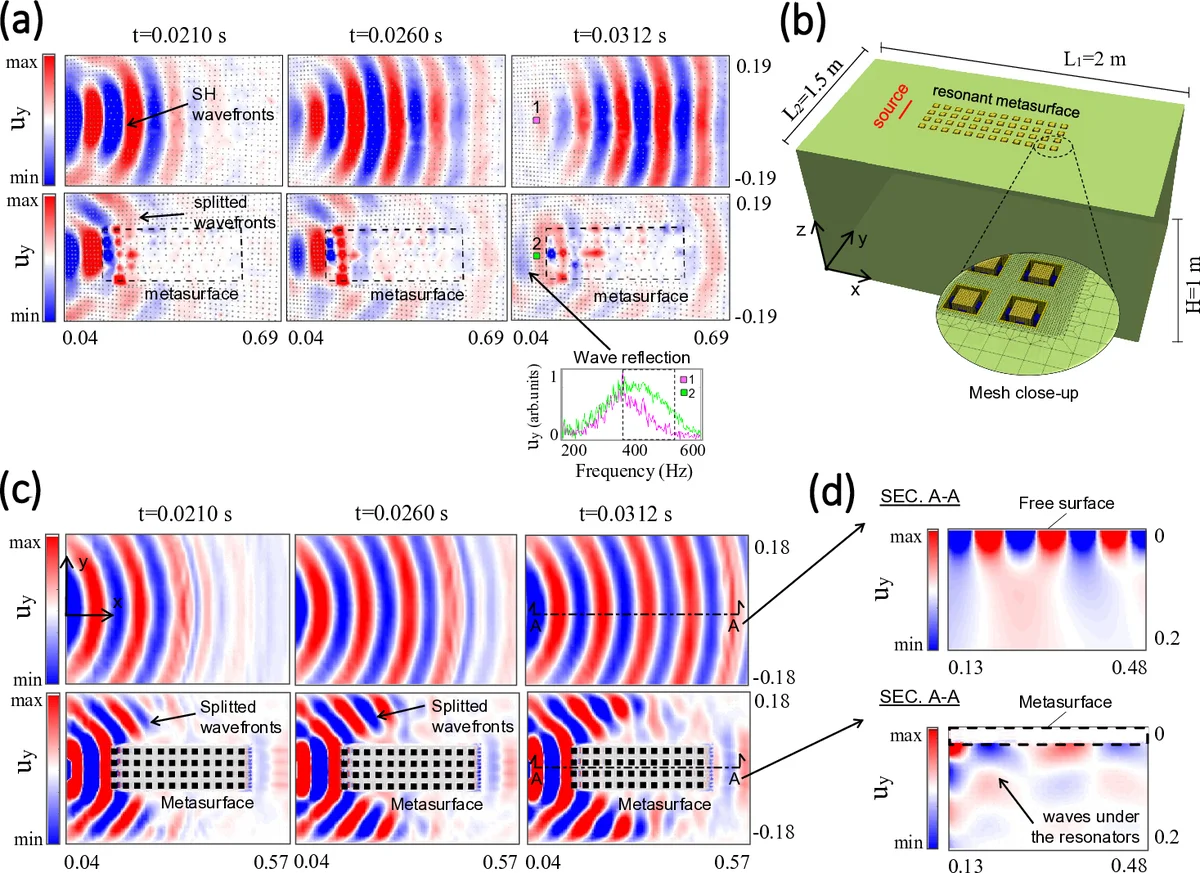
In this article the physics of horizontally polarized shear waves travelling across a locally resonant metasurface in an unconsolidated granular medium is experimentally and numerically explored. The metasurface is comprised of an arrangement of sub-wavelength horizontal mechanical resonators embedded in silica microbeads. The metasurface supports a frequency-tailorable attenuation zone induced by the translational mode of the resonators. The experimental and numerical findings reveal that the metasurface not only backscatters part of the energy, but also redirects the wavefront underneath the resonators leading to a considerable amplitude attenuation at the surface level, when all the resonators have similar resonant frequency. A more complex picture emerges when using resonators arranged in a so-called graded design, e.g., with a resonant frequency increasing/decreasing throughout the metasurface. Unlike Love waves propagating in a bi-layer medium, shear waves localized at the surface of our metasurface are not converted into bulk waves. Although a detachment from the surface occurs, the depth-dependent velocity profile of the granular medium prevents the mode-conversion, steering again the horizontally polarized shear waves towards the surface. The outcomes of our experimental and numerical studies allow for understanding the dynamics of wave propagation in resonant metamaterials embedded in vertically inhomogeneous soils and, therefore, are essential for improving the design of engineered devices for ground vibration and seismic wave containment.
💡 Research Summary
This paper investigates the propagation of horizontally polarized shear (SH) waves across a locally resonant metasurface embedded in an unconsolidated granular medium, using a combination of laboratory experiments, three‑dimensional finite‑element simulations, and analytical modeling. The granular medium consists of 150 µm glass beads, which create a depth‑dependent stiffness profile that mimics the power‑law variation of real soils under gravity. A 3‑axis piezoelectric actuator buried 20 mm below the free surface excites SH waves in the frequency range 100–800 Hz (chirp) and a 300 Hz centered Ricker pulse. Velocity fields are captured with a 3‑D laser Doppler vibrometer and processed via 2‑D discrete Fourier transforms to obtain dispersion curves.
The metasurface comprises 48 sub‑wavelength horizontal resonators arranged in a 4 × 12 grid. Each resonator consists of a brass mass supported by four truss‑like polymer springs that restrict vertical motion while allowing horizontal translation. By varying spring inclination and length, four resonator families are fabricated with nominal resonance frequencies of 250 Hz, 320 Hz, 330 Hz, and 360 Hz. A non‑resonant reference surface is built from identical casings that contain the brass mass but lack springs.
In the pristine granular medium, two guided surface acoustic modes are observed: the fundamental SH₁ (200–500 Hz, phase velocity ≈ 60 m/s) and a higher‑order SH₂ (≈ 80 m/s). When the resonant metasurface is installed, the SH₁ mode hybridizes with the collective translational resonance of the resonators, producing a flat, low‑velocity branch labeled “SH₁ᵐ”. This branch asymptotically approaches the resonator resonance frequency and exhibits a pronounced attenuation zone centered around 400 Hz, where surface particle velocity drops dramatically. Because the resonator spacing is more than six times the shortest wavelength at resonance, Bragg scattering is negligible; this is confirmed by the non‑resonant casing experiment, which shows no bandgap.
To interpret these observations, the authors develop a Bloch‑Floquet finite‑element model of a unit cell that incorporates the depth‑dependent shear velocity profile vₛ(z)=γₛ(ρgz)^{αₛ}. By fitting the experimental dispersion of SH₁, they obtain αₛ = 0.42 and γₛ = 3.82 m^{1‑αₛ}s^{‑1}. The analytical dispersion derived from the guided‑surface‑acoustic‑mode (GSAM) theory, which solves a depth‑dependent Helmholtz equation with stress‑free surface and radiation conditions, matches both the experimental data and the numerical eigenfrequency analysis. This constitutes the first experimental validation of GSAM predictions for SH waves in a granular medium.
Graded metasurfaces, where resonator resonance frequencies increase or decrease along the propagation direction, are also examined. In the decreasing‑frequency arrangement, the SH wave encounters resonators whose natural frequencies are progressively lower, leading to rapid attenuation near the metasurface entrance. Conversely, the increasing‑frequency arrangement allows the wave to traverse the metasurface with a more gradual reduction in amplitude, illustrating the ability to tailor attenuation bandwidths through spatial grading. Importantly, the depth‑dependent stiffness of the granular medium prevents conversion of SH energy into bulk (P‑SV) waves; instead, the wave energy is redirected beneath the resonators and then re‑emerges toward the surface, maintaining a surface‑guided character.
Key insights from the study are: (1) SH waves in a granular half‑space with a power‑law stiffness profile remain surface‑guided and do not convert to bulk modes, even in the presence of resonant inclusions; (2) locally resonant metasurfaces generate a hybridization‑induced attenuation zone without relying on Bragg scattering, effectively “stealing” energy from the surface and channeling it beneath the resonators; (3) graded designs broaden the effective attenuation band and enable spatial control of wave energy, offering a practical route to seismic‑wave mitigation; and (4) the agreement among experiment, finite‑element Bloch analysis, and GSAM theory demonstrates that the analytical framework can be employed for the design of engineered ground‑vibration control devices in realistic, vertically inhomogeneous soils. The work thus bridges the gap between metamaterial theory and practical geotechnical applications, providing a validated methodology for designing metasurfaces that attenuate low‑frequency shear waves relevant to civil‑engineering and seismic protection.
Comments & Academic Discussion
Loading comments...
Leave a Comment