Representing Graphs and Hypergraphs by Touching Polygons in 3D
Contact representations of graphs have a long history. Most research has focused on problems in 2D, but 3D contact representations have also been investigated, mostly concerning fully-dimensional geometric objects such as spheres or cubes. In this paper we study contact representations with convex polygons in 3D. We show that every graph admits such a representation. Since our representations use super-polynomial coordinates, we also construct representations on grids of polynomial size for specific graph classes (bipartite, subcubic). For hypergraphs, we represent their duals, that is, each vertex is represented by a point and each edge by a polygon. We show that even regular and quite small hypergraphs do not admit such representations. On the other hand, the two smallest Steiner triple systems can be represented.
💡 Research Summary
This paper investigates contact representations of graphs and hypergraphs in three‑dimensional space using convex polygons as the basic geometric objects. A contact representation is defined so that each vertex of a graph is represented by a non‑degenerate convex polygon, and two polygons touch if and only if they share exactly one corner; no other intersections are allowed. The authors first prove a universal existence result: every simple graph on n vertices admits such a representation. The construction relies on Lemma 2.2, which produces n lines in the xy‑plane with the property that the distances between consecutive intersection points on each line decrease geometrically by a factor of at least ½. By lifting the intersection point of line i and line j to height min(i, j) and taking the convex hull of all lifted points belonging to line i, they obtain a polygon Pi that lies in a vertical plane containing line i. For any pair i < j, Pi and Pj intersect only at the lifted point (i, j). This yields a contact representation of the complete graph Kn, and by deleting the points corresponding to non‑edges, a representation for any graph with minimum degree at least three. The coordinates involved grow exponentially, so the overall volume of the drawing is exponential in n.
Recognizing whether a given abstract graph is a segment‑intersection graph in three dimensions is shown to be ∃ℝ‑complete (Theorem 2.1). The proof adapts the classic reduction from the Stretchability problem: an arrangement of pseudolines is encoded as a set of segments together with three “frame” segments that force all original segments into a common plane. Additional “twin” segments are added to ensure that any three‑dimensional realization must keep every segment coplanar, thereby reducing the three‑dimensional problem to the known two‑dimensional ∃ℝ‑hard case.
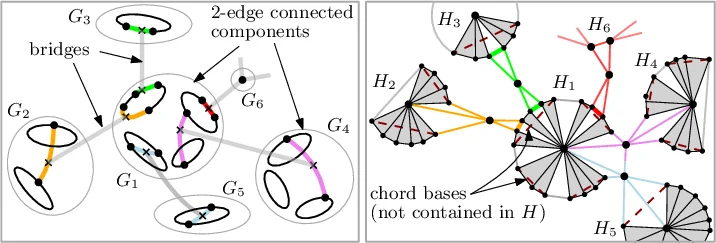
Because the universal construction uses exponential coordinates, the authors develop polynomial‑size grid algorithms for several important graph families. For bipartite graphs they place the two vertex parts on distinct parallel planes and use a two‑dimensional grid layout within each plane; the resulting volume is O(n²). For subcubic graphs (maximum degree three) they assign heights based on a topological ordering and construct convex polygons with at most four sides, achieving O(n³) volume and O(n log² n) running time. Similar bounds are obtained for 1‑planar and 2‑edge‑connected cubic graphs, as summarized in Table 1.
The paper then turns to hypergraphs, interpreting a hypergraph H = (V, E) via its dual: each vertex becomes a point in ℝ³, each hyperedge becomes a convex polygon whose vertices are the points of the incident vertices. Two polygons share a corner precisely when the corresponding hyperedges share a vertex. The authors prove several non‑representability results. In particular, the 3‑uniform hypergraph on six vertices containing all possible triples (the complete 3‑uniform hypergraph K⁽³⁾₆) cannot be drawn with non‑crossing triangles, because any two triangles sharing three vertices would have to be coplanar, leading to unavoidable intersections. More generally, any regular 4‑uniform hypergraph with sufficiently many vertices (e.g., Steiner quadruple systems) cannot be realized with convex quadrilaterals, nor with any quadrilaterals at all.
Conversely, the two smallest Steiner triple systems—STS(7) and STS(9)—are shown to admit contact representations using triangles. The construction places the seven (or nine) points in space and draws a triangle for each block, ensuring that any two triangles intersect only at a shared vertex. This demonstrates that small, highly symmetric hypergraphs can be represented, while larger or higher‑uniformity systems cannot.
Overall, the contributions of the paper are fourfold: (1) a universal existence proof for graph contact representations with convex polygons in 3D (exponential volume), (2) polynomial‑size grid algorithms for several natural graph classes, (3) a complexity classification showing that 3D segment‑intersection graph recognition is ∃ℝ‑complete, and (4) a systematic study of hypergraph dual representations, including both impossibility results for regular high‑uniformity hypergraphs and constructive realizations for the smallest Steiner triple systems. The work opens several avenues for future research, such as extending polynomial‑volume constructions to broader graph families, investigating representations with non‑convex polygons or higher‑dimensional polyhedra, and developing practical visualization tools based on the presented algorithms.
Comments & Academic Discussion
Loading comments...
Leave a Comment