Study of Di-muon Production Process in $pp$ Collision in CMS Data from Symmetry Scaling Perspective
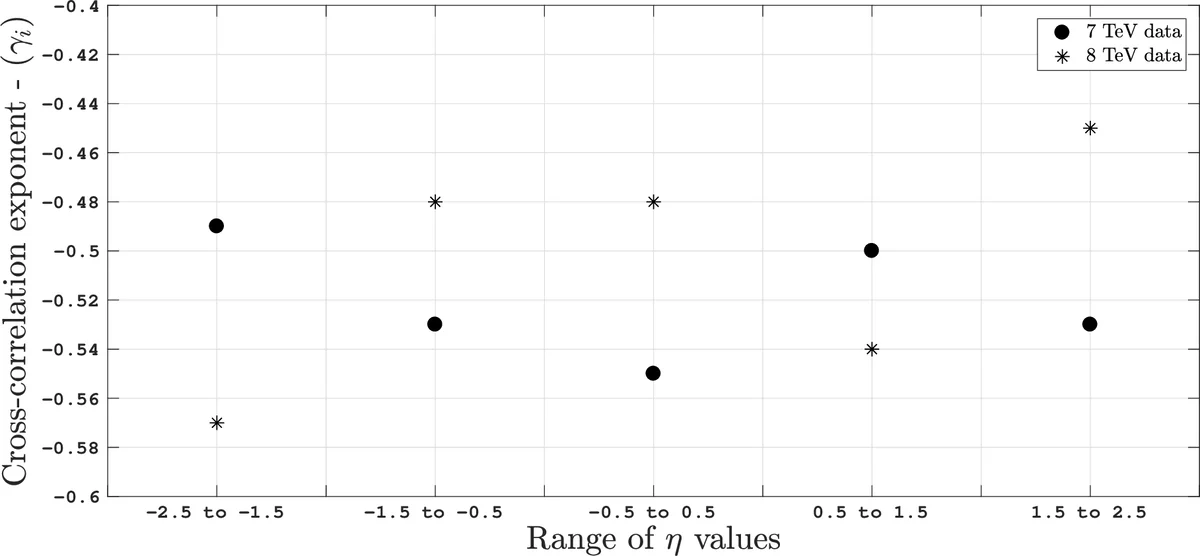
A deailed knowledge of pp collision is required both as input to comprehensive theoretical models of strong interactions and as baseline to decipher the AA collisions at relativistic and ultrarelativistic energies, which has been of great interest in the area of theoretical and experimental physics. The multiplicity distribution of particles produced in pp collisions and the multiplicity dependence of various global event features serve as rudimentary observables which reflect the features of the inherent dynamics of the process of particle production. Recent availability of dimuon data has triggered spur of interests in revisiting strong interaction process, the study of which in detail is extremely important for enhancement of our understanding on not only the theory of strong interaction but also possible physics scenarios beyond the standard model. Numerous papers have come up where background of production process of dimuon in pp collision has been discussed and analyzed particularly for production of dimuon from {\gamma}{\gamma} interaction. Apart from conventional approaches the present authors proposed a new approach with successful application in context of symmetry scaling in AA collision data from ALICE, pp collisions at 8TeV from CMS and so on. The different approach essentially analyses fluctuation pattern from the perspective of symmetry scaling or degree of self-similarity involved in the process. The proposed methods of analysis using pseudorapidity values of di-muon data taken from the primary dataset of RunA(2011)-7TeV and RunB(2012)-8TeV of the pp collision from CMS, reveal that pseudorapidity spaces corresponding to different ranges of rapidity are highly scale-free and the scaling pattern changes from one rapidity range to another at both energy. Also, the degree of cross-correlation between rapidity and azimuthal space has been found to follow the similar behavior.
💡 Research Summary
**
The manuscript titled “Study of Di‑muon Production Process in pp Collision in CMS Data from Symmetry Scaling Perspective” investigates the statistical properties of di‑muon events recorded by the CMS experiment at centre‑of‑mass energies of 7 TeV (Run A, 2011) and 8 TeV (Run B, 2012). Rather than focusing on conventional perturbative QCD or γγ‑induced dimuon production mechanisms, the authors apply techniques borrowed from the physics of complex systems—Multifractal Detrended Fluctuation Analysis (MF‑DFA) and Multifractal Detrended Cross‑Correlation Analysis (MF‑DXA)—to explore self‑similarity and long‑range correlations in the pseudorapidity (η) and azimuthal (φ) distributions of the muon pairs.
Data handling and preprocessing
The di‑muon events are first sorted into several η intervals (e.g., |η| < 0.5, 0.5–1.0, etc.). For each interval the η values are ordered in time‑like sequence to form a one‑dimensional series x(i). The mean of the series is subtracted and the cumulative deviation X(i) is constructed. The series is then divided into non‑overlapping windows of length s, where s spans a logarithmic range from 16 to 1024 (or 512) points. Within each window a linear (first‑order polynomial) trend is fitted and removed, yielding detrended residuals.
MF‑DFA methodology
For each window the variance F²(s, v) of the detrended residuals is computed. The q‑order fluctuation function F_q(s) is obtained by averaging over all windows and raising to the power q/2, with q ranging from –5 to +5 (q = 0 is treated by the usual logarithmic limit). If the data exhibit long‑range power‑law correlations, F_q(s) scales as s^{h(q)}. The exponent h(q) is the generalized Hurst exponent; h(2) corresponds to the classic Hurst exponent. The authors report clear power‑law behavior for all η intervals, with h(q) varying significantly with q, indicating multifractality. The multifractal spectrum τ(q) = q h(q) − 1 and the singularity spectrum f(α) are derived, and the width Δα of f(α) is used as a quantitative measure of multifractality. The 8 TeV data show a ∼10 % larger Δα than the 7 TeV sample, suggesting that higher collision energy enhances the range of fluctuations.
MF‑DXA methodology
To study the coupling between η and φ, the authors construct two simultaneous series X(i) (η) and Y(i) (φ). After detrending each window, the detrended covariance f²_xy(s, v) is calculated, and the q‑order cross‑fluctuation function F_xy(q, s) is obtained analogously to MF‑DFA. The scaling exponent h_xy(q) is extracted from the log‑log plot of F_xy versus s. For q = 2, h_xy(2) > 0.5 indicates persistent long‑range cross‑correlations, while h_xy(2) < 0.5 would indicate anti‑persistence. The authors find h_xy(2) > 0.5 for virtually all η intervals, with a modest increase at 8 TeV, implying that the azimuthal structure is positively correlated with the pseudorapidity structure over large scales.
Physical interpretation
The authors argue that the observed scale‑free, multifractal behavior reflects a self‑similar particle‑production mechanism that goes beyond simple partonic scattering. They suggest that the variation of scaling exponents with η may be linked to differing parton density and color‑field dynamics in central versus forward rapidity regions. The increase of multifractal width with energy is interpreted as evidence that higher‑energy collisions generate larger intrinsic fluctuations, possibly due to more intense parton showers or initial‑state gluon saturation effects.
Critical assessment
While the application of MF‑DFA and MF‑DXA to high‑energy collider data is novel, several shortcomings limit the impact of the work:
-
Insufficient data description – The manuscript does not provide the number of di‑muon events per η interval, the transverse‑momentum (p_T) cuts, or the procedures used to suppress background (e.g., cosmic‑ray muons, mis‑identified hadrons). Without these details, reproducibility is doubtful.
-
Parameter justification – The choice of window sizes (s), polynomial order (m = 1), and the q‑range is not motivated beyond “standard practice”. Sensitivity studies showing how the results change with different m or s‑ranges are absent.
-
Lack of comparison with conventional models – No direct comparison is made with predictions from Drell‑Yan, γγ → μ⁺μ⁻, or next‑to‑leading‑order QCD calculations. Consequently, it is unclear whether the multifractal signatures provide new discriminating power or simply reflect known statistical properties of the data.
-
Statistical significance – Uncertainties on h(q), Δα, and h_xy(q) are not reported. Confidence intervals or bootstrap error estimates would be essential to assess whether the observed differences between 7 TeV and 8 TeV are statistically robust.
-
Presentation issues – The manuscript contains numerous typographical and grammatical errors, duplicated sentences, and inconsistent notation, which obscure the scientific message.
Conclusion
The study demonstrates that di‑muon pseudorapidity and azimuthal distributions in CMS pp collisions exhibit clear multifractal scaling and persistent cross‑correlations, with modest energy dependence. These findings open an intriguing avenue for applying complex‑system analysis to high‑energy particle production. However, to establish the physical relevance of the observed scaling, future work should (i) provide a thorough description of the data sample and background treatment, (ii) perform systematic parameter scans and report uncertainties, (iii) benchmark the multifractal observables against standard perturbative QCD predictions, and (iv) improve the manuscript’s clarity and rigor. Only then can the symmetry‑scaling perspective be convincingly positioned as a complementary tool for probing the dynamics of dimuon production in proton–proton collisions.
Comments & Academic Discussion
Loading comments...
Leave a Comment