A Hybrid Lagrangian/Eulerian Collocated Advection and Projection Method for Fluid Simulation
💡 Research Summary
This paper presents a novel hybrid method for incompressible fluid simulation that innovatively addresses long-standing issues of numerical dissipation, algorithmic complexity, and free-surface handling prevalent in computer graphics. The core methodology rests on three interconnected pillars.
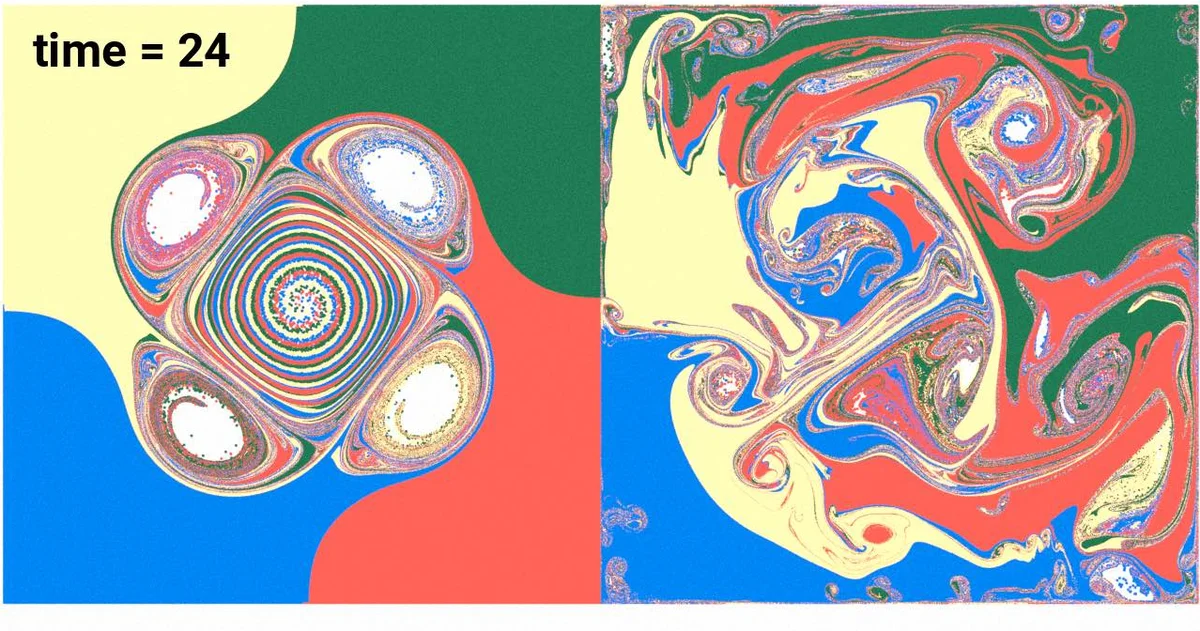
First, the authors introduce BSLQB (Backward Semi-Lagrangian for Quadratic B-splines), a new advection scheme. Moving beyond the standard explicit Semi-Lagrangian method known for its stability but high dissipation, BSLQB leverages the implicit relationship inherent in the solution of Burgers’ equation: 𝑢ⁿ⁺¹ = 𝑢(𝑥 - Δ𝑡𝑢ⁿ⁺¹, 𝑡ⁿ). By employing C1-continuous quadratic B-spline interpolation for the velocity field, this nonlinear equation can be solved efficiently at each grid point using Newton’s method. BSLQB achieves second-order accuracy in both space and time, dramatically reduces numerical diffusion, and remains stable for time steps larger than the CFL limit, as visually demonstrated in vorticity-rich examples.
Second, the paper proposes a variational projection method built on a collocated B-spline grid. This departs from the traditional staggered Marker-and-Cell (MAC) grid, simplifying algorithms since all variables reside at the same locations. The approach adopts a Taylor-Hood type mixed finite element method, using quadratic B-splines for velocity and linear functions for pressure. To handle complex boundaries and free surfaces, the formulation incorporates a cut-cell technique within this variational framework. A key advantage is that this collocated setup naturally accommodates free-surface boundary conditions without the need for the post-projection velocity extrapolation typically required in MAC-based methods.
Third, the work develops a hybrid BSLQB/PolyPIC strategy that seamlessly blends Lagrangian and Eulerian paradigms. This allows practitioners to combine the strengths of both worlds: the low-dissipation, detailed tracking of particle-based methods (PolyPIC) in regions of interest (e.g., near fluid interfaces or in detailed smoke plumes), and the efficiency and mathematical convenience of the grid-based BSLQB scheme elsewhere. Particles can be sparsely or densely placed as needed, providing artistic control over where simulation detail is concentrated.
The method is extensively validated through a series of compelling simulations, including dam breaks with obstacles, flow in spherical domains, and interactions with complex cut-cell geometries. The results show that the proposed technique can generate intricate flow details, preserve vorticity, and handle irregular domains and free surfaces effectively, even at modest spatial resolutions. In summary, this research makes significant contributions by delivering a fluid simulation framework that simultaneously advances accuracy, stability, computational efficiency, and artistic flexibility, effectively bridging sophisticated numerical analysis with the practical demands of visual effects.
Comments & Academic Discussion
Loading comments...
Leave a Comment