Which papers cited which tweets? An empirical analysis based on Scopus data
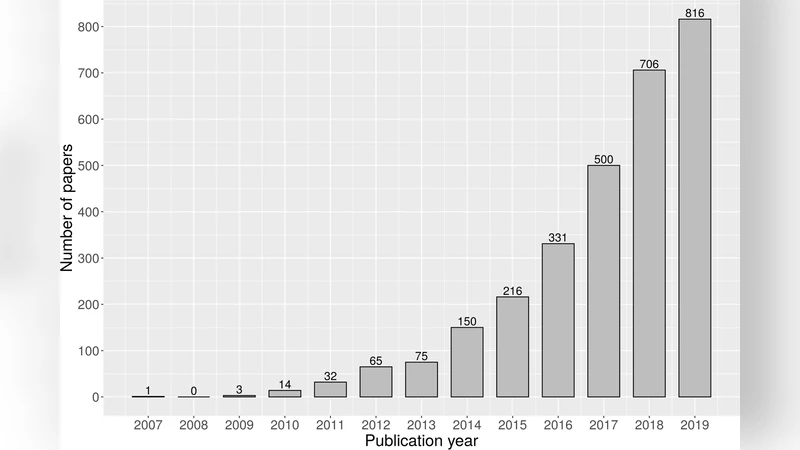
Many altmetric studies analyze which papers were mentioned how often in specific altmetrics sources. In order to study the potential policy relevance of tweets from another perspective, we investigate which tweets were cited in papers. If many tweets were cited in publications, this might demonstrate that tweets have substantial and useful content. Overall, a rather low number of tweets (n=5506) were cited by less than 3000 papers. Most tweets do not seem to be cited because of any cognitive influence they might have had on studies; they rather were study objects. Most of the papers citing tweets are from the subject areas Social Sciences, Arts and Humanities, and Computer Sciences. Most of the papers cited only one tweet. Up to 55 tweets cited in a single paper were found. This research-in-progress does not support a high policy-relevance of tweets. However, a content analysis of the tweets and/or papers might lead to a more detailed conclusion.
💡 Research Summary
This study adopts an unconventional “reverse” perspective on altmetrics by asking not how often scholarly articles are mentioned on Twitter, but rather which tweets are cited within scholarly publications. Using the Scopus citation database, the authors extracted all reference entries that contain a Twitter URL. In total, 5,506 distinct tweets were identified as being cited by approximately 2,900 peer‑reviewed papers. This represents less than 0.5 % of the total tweets examined, indicating that direct scholarly citation of individual tweets is a rare phenomenon.
The disciplinary distribution of the citing papers is heavily skewed toward the Social Sciences, Arts and Humanities, and Computer Sciences. In the social sciences and humanities, tweets often serve as empirical evidence of public opinion, media events, or policy debates, making them attractive as case material. In computer science, tweets are frequently employed as data sources for network analysis, sentiment mining, or real‑time data collection, explaining the relatively higher citation rate in that field. By contrast, natural sciences and engineering journals show virtually no instances of tweet citation, reflecting a lower perceived relevance of social‑media content for those domains.
Citation patterns reveal that the overwhelming majority of papers cite a single tweet. Only one paper was found to cite as many as 55 tweets, suggesting that in most cases the tweet functions as a specific piece of evidence rather than a dataset. When multiple tweets are cited together, they typically constitute a collection that illustrates a broader phenomenon (e.g., a series of official statements, a timeline of a breaking news event). The authors argue that this pattern underscores the role of tweets as “objects of study” rather than as sources that have directly shaped research hypotheses or methods.
From a policy‑relevance standpoint, the findings do not support the notion that tweets exert a strong, direct influence on scholarly discourse or on policy formulation. Instead, tweets appear in the scholarly literature mainly as illustrative material that documents the social context surrounding a policy issue. Consequently, any claim about the policy impact of Twitter would require a deeper qualitative examination of tweet content, citation context, and the argumentative role the tweet plays within the citing article.
The paper acknowledges several methodological limitations. First, reliance on Scopus means that any tweet citation not explicitly formatted as a URL in the reference list will be missed, potentially underestimating the true prevalence. Second, Scopus’s journal coverage is uneven across fields, so the observed disciplinary bias may partly reflect database composition rather than genuine differences in citation behavior. Third, the analysis is purely quantitative; it does not code the rhetorical function of each tweet citation (e.g., evidence, background, critique), leaving the substantive meaning of the citations unexplored.
Future research directions proposed include: (1) applying natural‑language processing to the tweet texts themselves to identify thematic or sentiment characteristics that make a tweet more likely to be cited; (2) conducting a systematic content analysis of the citing articles to classify the purpose of each tweet citation; and (3) comparing Twitter citation patterns with those of other altmetric sources (e.g., news outlets, policy documents, blogs) to situate Twitter within the broader ecosystem of scholarly impact metrics. By integrating these approaches, scholars can better assess whether Twitter functions merely as a convenient data source or whether it can meaningfully contribute to the generation of scientific knowledge and the shaping of public policy.