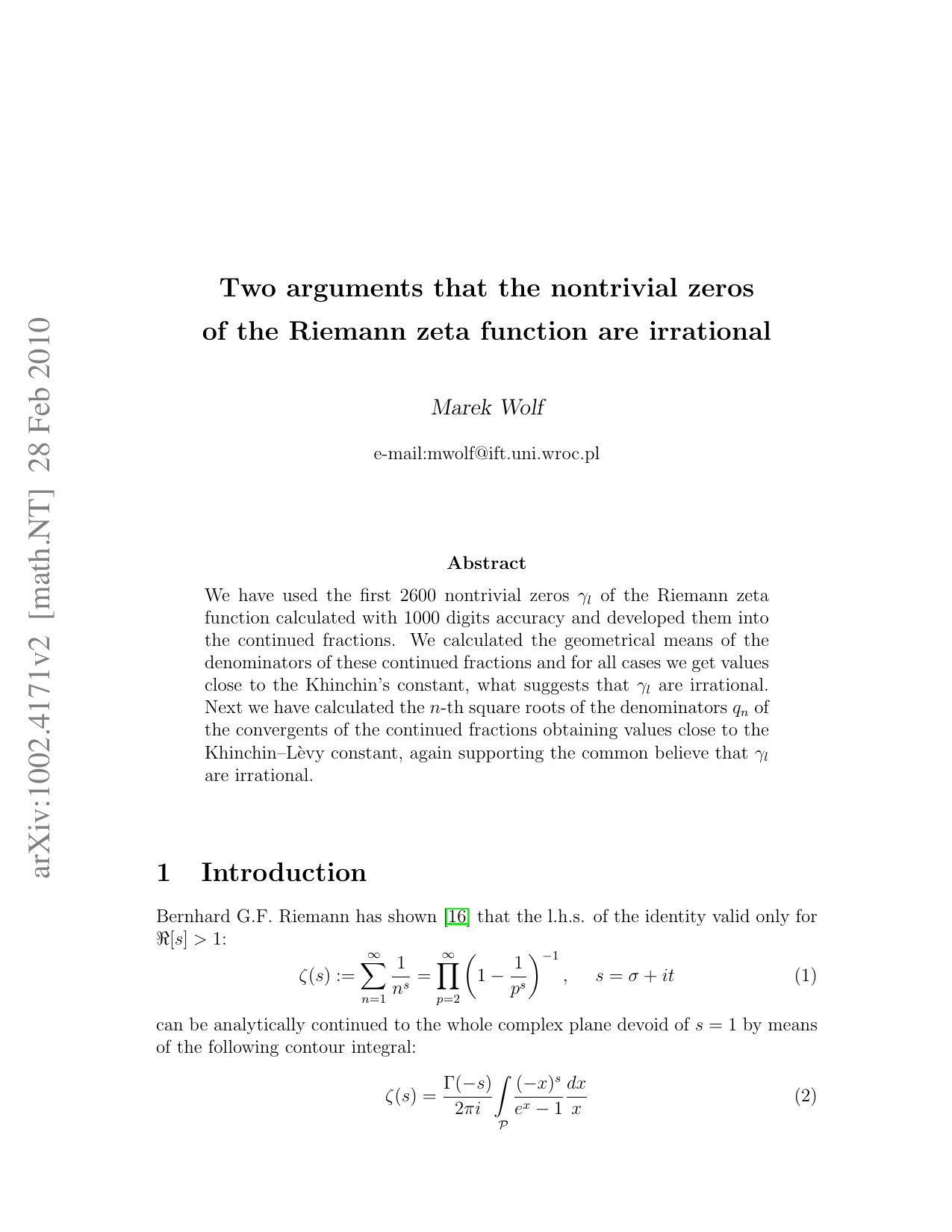
We have used the first 2600 nontrivial zeros gamma_l of the Riemann zeta function calculated with 1000 digits accuracy and developed them into the continued fractions. We calculated the geometrical means of the denominators of these continued fractions and for all cases we get values close to the Khinchin's constant, what suggests that gamma_l are irrational. Next we have calculated the n-th square roots of the denominators q_n of the convergents of the continued fractions obtaining values close to the Khinchin-Levy constant, again supporting the common believe that gamma_l are irrational.
Deep Dive into Two arguments that the nontrivial zeros of the Riemann zeta function are irrational.
We have used the first 2600 nontrivial zeros gamma_l of the Riemann zeta function calculated with 1000 digits accuracy and developed them into the continued fractions. We calculated the geometrical means of the denominators of these continued fractions and for all cases we get values close to the Khinchin’s constant, what suggests that gamma_l are irrational. Next we have calculated the n-th square roots of the denominators q_n of the convergents of the continued fractions obtaining values close to the Khinchin-Levy constant, again supporting the common believe that gamma_l are irrational.
Bernhard G.F. Riemann has shown [16] that the l.h.s. of the identity valid only for
[s] > 1:
can be analytically continued to the whole complex plane devoid of s = 1 by means of the following contour integral:
arXiv:1002.4171v2 [math.NT] 28 Feb 2010
where the integration is performed along the path P Now dozens of integrals and series representing the ζ(s) function are known, for collection of such formulas see for example the entry Riemann Zeta Function in [20] and references cited therein.
The ζ(s) function has trivial zeros -2, -4, -6, . . . and infinity of nontrivial complex zeros ρ l = β l + iγ l in the critical strip: β l ∈ (0, 1). The Riemann Hypothesis (RH) asserts that β l = 1 2 for all l -i.e. all zero lie on the critical line (s) = 1 2 . Presently it is added that these nontrivial zeros are simple: ζ (ρ l ) = 0 -many explicit formulas of number theory contain ζ (ρ l ) in the denominators. In 1914 G. Hardy [6] proved that infinitely many zeros of ζ(s) lie on the critical line. A. Selberg [18] in 1942 has shown that at least a (small) positive proportion of the zeros of ζ(s) lie on the critical line. The first quantitative result was obtained by N. Levinson in 1974 [9] who showed that at least one-third of the zeros lie on the critical line. In 1989 B. Conrey [2] improved this to two-fifths and quite recently with collaborators [1] to over 41%. It was checked computationally [5] that the 10 13 first zeros of the Riemann Zeta function fulfill the condition β l = 1 2 . A. Odlyzko checked that RH is true in different intervals around 10 20 [10], 10 21 [11], 10 22 [14], see also [5] for the two billion zeros from the zero 10 24 .
There is no hope to obtain the analytical formulas for the imaginary parts γ l of the nontrivial zeros of ζ(s) but the common belief is that they are irrational and perhaps even transcendental [13]. The problem of any linear relations between γ l with integral coefficients appeared for the first time in the paper of A.E. Ingham [7] in connection with the Mertens conjecture. This conjecture specifies the growth of the function M (x) defined by
where µ(n) is the Möbius function
The Mertens conjecture claims that
(
From this inequality the RH would follow. A. E. Ingham in [7] showed that the validity of the Merten’s conjecture requires that the imaginary parts of the nontrivial zeros should fulfill the relations of the form:
where c l are integers not all equal to zero. This result raised the doubts in the inequality ( 5) and indeed in 1985 A. Odlyzko and H. te Riele [15] disproved the Merten’s conjecture.
In this paper we are going to exploit two facts about the continued fractions: the existence of the Khinchin constant and Khinchin-Lèvy constant, see e.g. [4, §1.8], to support the irrationality of γ l . Let
be the continued fraction expansion of the real number r, where a 0 (r) is an integer and all a k (r) with k ≥ 1 are positive integers. Khinchin has proved [8], see also [17], that lim n→∞ a 1 (r) . . . a n (r)
is a constant for almost all real r [4, §1.8]. The exceptions are of the Lebesgue measure zero and include rational numbers, quadratic irrationals and some irrational numbers too, like for example the Euler constant e = 2.7182818285 . . . for which the limit (8) is infinity. The constant K 0 is called the Khinchin constant. If the quantities K(r; n) = a 1 (r)a 2 (r) . . . a n (r)
for a given number r are close to K 0 we can regard it as an indication that r is irrational.
Let the rational p n /q n be the n-th partial convergent of the continued fraction:
For almost all real numbers r the denominators of the finite continued fraction approximations fulfill:
where L 0 is called the Khinchin-Lèvy’s constant [4, §1.8]. Again the set of exceptions to the above limit is of the Lebesgue measure zero and it includes rational numbers, quadratic irrational etc.
First 100 zeros γ l of ζ(s) accurate to over 1000 decimal places we have taken from [12]. Next 2500 zeros of ζ(s) with precision of 1000 digits were calculated using the built in Mathematica v.7 procedure ZetaZero[m]. We have checked using PARI/GP [19] that these zeros were accurate within at least 996 places in the sense that in the worst case |ζ(ρ l )| < 10 -996 , l = 1, 2, . . . , 2600. PARI has built in function contfrac(r, {nmax}) which creates the row vector a(r) whose components are the denominators a n (r) of the continued fraction expansion of r, i.e. a = [a 0 (r); a 1 (r), . . . , a n (r)] means that r ≈ a 0 (r) + 1
The parameter nmax limits the number of terms a nmax (r); if it is omitted the expansion stops with a declared precision of representation of real numbers at the last significant partial quotient.
By trials we have determined that the precision set to \p 2200 is sufficient in the sense that scripts with larger precision generated exactly the same results: the rows a(γ l ) obtained with accuracy 2200 digits were the same for all l as those obtained for accuracy 2600 and the con
…(Full text truncated)…
This content is AI-processed based on ArXiv data.