Provable bounds for the Korteweg-de Vries reduction in multi-component Nonlinear Schrodinger Equation
We study the dynamics of multi-component Bose gas described by the Vector Nonlinear Schr"{o}dinger Equation (VNLS), aka the Vector Gross–Pitaevskii Equation (VGPE) . Through a Madelung transformation, the VNLS can be reduced to coupled hydrodynamic equations in terms of multiple density and velocity fields. Using a multi-scaling and a perturbation method along with the Fredholm alternative, we reduce the problem to a Korteweg de-Vries (KdV) system. This is of great importance to study more transparently, the obscure features hidden in VNLS. This ensures that hydrodynamic effects such as dispersion and nonlinearity are captured at an equal footing. Importantly, before studying the KdV connection, we provide a rigorous analysis of the linear problem. We write down a set of theorems along with proofs and associated corollaries that shine light on the conditions of existence and nature of eigenvalues and eigenvectors of the linear problem. This rigorous analysis is paramount for understanding the nonlinear problem and the KdV connection. We provide strong evidence of agreement between VNLS systems and KdV equations by using soliton solutions as a platform for comparison. Our results are expected to be relevant not only for cold atomic gases, but also for nonlinear optics and other branches where VNLS equations play a defining role.
💡 Research Summary
The manuscript addresses the long‑standing problem of extracting a transparent, reduced description for the dynamics of multi‑component Bose gases governed by the vector nonlinear Schrödinger (VNLS) or vector Gross‑Pitaevskii equations. By applying the Madelung transformation the authors rewrite the complex field equations in terms of real density and velocity fields, obtaining a coupled set of continuity and Euler‑type equations. The density equations remain uncoupled, while all inter‑species interactions appear in the velocity equations through a symmetric coupling matrix α.
A central part of the work is a rigorous linear stability analysis about the trivial uniform background (constant densities, zero velocities). Linearizing the hydrodynamic system yields a 2N‑dimensional first‑order system (\partial_t \mathbf{U}= -\partial_x A \mathbf{U}) with block matrix
(A=\begin{pmatrix}0 & \rho \ \alpha & 0\end{pmatrix}),
where ρ is a diagonal matrix of background densities. The authors prove a series of theorems (Theorems 1‑6) that completely characterize the spectrum of A. The key result (Theorem 1) shows that if α is real, symmetric and positive‑definite, then A possesses N positive and N negative real eigenvalues, occurring in opposite‑sign pairs. These eigenvalues correspond to sound speeds (c_j) of the coupled system; the associated eigenvectors determine the direction in which each mode propagates.
To make the analysis concrete, the authors adopt a specific “all‑to‑all” coupling form (Assumption 1): (\alpha_{ij}=g_i\delta_{ij}+h(1-\delta_{ij})) with all (g_i, h>0). Under this assumption the eigenvalues can be written explicitly as
(c_j^2 = g_j\rho_{0j}+h\sum_{k\neq j}\rho_{0k}),
and the eigenvectors are proportional to those of α. The paper also treats the case of degenerate eigenvalues, providing explicit constructions of the generalized eigenvectors.
Having established the linear spectrum, the authors proceed to a reductive perturbation analysis. Introducing a small parameter ε they scale space and time as (X=\varepsilon x,, T=\varepsilon t) and expand densities and velocities to order ε². At order ε the linear equations reappear, while at order ε² nonlinear advection terms and third‑order spatial derivatives (dispersion) emerge. By projecting the higher‑order equations onto the eigenvectors of A and invoking the Fredholm alternative, each linear mode decouples and satisfies a Korteweg‑de‑Vries (KdV) equation of the form
(\partial_T \phi_j + c_j \partial_X \phi_j + \beta_j \phi_j \partial_X \phi_j + \gamma_j \partial_X^3 \phi_j =0).
The coefficients (\beta_j) (nonlinearity) and (\gamma_j) (dispersion) are expressed analytically in terms of the background densities and the entries of α, thus providing a direct map from the original VNLS parameters to the reduced KdV model.
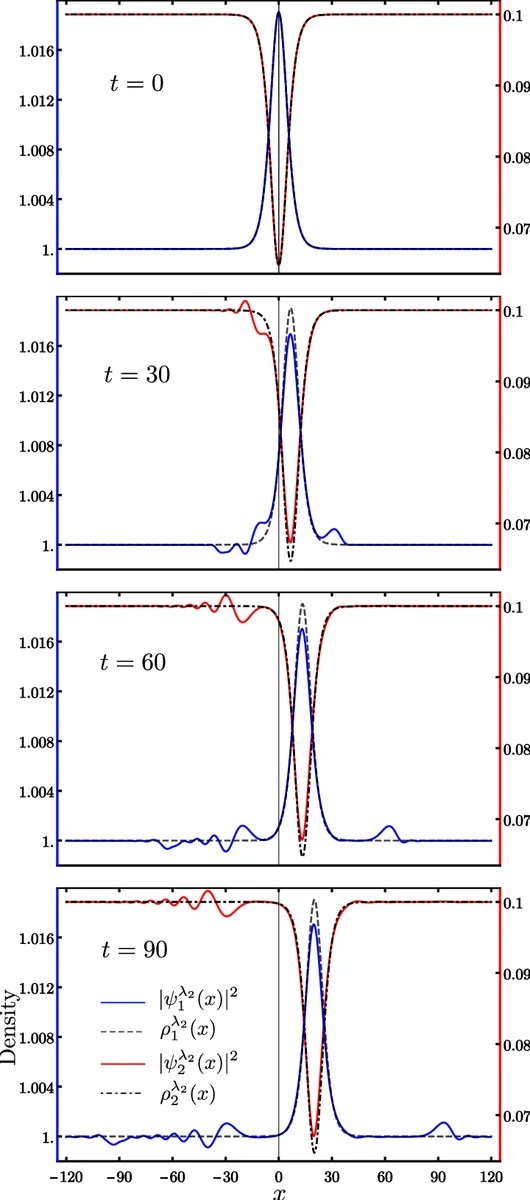
The theoretical derivation is complemented by numerical experiments for the two‑component case (N=2). The authors simulate the full VNLS system with an initial solitary‑wave profile and, in parallel, integrate the corresponding coupled KdV equations using the analytically derived coefficients. The comparison shows excellent agreement in wave speed, amplitude preservation, and shape evolution, confirming that the KdV reduction captures the essential long‑wavelength, small‑amplitude dynamics of the multi‑component VNLS. Additional parameter sweeps illustrate how varying the inter‑species coupling h modifies the sound speeds and the KdV coefficients, thereby affecting soliton interactions.
The paper is organized as follows: Section II presents the Madelung transformation and the linearized hydrodynamic model; Section III delivers the full spectral analysis of the matrix A, including proofs of reality, multiplicity, and explicit eigenvectors; Section IV carries out the multi‑scale expansion and the Fredholm‑alternative‑based reduction to KdV; Section V provides explicit formulas for N=2 and N=3 and shows numerical validation; Section VI discusses implications, possible extensions to other coupling matrices, and relevance to cold‑atom experiments, nonlinear optics, plasma physics, and related fields.
In summary, the work makes three major contributions: (1) a mathematically rigorous spectral theory for the linearized multi‑component VNLS, (2) a systematic derivation of a set of coupled KdV equations governing the weakly nonlinear, long‑wavelength regime, and (3) a concrete numerical demonstration that the reduced KdV model faithfully reproduces soliton dynamics of the original VNLS. These results provide a powerful analytical toolbox for researchers studying multi‑species Bose–Einstein condensates, vector optical solitons, and any physical system described by coupled nonlinear Schrödinger‑type equations.
Comments & Academic Discussion
Loading comments...
Leave a Comment