On the existence and number of $(k+1)$-kings in $k$-quasi-transitive digraphs
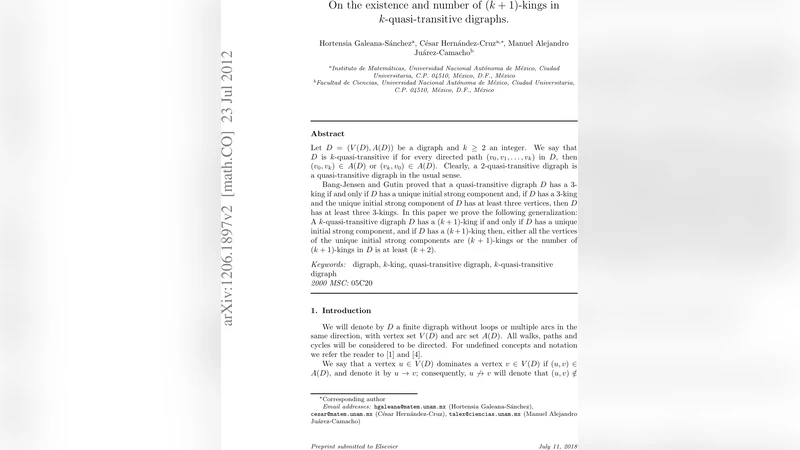
Let $D=(V(D), A(D))$ be a digraph and $k \ge 2$ an integer. We say that $D$ is $k$-quasi-transitive if for every directed path $(v_0, v_1,…, v_k)$ in $D$, then $(v_0, v_k) \in A(D)$ or $(v_k, v_0) \in A(D)$. Clearly, a 2-quasi-transitive digraph is a quasi-transitive digraph in the usual sense. Bang-Jensen and Gutin proved that a quasi-transitive digraph $D$ has a 3-king if and only if $D$ has a unique initial strong component and, if $D$ has a 3-king and the unique initial strong component of $D$ has at least three vertices, then $D$ has at least three 3-kings. In this paper we prove the following generalization: A $k$-quasi-transitive digraph $D$ has a $(k+1)$-king if and only if $D$ has a unique initial strong component, and if $D$ has a $(k+1)$-king then, either all the vertices of the unique initial strong components are $(k+1)$-kings or the number of $(k+1)$-kings in $D$ is at least $(k+2)$.
💡 Research Summary
The paper investigates the existence and multiplicity of (k+1)-kings in k‑quasi‑transitive digraphs, where k is an integer at least 2. A digraph D is called k‑quasi‑transitive if for every directed path (v₀, v₁, …, v_k) the pair (v₀, v_k) or (v_k, v₀) is an arc of D. This definition generalises the well‑known notion of quasi‑transitivity (the case k = 2). The authors extend a classical result of Bang‑Jensen and Gutin, which characterises 3‑kings in quasi‑transitive digraphs, to the whole family of k‑quasi‑transitive digraphs.
The first main theorem establishes a necessary and sufficient condition for the existence of a (k+1)-king. It states that a k‑quasi‑transitive digraph D possesses a (k+1)-king if and only if D has a unique initial strong component (i.e., a strong component with no incoming arcs from other components). The proof proceeds in two directions. If D has more than one initial strong component, there are vertices that cannot be reached within distance k+1 from any candidate king, contradicting the definition of a (k+1)-king. Conversely, when there is a single initial strong component C, the strong connectivity of C guarantees that any two vertices inside C are at distance at most k. Moreover, all arcs from C to the rest of the digraph are oriented outward, which ensures that every vertex of C can reach any vertex outside C within at most k+1 steps. Hence any vertex of C is a (k+1)-king, proving existence.
The second theorem concerns the number of (k+1)-kings. Assuming D has a (k+1)-king, the authors show that either every vertex of the unique initial strong component C is a (k+1)-king, or D contains at least (k+2) distinct (k+1)-kings. The argument distinguishes two cases. If C contains a vertex that is not a (k+1)-king, the authors construct a set of at least (k+2) vertices that are (k+1)-kings by exploiting the k‑quasi‑transitive property and the distances within C. The key observation is the “king‑propagation” phenomenon: if a vertex w is a (k+1)-king, then every vertex at distance at most k from w is also a (k+1)-king. This follows directly from the definition of k‑quasi‑transitivity. By repeatedly applying this propagation inside C, one can generate a large collection of kings. If, on the other hand, every vertex of C is a (k+1)-king, then the number of kings equals |C|, which is automatically at least (k+2) when |C| ≥ k+2. The paper also discusses the borderline situation where |C| = 2; in this case the lower bound (k+2) does not apply, and the digraph may have fewer kings, which is consistent with the theorem’s statement.
To substantiate the theoretical results, the authors provide explicit constructions and counter‑examples. They illustrate digraphs with a unique initial component of size three that indeed contain exactly (k+2) (k+1)-kings, confirming the tightness of the bound. They also present digraphs with multiple initial components, showing that no (k+1)-king can exist in such configurations. These examples clarify why the uniqueness of the initial strong component is indispensable.
The paper concludes by highlighting the significance of the findings. By generalising the 3‑king result to arbitrary k, the authors reveal a robust structural principle: the presence and abundance of (k+1)-kings in k‑quasi‑transitive digraphs are governed solely by the configuration of the initial strong component. This insight not only deepens the theoretical understanding of king‑type vertices in directed graphs but also opens avenues for algorithmic applications, such as efficiently locating (k+1)-kings or determining their number in large networks that satisfy the k‑quasi‑transitive condition.
Comments & Academic Discussion
Loading comments...
Leave a Comment