Some Applications of Lie Groups in Theory of Technical Progress
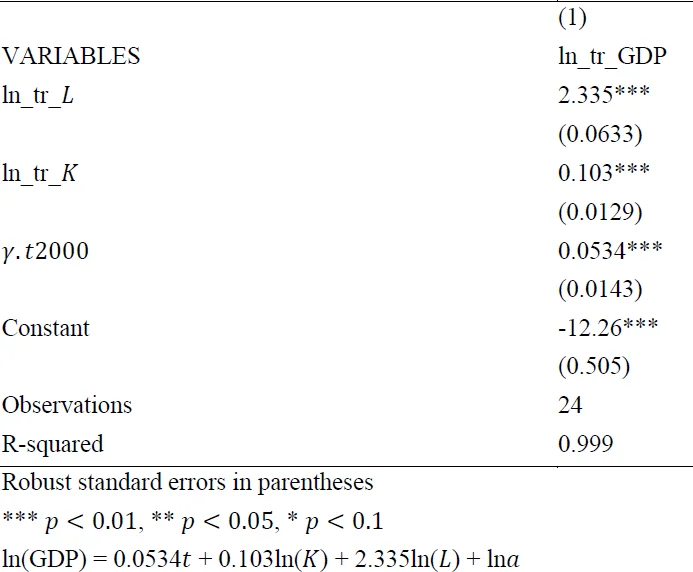
In recent decades, we have known some interesting applications of Lie theory in the theory of technological progress. Firstly, we will discuss some results of R. Saito in \cite{rS1980} and \cite{rS1981} about the application modeling of Lie groups in the theory of technical progress. Next, we will describe the result on Romanian economy of G. Zaman and Z. Goschin in \cite{ZG2010}. Finally, by using Sato’s results and applying the method of G. Zaman and Z. Goschin, we give an estimation of the GDP function of Viet Nam for the 1995-2018 period and give several important observations about the impact of technical progress on economic growth of Viet Nam.
💡 Research Summary
The paper surveys the application of Lie‑group theory to the study of technical progress in economic growth and then uses this framework to estimate Vietnam’s aggregate production function for the period 1995‑2018. It begins by recalling the seminal Solow (1957) insight that a large share of output growth cannot be explained by capital‑labour accumulation alone and must be attributed to “technical progress”. The authors distinguish between endogenous technical change (generated within the economy) and exogenous technical change (imported from abroad).
The theoretical core rests on the work of R. Saito (1980, 1981). Saito formalizes technical progress as a family of transformations (T_t=(\varphi_t(K,L),\psi_t(K,L))) indexed by a time parameter (t). When these transformations satisfy the group axioms (T_t\circ T_{t’}=T_{t+t’}), (T_{-t}=T_t^{-1}) and (T_0=\text{Id}), they constitute a one‑parameter continuous subgroup of a Lie group. A production function (Y=f(K,L)) is called holothetic with respect to a given technical‑progress family if there exists a monotone family of output transformations (F_t) such that (f(\varphi_t(K,L),\psi_t(K,L))=F_t(f(K,L))). Under holotheticity the entire effect of technical progress can be absorbed into a scale effect: iso‑quant shapes remain unchanged, marginal rates of substitution are invariant, and the functional form of the production function is preserved. Saito proves that for any sufficiently smooth production function at least one Lie‑type technical‑progress family exists, and that only when the function is not holothetic can the technical‑progress effect be identified separately from the scale effect.
The authors then review Zaman and Goschin (2010), who applied Saito’s framework to Romania. Using an exogenous, exponential technical‑progress specification (K_t=e^{\lambda t}K,;L_t=e^{\lambda t}L) (which satisfies the Lie‑group properties), they estimated a Cobb‑Douglas‑type GDP function for 1990‑2007. This empirical illustration demonstrates that the Lie‑group approach can be operationalized with real macro‑data.
Turning to Vietnam, the paper adopts the same exogenous exponential technical‑progress form because Vietnam’s R&D intensity has been very low; thus endogenous progress is deemed inappropriate. The aggregate production function is specified as
\
Comments & Academic Discussion
Loading comments...
Leave a Comment