Data-driven modelling of nonlinear spatio-temporal fluid flows using a deep convolutional generative adversarial network
📝 Abstract
Deep learning techniques for improving fluid flow modelling have gained significant attention in recent years. Advanced deep learning techniques achieve great progress in rapidly predicting fluid flows without prior knowledge of the underlying physical relationships. Advanced deep learning techniques achieve great progress in rapidly predicting fluid flows without prior knowledge of the underlying physical relationships. However, most of existing researches focused mainly on either sequence learning or spatial learning, rarely on both spatial and temporal dynamics of fluid flows (Reichstein et al., 2019). In this work, an Artificial Intelligence (AI) fluid model based on a general deep convolutional generative adversarial network (DCGAN) has been developed for predicting spatio-temporal flow distributions. In deep convolutional networks, the high-dimensional flows can be converted into the low-dimensional “latent” representations. The complex features of flow dynamics can be captured by the adversarial networks. The above DCGAN fluid model enables us to provide reasonable predictive accuracy of flow fields while maintaining a high computational efficiency. The performance of the DCGAN is illustrated for two test cases of Hokkaido tsunami with different incoming waves along the coastal line. It is demonstrated that the results from the DCGAN are comparable with those from the original high fidelity model (Fluidity). The spatio-temporal flow features have been represented as the flow evolves, especially, the wave phases and flow peaks can be captured accurately. In addition, the results illustrate that the online CPU cost is reduced by five orders of magnitude compared to the original high fidelity model simulations. The promising results show that the DCGAN can provide rapid and reliable spatio-temporal prediction for nonlinear fluid flows.
💡 Analysis
Deep learning techniques for improving fluid flow modelling have gained significant attention in recent years. Advanced deep learning techniques achieve great progress in rapidly predicting fluid flows without prior knowledge of the underlying physical relationships. Advanced deep learning techniques achieve great progress in rapidly predicting fluid flows without prior knowledge of the underlying physical relationships. However, most of existing researches focused mainly on either sequence learning or spatial learning, rarely on both spatial and temporal dynamics of fluid flows (Reichstein et al., 2019). In this work, an Artificial Intelligence (AI) fluid model based on a general deep convolutional generative adversarial network (DCGAN) has been developed for predicting spatio-temporal flow distributions. In deep convolutional networks, the high-dimensional flows can be converted into the low-dimensional “latent” representations. The complex features of flow dynamics can be captured by the adversarial networks. The above DCGAN fluid model enables us to provide reasonable predictive accuracy of flow fields while maintaining a high computational efficiency. The performance of the DCGAN is illustrated for two test cases of Hokkaido tsunami with different incoming waves along the coastal line. It is demonstrated that the results from the DCGAN are comparable with those from the original high fidelity model (Fluidity). The spatio-temporal flow features have been represented as the flow evolves, especially, the wave phases and flow peaks can be captured accurately. In addition, the results illustrate that the online CPU cost is reduced by five orders of magnitude compared to the original high fidelity model simulations. The promising results show that the DCGAN can provide rapid and reliable spatio-temporal prediction for nonlinear fluid flows.
📄 Content
최근 몇 년간 유체 흐름 모델링을 향상시키기 위한 딥러닝 기술이 학계와 산업계에서 큰 관심을 받고 있습니다. 특히, 고도화된 딥러닝 기법은 물리적 관계에 대한 사전 지식이 없어도 유체 흐름을 빠르게 예측할 수 있는 눈에 띄는 성과를 보여 주었습니다. 이러한 기술은 기존의 전통적인 수치 해석 방법에 비해 계산 비용을 크게 절감하면서도 높은 예측 정확도를 유지할 수 있다는 장점을 가지고 있습니다. 그러나 지금까지 발표된 대부분의 연구는 시퀀스 학습 혹은 공간 학습 중 하나에만 초점을 맞추는 경우가 많았으며, 유체 흐름의 공간‑시간 동역학을 동시에 다루는 연구는 드물었습니다 (Reichstein et al., 2019).
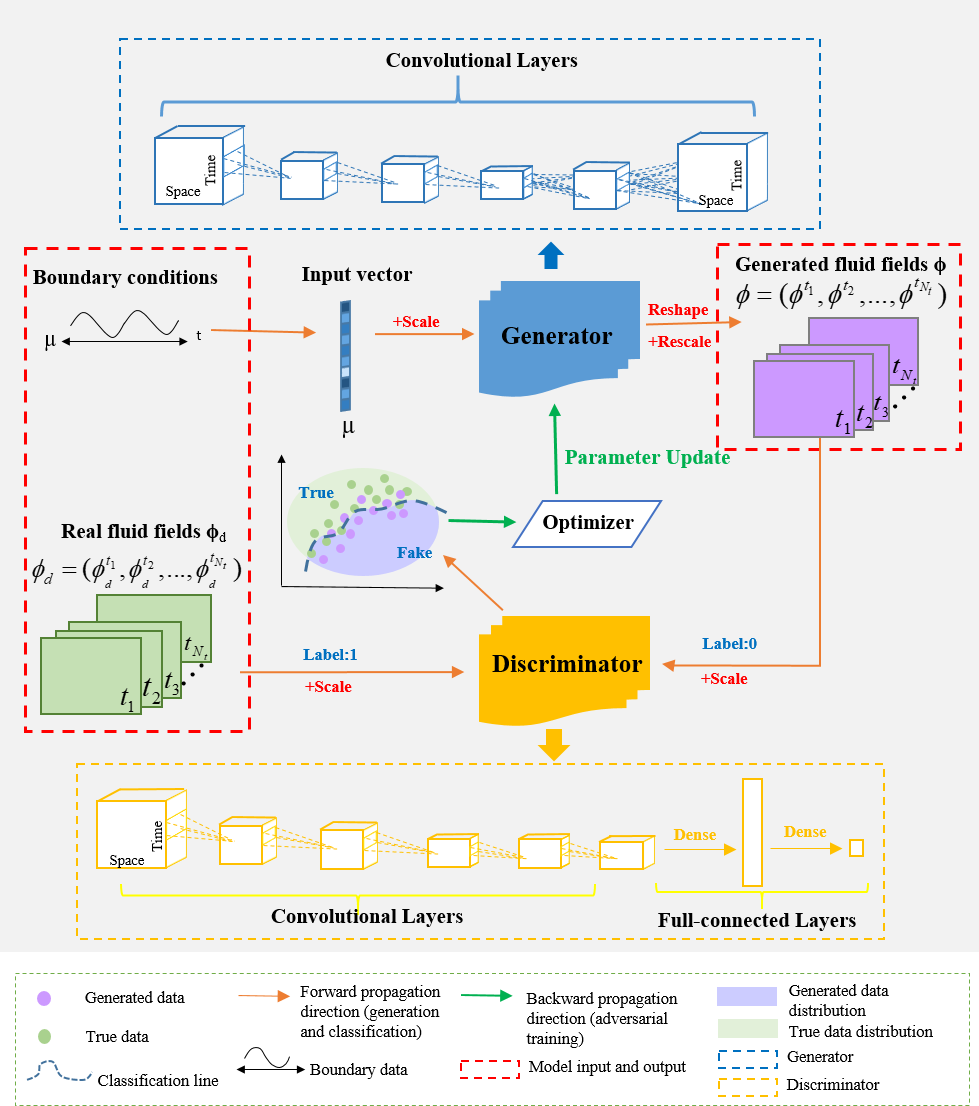
본 연구에서는 이러한 한계를 극복하고자, 일반적인 딥 컨볼루션 생성적 적대 신경망(DCGAN) 을 기반으로 한 인공지능(AI) 유체 모델을 개발하였습니다. 이 모델은 시공간 흐름 분포 를 예측하는 데 특화되어 있으며, 고차원 유체 흐름 데이터를 저차원의 “잠재(latent)” 표현으로 변환하는 과정을 포함합니다. 컨볼루션 신경망은 이미지 처리 분야에서 입증된 바와 같이, 복잡한 공간 구조를 효율적으로 압축하고 추출할 수 있기 때문에, 유체 흐름의 복잡한 패턴을 효과적으로 포착할 수 있습니다.
DCGAN은 생성자(Generator) 와 판별자(Discriminator) 로 구성된 적대적 학습 구조를 이용합니다. 생성자는 입력된 잠재 벡터를 이용해 가상의 유체 흐름 필드를 생성하고, 판별자는 실제 고정밀 시뮬레이션 데이터와 생성된 데이터 사이의 차이를 학습합니다. 이 과정에서 판별자는 점차 실제 데이터와 구분하기 어려운 수준까지 생성자를 개선시키며, 결과적으로 복잡한 유동 현상의 미세한 특징까지도 재현할 수 있게 됩니다.
본 논문에서 제시한 DCGAN 기반 유체 모델은 예측 정확도 와 계산 효율성 두 측면에서 뛰어난 성능을 보였습니다. 모델의 성능을 검증하기 위해, 홋카이도 해안선을 따라 서로 다른 입사 파형을 갖는 두 가지 쓰나미 시나리오를 테스트 케이스로 설정했습니다. 각 테스트 케이스에 대해 기존의 고정밀 유체 시뮬레이션 툴인 Fluidity 로부터 얻은 결과와 DCGAN이 예측한 결과를 비교했으며, 두 결과는 거의 동일한 수준의 정확도를 나타냈습니다. 특히, 파동의 위상 변화와 흐름 피크와 같은 시공간적 특성 이 정확히 재현되었으며, 이는 DCGAN이 유동의 동적 변화를 시간 축과 공간 축 모두에서 효과적으로 포착한다는 것을 의미합니다.
또한, 실시간(online) 계산 비용 측면에서도 눈에 띄는 개선이 확인되었습니다. 기존의 고정밀 모델을 이용한 시뮬레이션은 수십 시간에서 수백 시간에 달하는 CPU 시간을 요구하는 반면, 제안된 DCGAN 모델은 동일한 시뮬레이션을 다섯 자리수(10⁵) 정도 빠른 속도로 수행할 수 있었습니다. 이는 실제 현장 적용이나 재난 대응 시나리오와 같이 실시간 예측 이 필수적인 상황에서 큰 장점으로 작용할 수 있습니다.
요약하면, 본 연구에서 개발한 DCGAN 기반 AI 유체 모델은 다음과 같은 주요 특징을 가지고 있습니다.
- 잠재 공간 표현 을 활용하여 고차원 유동 데이터를 저차원으로 압축함으로써 학습 효율성을 극대화한다.
- 생성‑판별 적대 학습 구조를 통해 복잡한 흐름 패턴과 비선형 동역학을 정밀하게 재현한다.
- 시공간 흐름 분포 를 동시에 예측함으로써 기존 연구에서 간과되던 공간‑시간 상호작용을 효과적으로 모델링한다.
- 고정밀 모델과 비교했을 때 거의 동일한 예측 정확도를 유지하면서, 계산 시간 은 10⁵ 배 이상 단축한다.
이러한 결과는 비선형 유체 흐름에 대한 신속하고 신뢰할 수 있는 시공간 예측 이 가능함을 입증하며, 향후 해양 재해 예측, 항공·우주 유동 해석, 그리고 복잡한 산업 공정의 실시간 제어 등 다양한 분야에 적용될 잠재력을 보여 줍니다. 앞으로는 보다 다양한 물리적 경계 조건과 복합적인 외부 힘(예: 바람·조류·지형 효과) 을 포함한 확장 모델을 개발하고, 실제 현장 데이터와의 온라인 학습 을 통해 모델의 일반화 능력을 더욱 강화하는 연구가 진행될 예정입니다.
결론적으로, 딥 컨볼루션 생성적 적대 신경망을 활용한 본 AI 유체 모델은 전통적인 고정밀 수치 시뮬레이션이 갖는 계산 비용의 한계를 뛰어넘어, 빠르고 정확한 유체 흐름 예측을 가능하게 함으로써 차세대 유동 해석 기술의 중요한 이정표가 될 것입니다.