A commuting network model: going to the bulk
The influence of commuting in socio-economic dynamics increases constantly. Analysing and modelling the networks formed by commuters to help decision-making regarding the land-use has become crucial. This paper presents a simple spatial interaction simulated model with only one parameter. The proposed algorithm considers each individual who wants to commute, starting from their living place to all their workplaces. It decides where the location of the workplace following the classical rule inspired from the gravity law consisting in a compromise between the job offers and the distance to the jobs. The further away the job offer is, the more important it must be in order to be considered. Inversely, only the quantity of offers is important for the decision when these offers are close. The paper also presents a comparative analysis of the structure of the commuting networks of the four European regions to which we apply our model. The model is calibrated and validated on these regions. Results from the analysis shows that the model is very efficient in reproducing most of the statistical properties of the network given by the data sources.
💡 Research Summary
The paper introduces a minimalist spatial‑interaction model for commuting networks that relies on a single calibrated parameter. Inspired by the classical gravity law, the algorithm treats each individual commuter as an agent who evaluates all possible workplaces. The probability of choosing a destination j from residence i is proportional to the product of the job offer size O_j and a distance deterrence function, taken here as a power‑law decay d_{ij}^{‑β}. The only free parameter β controls how strongly distance penalises distant jobs; when offers are close, the distance term becomes negligible and the decision is driven mainly by the number of available positions.
The model operates on an origin‑destination (OD) matrix supplied by statistical offices. For each municipality the numbers of residents and of out‑commuters are stored as counters. As each commuter is assigned a workplace according to the probability rule, the corresponding counters are decremented, guaranteeing that the simulated OD matrix preserves the observed marginal totals without the need for iterative proportional fitting. The stochastic nature of the assignment means that each simulation run yields a slightly different micro‑network, yet macro‑level statistics (total flows, average distance, in‑ and out‑degree distributions) remain stable.
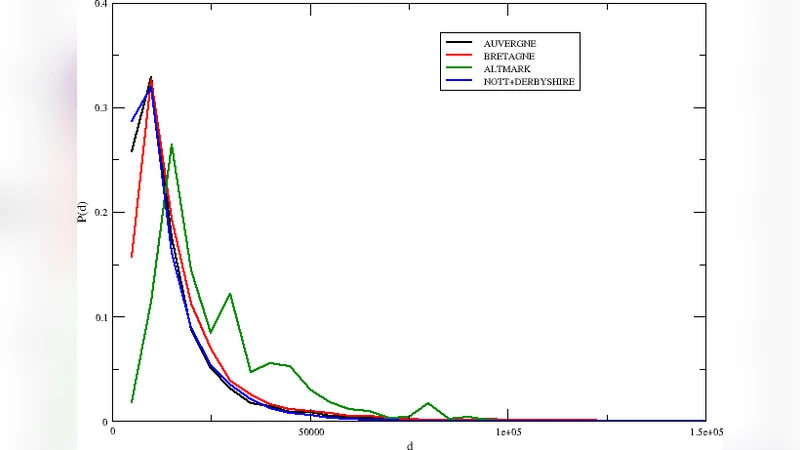
Four European rural regions are used for calibration and validation: two NUTS‑2 regions in France (Auvergne and Bretagne), the Altmark area in Germany, and the combined Nottinghamshire/Derbyshire region in the United Kingdom. Empirical OD tables for the years 1999–2001 are processed, diagonal entries (non‑commuting residents) are excluded, and the model is fitted by minimizing the squared error between simulated and observed flows, resulting in region‑specific β values ranging roughly from 1.2 to 1.8.
Validation focuses on several network‑level descriptors: (1) the in‑ and out‑degree distributions, which both follow heavy‑tailed (log‑normal) shapes and are reproduced with high fidelity; (2) the functional form of the deterrence function, where the power‑law provides a better fit than exponential alternatives; (3) clustering coefficients and modularity, indicating that community structure is captured; (4) Pearson correlation (R² > 0.92) between simulated and observed flow values across all municipality pairs. These results demonstrate that the simple gravity‑based rule, despite its parsimony, can generate realistic commuting networks.
The authors argue that the one‑parameter design offers practical advantages: it reduces calibration effort, works with limited data (common in rural administrations), and retains the essential economic intuition that distant jobs must be more attractive to outweigh travel costs. However, the model’s simplicity also imposes limitations. It does not differentiate between job types, wages, or individual attributes such as age and education, nor does it incorporate dynamic travel times or congestion effects. The authors suggest future extensions, including region‑ or sector‑specific β values, alternative deterrence functions (e.g., exponential or hybrid forms), and integration of transport network travel times to better reflect real mobility constraints.
In conclusion, the study provides a compelling proof‑of‑concept that a gravity‑law inspired, single‑parameter commuting model can faithfully reproduce the statistical properties of real commuting networks across diverse European rural contexts. This balance of simplicity and empirical accuracy makes the approach attractive for policymakers and planners who need a tractable tool for evaluating land‑use, infrastructure, and employment policies at the regional level.
Comments & Academic Discussion
Loading comments...
Leave a Comment