$G^1$ hole filling with S-patches made easy
💡 Research Summary
The paper addresses the practical problem of filling multi‑sided holes in surface networks with G¹ continuity using S‑patches, a generalization of Bézier triangles to arbitrary n‑gons. Although S‑patches have been known for decades, their adoption has been limited because the number of control points grows combinatorially with the number of sides and the polynomial degree. The author argues that this drawback is less critical when the patch is used solely for hole filling, where the boundary is prescribed and the interior can be generated automatically.
First, the mathematical definition of an n‑sided S‑patch is recalled. The patch is defined over an n‑gon using generalized barycentric coordinates λ (e.g., Wachspress). Control points are indexed by integer n‑tuples s = (s₁,…,sₙ) with non‑negative entries summing to the degree d; the set Lₙ,₍d₎ contains C(n+d‑1,d) elements. A shift operator σ±j modifies adjacent entries, establishing adjacency relations among control points.
The hole‑filling algorithm proceeds in two stages. In the boundary stage, the given Bézier boundary curves (all of the same degree d) are expressed as a Sabin net: two rows of control points per side that satisfy twist compatibility. To achieve G¹ continuity, the author shows that the S‑patch must be elevated to degree d+3. Each side is then equipped with d boundary panels, each panel being an affine image of the regular n‑gon. The interior point of each panel, Pᵢⱼ,ₙ, is computed from the boundary control points Pᵢⱼ,₁ using a closed‑form formula (Equation 2) that holds for any degree d and any number of sides n. The formula involves the cosine of 2π/n (c = −cos(2π/n)) and a set of Kronecker‑delta selectors δₕˡ(j) that activate the appropriate terms. This generalizes earlier work that only gave explicit expressions for d = 2 and 3.
After fixing the boundary panels, the remaining interior control points are placed automatically by solving discrete Laplacian systems. A harmonic mask enforces that each interior point equals the average of its four neighbors, leading to the linear system Qᵢ₊₁,ⱼ + Qᵢ₋₁,ⱼ + Qᵢ,ⱼ₊₁ + Qᵢ,ⱼ₋₁ − 4Qᵢ,ⱼ = 0. When cross‑derivatives are already prescribed on the boundary, a biharmonic mask (the harmonic mask applied twice) is used to obtain a smoother distribution. Algorithm 1 details how to construct these masks efficiently by iterating over adjacency relations. The method works for any n, any degree, and any continuity requirement (G⁰ or G¹).
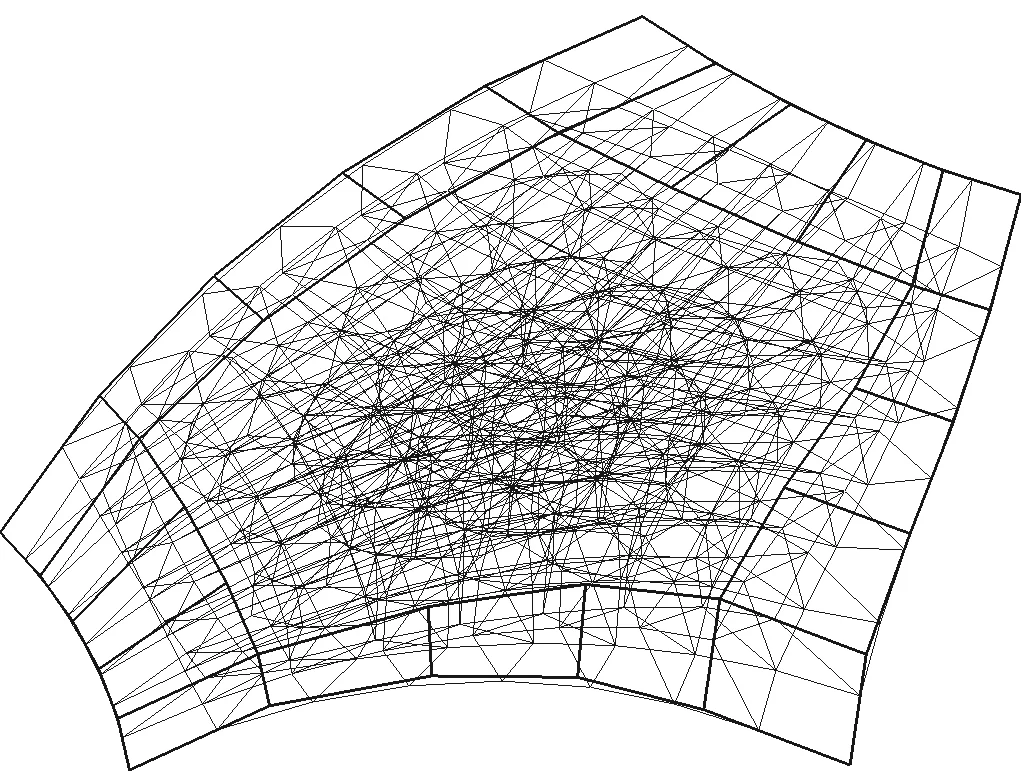
The paper presents a concrete example: filling a five‑sided quintic hole. The boundary rib consists of 40 control points; after degree elevation the full S‑patch contains 495 control points (135 in the boundary panels, 360 interior). Visual inspection of isophotes demonstrates high surface quality, and G¹ continuity with adjacent patches is confirmed by ribbon and contour plots.
In conclusion, the author demonstrates that S‑patches can be made practical for hole filling by (1) providing a universal G¹ boundary panel construction valid for arbitrary n and d, and (2) introducing a mask‑based interior point placement algorithm that is independent of the patch’s topology. Remaining open questions include a theoretical analysis of the functional minimized by the masks, extensions to curvature‑continuous (C²) joins, and efficient data structures for large‑scale models with complex topology. The work is supported by the Hungarian Scientific Research Fund (OTKA No. 124727).
Comments & Academic Discussion
Loading comments...
Leave a Comment