Bipartite Perfect Matching as a Real Polynomial
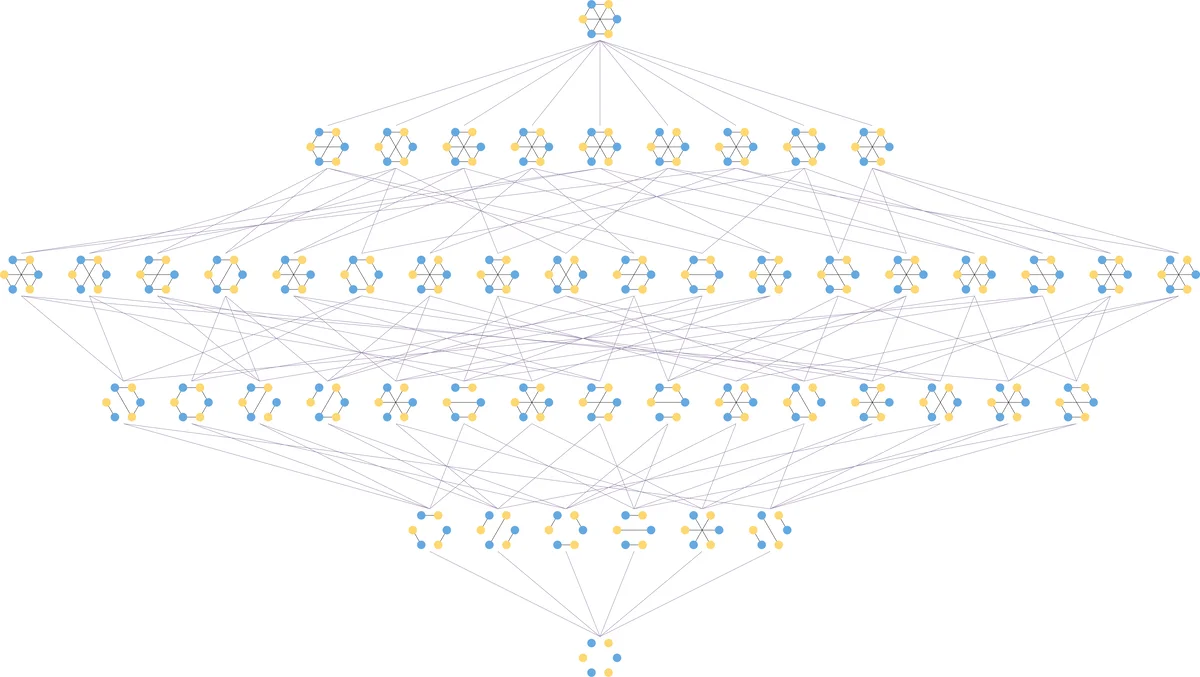
We obtain a description of the Bipartite Perfect Matching decision problem as a multilinear polynomial over the Reals. We show that it has full degree and $(1-o_n(1))\cdot 2^{n^2}$ monomials with non-zero coefficients. In contrast, we show that in the dual representation (switching the roles of 0 and 1) the number of monomials is only exponential in $\Theta(n \log n)$. Our proof relies heavily on the fact that the lattice of graphs which are “matching-covered” is Eulerian.
💡 Research Summary
This paper provides a comprehensive algebraic characterization of the Bipartite Perfect Matching (BPM) decision problem by representing it explicitly as a multilinear polynomial over the reals. The authors investigate the unique polynomial representation of the Boolean function BPM_n, which outputs 1 if and only if the n-by-n bipartite graph specified by the input variables contains a perfect matching.
The first main result (Theorem 1) gives a closed-form expression for the coefficients of this polynomial. Each monomial corresponds to a subset of edges (a subgraph G). The coefficient a_G is zero if G is not “matching-covered” (meaning its edges cannot be expressed as a union of perfect matchings). If G is matching-covered, the coefficient is (-1)^χ(G), where χ(G) is the cyclomatic number of the graph. The proof hinges on the structure of the lattice of matching-covered graphs. A key step utilizes a result from Billera and Sarangarajan showing that this lattice is isomorphic to the face lattice of the Birkhoff polytope, which implies it is Eulerian. This topological property is then exploited via the Möbius function of the lattice to derive the coefficient formula.
Several corollaries follow: (1) Since almost all subgraphs are matching-covered, the polynomial BPM_n contains (1-o_n(1))·2^{n^2} monomials with non-zero coefficients, meaning it is essentially “dense”. (2) This yields a closed-form count for the number of bipartite graphs with a perfect matching, which is shown to be an odd number. (3) It allows for the analysis of the Fourier spectrum, showing that almost all Fourier coefficients are extremely small (2^{-n^2+1}) yet non-zero. (4) It implies strong query complexity lower bounds: BPM_n is evasive for XOR decision trees (requiring exactly n^2 queries), and requires at least (log_3 2)·n^2 - o(n^2) queries for AND decision trees.
The second part of the paper analyzes the “dual representation” BPM*_n, defined by switching the roles of 0 and 1 (i.e., BPM*_n(x) = 1 - BPM_n(1-x)). This function detects when the complement graph violates Hall’s condition. Theorem 2 provides a fine-grained, though not complete, characterization of its polynomial coefficients a*G. A necessary condition for a non-zero coefficient is that the graph G is “totally ordered” (its left vertices can be ordered such that their neighbor sets are monotonically decreasing by inclusion). For “strictly totally ordered” graphs, the coefficient is exactly (-1)^{n+1}. For graphs that are totally ordered but not strictly so, the coefficients can be 0, ±1, or even larger integers (e.g., for G = K{n-1,n-1}, a*_G = (n-2)^2). A complete characterization remains an open problem.
A crucial consequence is that the number of monomials in BPM*_n is only 2^{Θ(n log n)}, exponentially sparser than the original BPM_n polynomial. This sparsity has positive algorithmic implications: it implies that the real rank of the communication matrix for BPM*_n is bounded by 2^{O(n log n)}, which provides a lower bound for its deterministic communication complexity. It also yields a lower bound of 2 log_3(n!) for OR decision trees, a model that captures many known combinatorial algorithms for bipartite matching.
In summary, the paper unveils a profound algebraic asymmetry between the standard and dual polynomial representations of a fundamental combinatorial problem, connecting graph theory, lattice theory, and computational complexity to derive novel structural insights and complexity bounds.
Comments & Academic Discussion
Loading comments...
Leave a Comment