On the multi-symplectic structure of Boussinesq-type systems. I: Derivation and mathematical properties
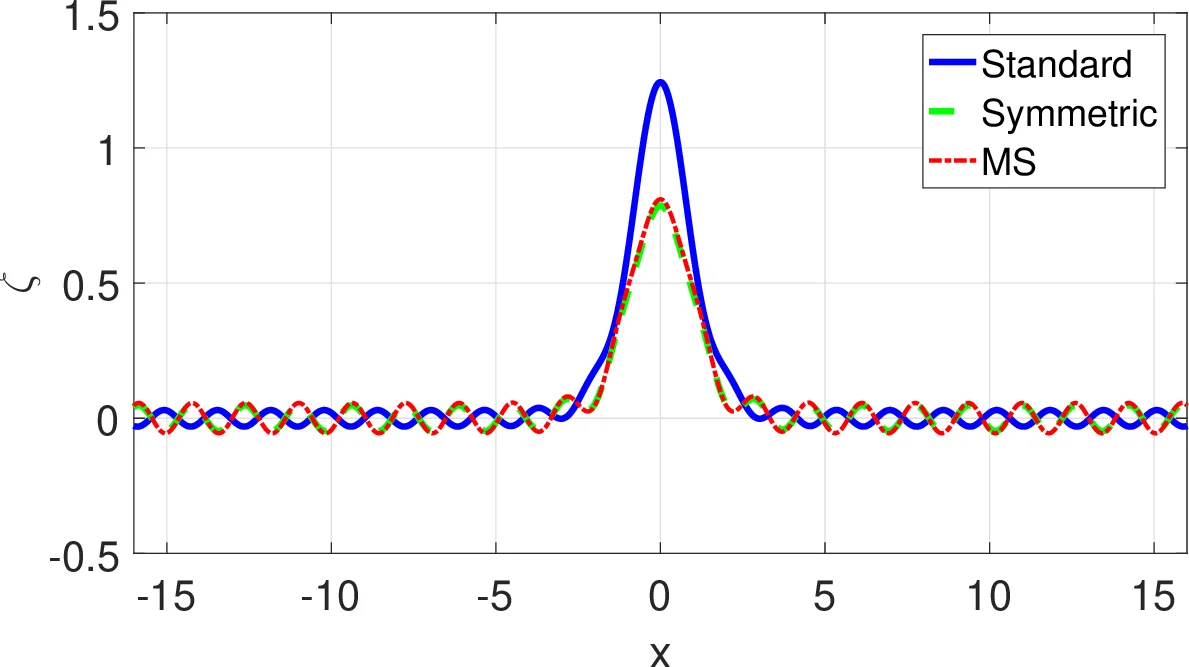
The Boussinesq equations are known since the end of the XIXst century. However, the proliferation of various \textsc{Boussinesq}-type systems started only in the second half of the XXst century. Today they come under various flavours depending on the goals of the modeller. At the beginning of the XXIst century an effort to classify such systems, at least for even bottoms, was undertaken and developed according to both different physical regimes and mathematical properties, with special emphasis, in this last sense, on the existence of symmetry groups and their connection to conserved quantities. Of particular interest are those systems admitting a symplectic structure, with the subsequent preservation of the total energy represented by the Hamiltonian. In the present paper a family of Boussinesq-type systems with multi-symplectic structure is introduced. Some properties of the new systems are analyzed: their relation with already known Boussinesq models, the identification of those systems with additional Hamiltonian structure as well as other mathematical features like well-posedness and existence of different types of solitary-wave solutions. The consistency of multi-symplectic systems with the full Euler equations is also discussed.
💡 Research Summary
The paper investigates the multi‑symplectic structure of Boussinesq‑type wave equations, introducing a new family of systems that simultaneously possess multi‑symplectic and, in certain cases, traditional Hamiltonian (co‑symplectic) structures. After a brief historical overview of Boussinesq models—originating with Boussinesq’s 1877 work and later proliferating in the second half of the 20th century—the authors focus on the four‑parameter “(a,b,c,d)” family introduced by Bona, Colin, and Lannes for even‑bottom, long‑wave, small‑amplitude, irrotational flows. In this family the dependent variables η(x,t) (free‑surface elevation) and u(x,t) (horizontal velocity) satisfy a coupled system of two second‑order PDEs, with coefficients a,b,c,d expressed in terms of physical nondimensional parameters (θ, ν, μ).
The central contribution is the systematic derivation of a multi‑symplectic formulation for these equations. Multi‑symplectic PDEs are written in the canonical form
K z_t + M z_x = ∇_z S(z),
where K and M are constant skew‑symmetric matrices representing the symplectic structures associated with time and space, respectively, and S(z) is a scalar potential. This framework treats time and space on an equal footing, thereby extending the classical Hamiltonian formalism (which isolates time) and automatically generating local conservation laws for the 2‑forms ω = ½ dz∧K dz (energy‑like) and κ = ½ dz∧M dz (momentum‑like).
To illustrate the methodology, the authors first recast the KdV–BBM equation
u_t + u u_x + α u_{xxx} − β u_{xxt}=0
into multi‑symplectic form by introducing auxiliary variables (z₁ = u, z₂ = u_x, z₃ = u_{xx}). The resulting K and M matrices are explicitly displayed, and the potential S(z) = ½ u² + α/2 u_x² is identified, confirming that KdV–BBM is multi‑symplectic.
The same procedure is applied to the symmetric (a,b,c,d) system
η_t + u_x + a u_{xxx} − b η_{xxt}=0,
u_t + η_x + c η_{xxx} − d u_{xxt}=0.
By restricting the nonlinear terms to homogeneous quadratic polynomials and imposing specific relations among the parameters (most notably a = c and b = d), the authors obtain constant skew‑symmetric K and M, thereby achieving a genuine multi‑symplectic formulation. Under these constraints the system also retains a co‑symplectic Hamiltonian structure with Hamiltonian
H = ½∫
Comments & Academic Discussion
Loading comments...
Leave a Comment