Local Runup Amplification By Resonant Wave Interactions
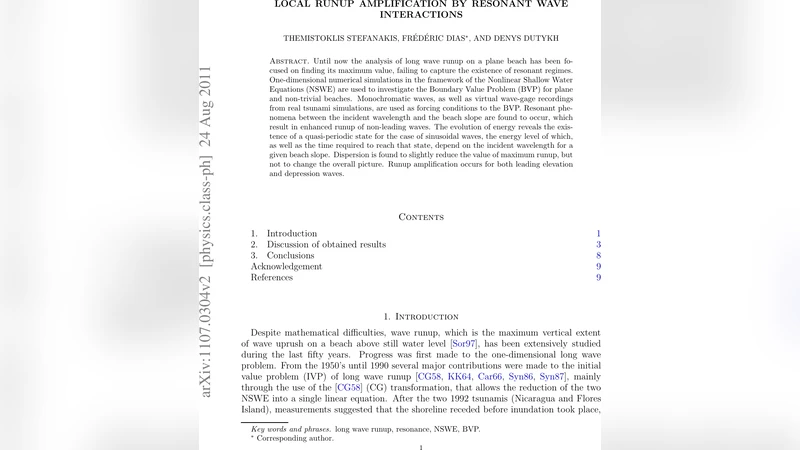
Until now the analysis of long wave runup on a plane beach has been focused on finding its maximum value, failing to capture the existence of resonant regimes. One-dimensional numerical simulations in the framework of the Nonlinear Shallow Water Equations (NSWE) are used to investigate the Boundary Value Problem (BVP) for plane and non-trivial beaches. Monochromatic waves, as well as virtual wave-gage recordings from real tsunami simulations, are used as forcing conditions to the BVP. Resonant phenomena between the incident wavelength and the beach slope are found to occur, which result in enhanced runup of non-leading waves. The evolution of energy reveals the existence of a quasi-periodic state for the case of sinusoidal waves, the energy level of which, as well as the time required to reach that state, depend on the incident wavelength for a given beach slope. Dispersion is found to slightly reduce the value of maximum runup, but not to change the overall picture. Runup amplification occurs for both leading elevation and depression waves.
💡 Research Summary
The paper investigates a previously overlooked aspect of long‑wave run‑up on beaches: the resonant amplification of non‑leading waves. While most earlier studies focused on the maximum run‑up height obtained from the first incident wave, field observations after several tsunamis have shown that later waves can sometimes produce higher inundation. To address this, the authors formulate the boundary‑value problem (BVP) for the nonlinear shallow‑water equations (NSWE) in one spatial dimension and solve it numerically using a finite‑volume scheme.
Two types of forcing are applied at the offshore boundary: (i) idealized monochromatic waves η(−L,t)=±η₀ sin ωt with angular frequencies ω ranging from 0 to 6.29 (g tanθ/L)¹ᐟ², and (ii) realistic time series extracted from a virtual wave‑gauge for the 25 October 2010 Mentawai Islands tsunami. Beach slopes of tan θ = 0.13, 0.26, 0.30 and offshore distances L = 12.5 m and 4000 m are examined.
The key finding is a clear resonance condition linking the incident wavelength λ₀ and the beach length L. For all slopes the run‑up amplification ratio R_max/η₀ reaches a maximum when the non‑dimensional wavelength λ₀/L≈5.1 (e.g., λ₀≈510 m for L = 100 m). The amplification grows with slope, attaining R_max/η₀≈60 for tan θ = 0.30. A secondary resonance appears at λ₀/L≈1.5 for longer beaches. Importantly, the first incident wave does not generate the highest run‑up; subsequent waves, after interacting with reflected waves, build up energy and produce a quasi‑periodic state with a single dominant peak in the resonant case, whereas non‑resonant frequencies display multiple peaks.
Energy analysis reveals that potential and kinetic energy exchange periodically until the quasi‑periodic state is reached. The potential energy peaks at the moment of maximum run‑up and is roughly five times larger than the kinetic component. Energy density concentrates near the shoreline, and each reflection‑refraction cycle transfers energy shoreward, sustaining the amplification. Adding weak dispersion (DKM11 model) reduces the peak run‑up by about 5–10 % but does not alter the resonance mechanism, confirming that non‑linearity is the dominant factor.
Applying the methodology to the Mentawai tsunami data, the authors find that the first recorded wave, despite having the largest offshore amplitude, produces a modest run‑up. The second and third waves generate higher run‑up, and the interval between peak run‑ups is about 600 s. Interpreting this interval as the period T of a dominant mode yields λ₀/L≈5.15, precisely the resonant value identified in the idealized experiments. This demonstrates that local resonant amplification can explain why later tsunami waves sometimes cause the greatest damage.
The study also explores non‑trivial bathymetries: (i) a plane beach perturbed by a Gaussian underwater mound, and (ii) the actual bathymetry of the Mentawai region. In both cases resonant frequencies are present, though the amplification factors are lower than for the ideal plane beach. Multiple peaks in the run‑up curves suggest that wave trapping and harmonic generation further enrich the resonant dynamics.
In conclusion, the authors uncover a robust resonant amplification mechanism inherent to the 1‑D NSWE BVP on sloping beaches. The resonance arises from phase‑locked interactions between incoming and reflected long waves, and its strength depends on the beach slope and the λ₀/L ratio. This mechanism provides a plausible explanation for observed extreme run‑up events that cannot be captured by linear theory or by analyses limited to the leading wave. The findings have practical implications for tsunami hazard assessment: both the spectral content of incoming waves and the detailed near‑shore bathymetry must be considered to predict potentially hazardous run‑up from non‑leading waves.
Comments & Academic Discussion
Loading comments...
Leave a Comment