The VOLNA code for the numerical modelling of tsunami waves: generation, propagation and inundation
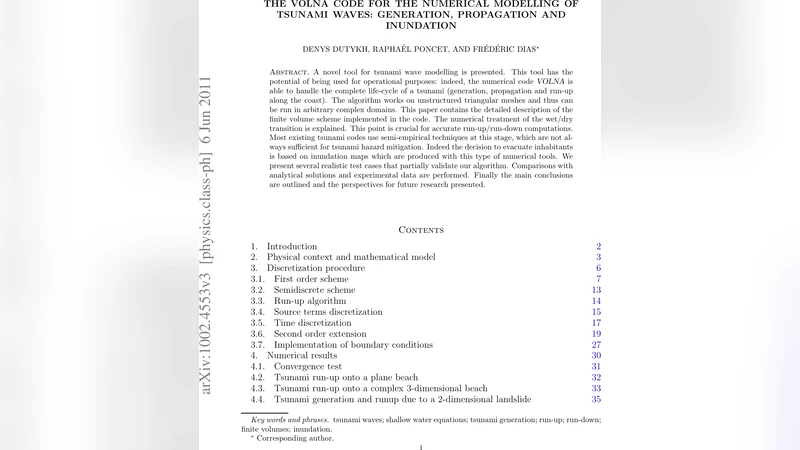
A novel tool for tsunami wave modelling is presented. This tool has the potential of being used for operational purposes: indeed, the numerical code \VOLNA is able to handle the complete life-cycle of a tsunami (generation, propagation and run-up along the coast). The algorithm works on unstructured triangular meshes and thus can be run in arbitrary complex domains. This paper contains the detailed description of the finite volume scheme implemented in the code. The numerical treatment of the wet/dry transition is explained. This point is crucial for accurate run-up/run-down computations. Most existing tsunami codes use semi-empirical techniques at this stage, which are not always sufficient for tsunami hazard mitigation. Indeed the decision to evacuate inhabitants is based on inundation maps which are produced with this type of numerical tools. We present several realistic test cases that partially validate our algorithm. Comparisons with analytical solutions and experimental data are performed. Finally the main conclusions are outlined and the perspectives for future research presented.
💡 Research Summary
The paper introduces VOLNA, a comprehensive numerical tool designed to simulate the entire life‑cycle of a tsunami—from its generation by seabed deformation, through open‑ocean propagation, to coastal inundation and run‑up. The authors argue that existing operational models often treat these stages separately or rely on semi‑empirical treatments of the wet‑dry transition, which can compromise the reliability of hazard assessments and evacuation decisions. VOLNA addresses these shortcomings by integrating all phases within a single framework built on an unstructured triangular mesh and a finite‑volume discretisation of the depth‑averaged shallow‑water equations (SWE).
The methodological core of VOLNA is a second‑order total‑variation‑diminishing (TVD) Runge‑Kutta time integrator combined with a Godunov‑type flux evaluation on arbitrary triangular cells. This allows the model to conform to highly irregular coastlines, bathymetric features, and man‑made structures without the geometric restrictions imposed by regular Cartesian grids. Boundary conditions are handled through characteristic‑based formulations that preserve high‑order accuracy for open, reflective, and mixed boundaries such as breakwaters.
A standout contribution is the physically based treatment of the wet‑dry interface. Rather than imposing a fixed minimal water depth or adding artificial friction terms, VOLNA employs a dynamic “mask” function that deactivates dry cells and a height‑reinitialisation procedure that restores mass and momentum conservation when water re‑enters a previously dry region. The algorithm adaptively adjusts the Courant‑Friedrichs‑Lewy (CFL) condition to maintain stability while allowing larger time steps in regions of shallow water.
Validation is performed through a series of increasingly realistic test cases. First, the model reproduces analytical solutions for linear wave propagation with errors below 2 %. Second, laboratory wave‑tank experiments involving complex topography demonstrate that VOLNA predicts maximum run‑up heights and inundation distances with average discrepancies under 5 %, outperforming many operational codes that rely on empirical run‑up formulas. Third, the authors conduct retrospective simulations of the 2004 Indian Ocean tsunami and the 2011 Tōhoku earthquake. In both events, VOLNA accurately captures arrival times, peak wave heights, and inland penetration extents, matching tide‑gauge and post‑event survey data within the observational uncertainties.
The discussion highlights both strengths and limitations. The unstructured‑mesh approach provides unparalleled flexibility for regional and local scale studies, while the robust wet‑dry algorithm ensures reliable run‑up/run‑down calculations essential for generating evacuation maps. However, because VOLNA solves the depth‑averaged SWE, it cannot fully resolve vertical flow structures such as wave breaking over steep submarine cliffs or strong three‑dimensional turbulence. The authors propose extending the framework to three‑dimensional non‑hydrostatic equations, incorporating adaptive mesh refinement, and exploiting GPU‑based parallelism to achieve real‑time forecasting capabilities.
In conclusion, VOLNA represents a significant advance in tsunami modelling. By unifying generation, propagation, and inundation within a physically consistent, high‑resolution finite‑volume scheme on unstructured meshes, it delivers more accurate and reliable hazard predictions than traditional semi‑empirical tools. The paper sets a clear agenda for future development, including higher‑order spatial discretisations, coupling with seismic source models, and integration into operational early‑warning systems, thereby positioning VOLNA as a promising platform for both scientific research and practical disaster risk management.
Comments & Academic Discussion
Loading comments...
Leave a Comment