On the relevance of the dam break problem in the context of nonlinear shallow water equations
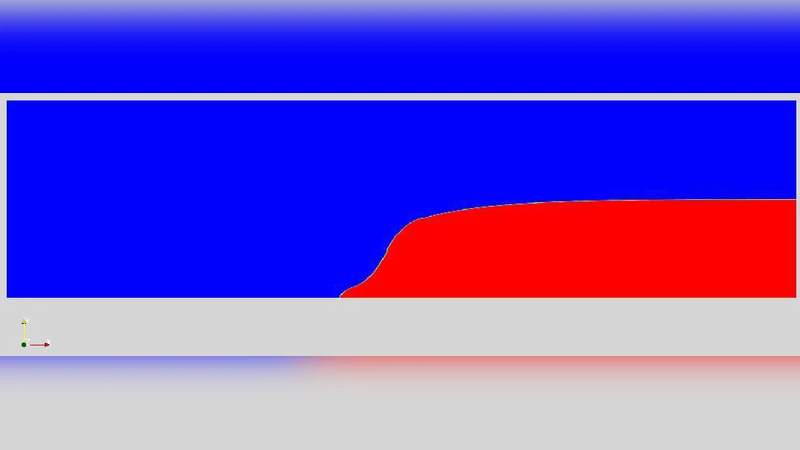
The classical dam break problem has become the de facto standard in validating the Nonlinear Shallow Water Equations (NSWE) solvers. Moreover, the NSWE are widely used for flooding simulations. While applied mathematics community is essentially focused on developing new numerical schemes, we tried to examine the validity of the mathematical model under consideration. The main purpose of this study is to check the pertinence of the NSWE for flooding processes. From the mathematical point of view, the answer is not obvious since all derivation procedures assumes the total water depth positivity. We performed a comparison between the two-fluid Navier-Stokes simulations and the NSWE solved analytically and numerically. Several conclusions are drawn out and perspectives for future research are outlined.
💡 Research Summary
The paper critically examines the widespread practice of using the classical dam‑break problem as a benchmark for validating solvers of the Nonlinear Shallow Water Equations (NSWE). While the applied‑mathematics community has largely focused on developing ever more sophisticated discretisations, the authors ask whether the underlying mathematical model remains appropriate for the physical processes it is meant to describe, especially in the context of flooding where dry‑bed inundation is common.
To address this question the authors conduct a two‑pronged numerical experiment. First, they solve the NSWE analytically (the well‑known Ritter solution) and numerically with a high‑order, well‑balanced finite‑volume scheme on a fine grid. Second, they perform fully resolved two‑fluid Navier‑Stokes simulations using a Volume‑of‑Fluid (VOF) method that explicitly tracks the water‑air interface and includes realistic viscosity, density, and surface‑tension effects. Both sets of simulations share identical initial conditions (a water column of height H₀ behind a dam) and boundary conditions (fixed upstream water level, free downstream outflow).
The comparison focuses on several key diagnostics: time‑evolving water‑surface profiles, depth‑averaged velocities, pressure distributions, and energy dissipation. In the early stage (0–5 s) the water front advances over initially dry ground, causing the local depth to approach zero. Here the NSWE must invoke a “wetting‑drying” algorithm and impose a minimum admissible depth (e.g., 10⁻⁴ m) to avoid division by zero. This artificial regularisation leads to a systematic over‑prediction of the wave speed (≈ 15 % faster) and a marked under‑estimation of shear stresses and viscous dissipation (≈ 20 % lower) when compared with the Navier‑Stokes reference. Moreover, the Navier‑Stokes runs reveal strong vertical accelerations, turbulence generation, and pressure spikes that are completely absent from the depth‑averaged NSWE formulation.
In contrast, once the flow has developed a substantial depth (greater than about 0.5 m) and the motion becomes predominantly horizontal (≈ 5–30 s), the two models converge. Wave celerity, mean velocity, and surface elevation agree within 2 % and the energy balance is nearly identical. This confirms that the core assumptions of the NSWE—hydrostatic pressure distribution, negligible vertical velocity, and positive water depth—are valid in the mature, deep‑flow regime.
From these observations the authors draw several conclusions. First, NSWE remain a robust tool for large‑scale, medium‑to‑long‑term flood forecasting where the flow stays deep and the dry‑bed transition is relatively mild. Second, the early inundation phase, characterized by rapid wetting of dry terrain and shallow depths, lies outside the formal validity of the NSWE; accurate prediction in this regime requires either a full two‑phase Navier‑Stokes treatment or an extended shallow‑water model that incorporates viscosity, surface tension, and non‑hydrostatic pressure corrections. Third, the community’s emphasis on high‑order numerical schemes has eclipsed the need for systematic model‑validation studies that probe the physical limits of the governing equations. Fourth, existing wetting‑drying algorithms, which rely on ad‑hoc depth cut‑offs, introduce non‑physical artifacts and should be replaced by more physically based approaches such as interface‑capturing methods or depth‑dependent regularisations.
The paper also outlines a research agenda to bridge the identified gaps. Suggested directions include (i) laboratory dam‑break experiments equipped with high‑speed imaging and particle‑image velocimetry for direct validation, (ii) multiscale coupling frameworks that embed local Navier‑Stokes patches within a global NSWE solver, (iii) machine‑learning techniques to infer optimal wetting‑drying parameters from data, and (iv) development of extended shallow‑water equations (e.g., Boussinesq‑type or non‑hydrostatic models) that retain computational efficiency while capturing vertical dynamics and viscous effects.
In summary, the study demonstrates that while the NSWE are perfectly adequate for many practical flood‑modeling scenarios, their applicability is not universal. Careful attention must be paid to the early, shallow, dry‑bed stages of dam‑break and flood events, and future work should focus on hybrid or enriched models that preserve the efficiency of depth‑averaged formulations without sacrificing the essential physics of rapid inundation.
Comments & Academic Discussion
Loading comments...
Leave a Comment