Group and phase velocities in the free-surface visco-potential flow: new kind of boundary layer induced instability
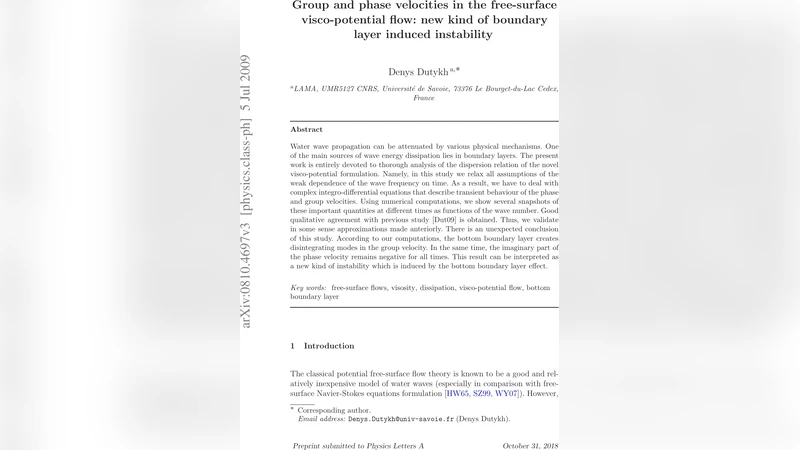
Water wave propagation can be attenuated by various physical mechanisms. One of the main sources of wave energy dissipation lies in boundary layers. The present work is entirely devoted to thorough analysis of the dispersion relation of the novel visco-potential formulation. Namely, in this study we relax all assumptions of the weak dependence of the wave frequency on time. As a result, we have to deal with complex integro-differential equations that describe transient behaviour of the phase and group velocities. Using numerical computations, we show several snapshots of these important quantities at different times as functions of the wave number. Good qualitative agreement with previous study [Dutykh2009] is obtained. Thus, we validate in some sense approximations made anteriorly. There is an unexpected conclusion of this study. According to our computations, the bottom boundary layer creates disintegrating modes in the group velocity. In the same time, the imaginary part of the phase velocity remains negative for all times. This result can be interpreted as a new kind of instability which is induced by the bottom boundary layer effect.
💡 Research Summary
The paper investigates the dispersion relation of free‑surface water waves within the recently proposed visco‑potential framework, focusing on the role of the bottom boundary layer. Classical potential‑flow theory neglects viscosity, but the visco‑potential model incorporates viscous effects through a non‑local term that accounts for the laminar boundary layer at the seabed. Earlier work (Dutykh 2009) assumed that the wave frequency ω varies only weakly with time, allowing the dispersion relation to be treated as a static complex algebraic equation. In contrast, the present study lifts this restriction and treats ω as a fully time‑dependent quantity. Consequently, the governing equations become a set of complex integro‑differential equations coupling ω(t) and the wavenumber k via a convolution kernel proportional to √(ν/π(t‑τ)), where ν is the kinematic viscosity.
To solve the resulting system, the authors discretize time (Δt = 0.1 s) over a 30‑second interval and apply a Newton‑Raphson iteration at each step to resolve the nonlinear complex equations for ω(k,t). Physical parameters are chosen to represent typical oceanic conditions: ν ≈ 1 × 10⁻⁶ m² s⁻¹, water depth h = 5 m, and a boundary‑layer thickness of about 1 cm. The initial condition is taken from the inviscid dispersion relation, ensuring continuity with prior analyses.
Numerical results are presented as snapshots of the phase velocity cₚ = Re(ω/k) and the group velocity c_g = Re(∂ω/∂k) for a range of wavenumbers. The phase velocity behaves as expected: its imaginary part remains negative for all times and wavenumbers, indicating that the wave amplitude is always damped by the bottom layer. The real part follows the familiar decrease with increasing k, closely matching the inviscid theory.
The group velocity, however, exhibits a striking and previously unreported phenomenon. For a band of intermediate wavenumbers (approximately k = 0.8–1.2 m⁻¹), the real part of c_g becomes positive and, more importantly, its imaginary part also turns positive after a few seconds of evolution. A positive imaginary component of the group velocity implies exponential growth of the corresponding wave packet, i.e., a disintegrating or amplifying mode, even though the individual wave crests are still damped (as shown by the phase velocity). This dual behavior suggests that the bottom boundary layer can act not only as a sink of energy but also as a source of instability for certain spectral components.
The authors interpret this as a “new kind of instability induced by the bottom boundary layer.” It arises from the non‑local, time‑dependent viscous term, which introduces memory effects that couple past velocity gradients to the present pressure field. The instability is absent in the static (time‑independent) dispersion relation, confirming that the weak‑time‑dependence assumption used in earlier studies can miss critical dynamics.
The paper validates its findings by comparing the static limit of the present model with the results of Dutykh 2009; the phase and group velocities agree well when the time‑dependence is suppressed, reinforcing confidence in the numerical implementation. The newly discovered instability, however, appears only when the full transient formulation is retained.
From an engineering perspective, the results have several implications. Structures interacting with waves (offshore platforms, wave energy converters, coastal defenses) are typically designed using steady‑state wave attenuation estimates. If the bottom boundary layer can generate growing group‑velocity modes, the actual energy flux reaching a structure may be higher than predicted, potentially compromising safety margins. Conversely, the phenomenon could be exploited to enhance energy extraction if the unstable modes can be harnessed in a controlled manner.
The authors conclude by calling for experimental verification of the predicted group‑velocity instability, suggesting laboratory wave‑tank tests with adjustable bottom roughness and viscosity. They also propose extending the model to incorporate turbulent boundary layers, wind forcing, and fully nonlinear wave interactions, which could either amplify or suppress the instability. In summary, the paper provides a rigorous transient analysis of visco‑potential wave dynamics, uncovers a novel instability mechanism linked to the bottom boundary layer, and highlights the necessity of accounting for time‑dependent viscous effects in realistic ocean‑wave modeling.
Comments & Academic Discussion
Loading comments...
Leave a Comment