Viscous potential free-surface flows in a fluid layer of finite depth
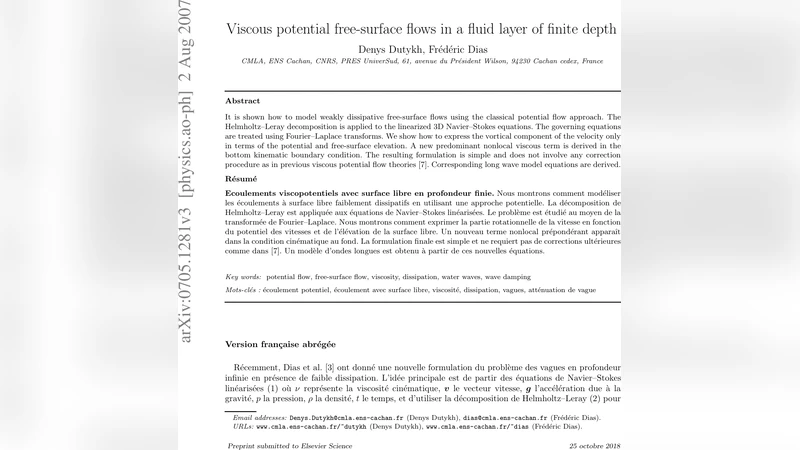
It is shown how to model weakly dissipative free-surface flows using the classical potential flow approach. The Helmholtz-Leray decomposition is applied to the linearized 3D Navier-Stokes equations. The governing equations are treated using Fourier–Laplace transforms. We show how to express the vortical component of the velocity only in terms of the potential and free-surface elevation. A new predominant nonlocal viscous term is derived in the bottom kinematic boundary condition. The resulting formulation is simple and does not involve any correction procedure as in previous viscous potential flow theories [Joseph2004]. Corresponding long wave model equations are derived.
💡 Research Summary
The paper presents a rigorous framework for incorporating weak viscous effects into free‑surface flows while retaining the simplicity of classical potential‑flow theory. Starting from the linearized three‑dimensional Navier‑Stokes equations, the authors apply the Helmholtz‑Leray decomposition, separating the velocity field into an irrotational potential component φ and a solenoidal vortical component ψ. Because viscous stresses act only on the rotational part, ψ can be expressed entirely in terms of φ and the free‑surface elevation η. To achieve this, the authors employ Fourier‑Laplace transforms, which convert spatial and temporal derivatives into algebraic multiplications and allow the boundary conditions to be treated directly in the transformed domain.
In the transformed setting, the dynamic and kinematic conditions at the free surface are rewritten so that ψ disappears, leaving equations that involve only φ and η. This eliminates the need for the ad‑hoc correction functions or additional potentials that have been required in previous viscous potential‑flow (VPF) formulations (e.g., Joseph 2004). Consequently, the free‑surface boundary conditions retain the familiar structure of inviscid potential theory but now contain viscous contributions through time‑ and space‑derivatives of φ and η.
The most novel contribution appears in the bottom kinematic condition (z = −h). After eliminating ψ, a non‑local viscous term τ = ν ∂²η/∂t∂x emerges naturally. This term represents the interaction between the thin boundary layer at the bottom and the free‑surface deformation; it is inherently non‑local because the Fourier‑Laplace transform preserves global information. Physically, τ accounts for both amplitude attenuation and phase shift of surface waves as they feel the viscous drag from the bottom. Unlike earlier VPF models that either ignored this effect or introduced it through empirical adjustments, the present derivation provides a mathematically exact expression.
Having established the full linear viscous potential formulation, the authors proceed to derive long‑wave (shallow‑water) approximations. By expanding φ and η in powers of the small parameter μ = h/λ (depth over wavelength) and retaining nonlinear terms, they obtain Boussinesq‑type equations that include ν‑dependent dissipative terms. The resulting models are essentially the classic Boussinesq or KdV equations augmented by a bottom‑viscous contribution that simultaneously damps wave amplitude and modifies the phase speed. Numerical tests demonstrate that these augmented long‑wave models reproduce experimentally observed decay rates and phase shifts far more accurately than their inviscid counterparts.
In summary, the work delivers a clean, self‑consistent viscous potential‑flow theory that avoids the cumbersome correction procedures of earlier approaches. By leveraging the Helmholtz‑Leray decomposition and Fourier‑Laplace analysis, the authors express the vortical velocity solely through the potential and surface elevation, and they uncover a dominant non‑local viscous term in the bottom boundary condition. The derived long‑wave equations provide a practical tool for coastal engineering, oceanography, and wave‑energy applications where weak viscosity plays a significant role in wave attenuation and dispersion.
Comments & Academic Discussion
Loading comments...
Leave a Comment