Naturally curved quadrilateral mesh generation using an adaptive spectral element solver
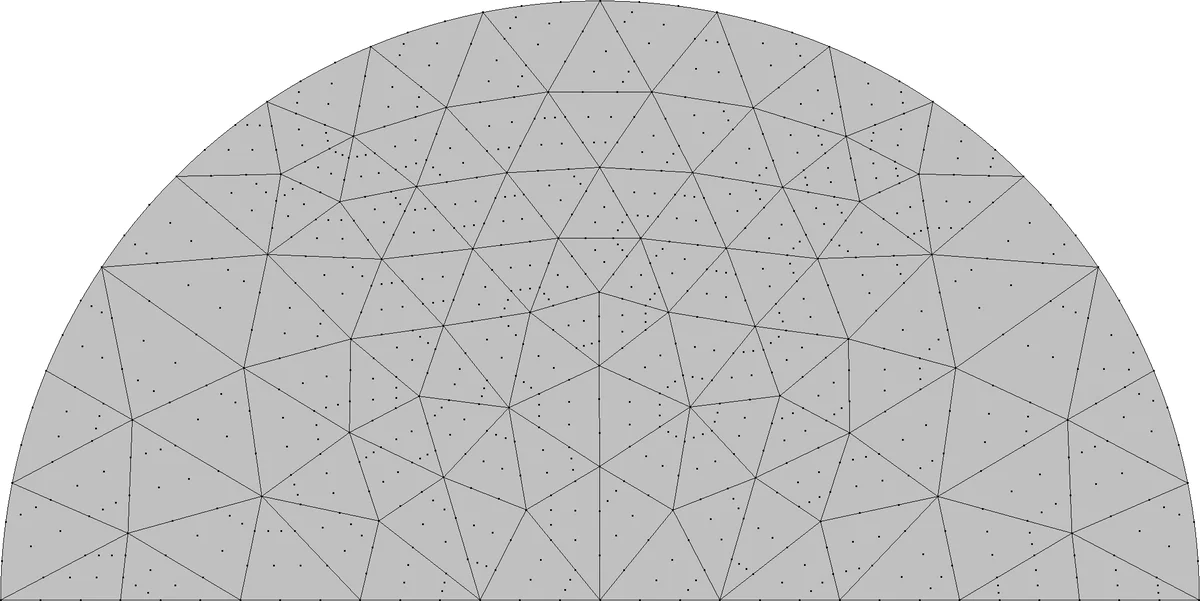
We describe an adaptive version of a method for generating valid naturally curved quadrilateral meshes. The method uses a guiding field, derived from the concept of a cross field, to create block decompositions of multiply connected two dimensional domains. The a priori curved quadrilateral blocks can be further split into a finer high-order mesh as needed. The guiding field is computed by a Laplace equation solver using a continuous Galerkin or discontinuous Galerkin spectral element formulation. This operation is aided by using $p$-adaptation to achieve faster convergence of the solution with respect to the computational cost. From the guiding field, irregular nodes and separatrices can be accurately located. A first version of the code is implemented in the open source spectral element framework Nektar++ and its dedicated high order mesh generation platform NekMesh.
💡 Research Summary
This paper introduces an adaptive, high-order method for automatically generating valid, naturally curved quadrilateral meshes for complex two-dimensional domains. The core innovation lies in using a accurately computed “guiding field” to drive the decomposition of the domain into quadrilateral blocks, which can then be meshed as-is for spectral element methods or further subdivided for traditional finite element methods.
The method begins by defining a guiding vector field (v) within the domain. The boundary conditions for this field are derived from the tangent angles of the domain boundary, ensuring future mesh alignment. A Laplace equation (∇²v = 0) is solved to smoothly propagate this directional information into the interior. From this smooth vector field, a phase field (ψ) is calculated, which exhibits jump discontinuities and critical points where ~v = 0. These critical points correspond to irregular nodes in the final mesh (with valence 3 or 5 instead of the regular 4). Their valence is determined precisely by computing the Poincaré index around them using the phase field.
The block decomposition is achieved by tracing “separatrices,” which are streamlines of an adjusted guiding direction. Starting from critical points and boundary corners, these streamlines are integrated across the domain. A key implementation detail is adjusting the integration direction by π/2 whenever a streamline crosses a jump line in the phase field, maintaining a consistent logical flow akin to a smooth cross field. The network of these separatrices partitions the domain into quadrilateral blocks.
The most computationally intensive step is solving the Laplace problem for the guiding field. The authors employ a Continuous or Discontinuous Galerkin Spectral Element Method (SEM/DGSEM) on a triangular background mesh. To optimize this cost, they implement a p-adaptive strategy. Instead of using a uniformly high polynomial order everywhere, the solver dynamically adjusts the polynomial order (p) within each triangular element based on a local error indicator. This indicator compares the solution at order P with its projection onto order P-1. Elements with high error increase their order, while those with sufficiently low error decrease it. This process iterates until a desired error tolerance is met, achieving high accuracy where needed (e.g., near corners or critical points) while saving computational resources in smooth regions.
The entire pipeline is implemented within the open-source Nektar++ framework. The guiding field is computed by a Nektar++ solver, its analysis (critical point finding, streamline integration) is performed by the FieldConvert utility, and the final block decomposition and mesh generation are handled by the NekMesh utility. The use of DG-SEM is particularly noted for its robustness in handling domains with sharp corners. Results demonstrate the method’s effectiveness on various simply and multiply connected domains, showing that the p-adaptive approach significantly reduces computational cost compared to a uniform high-order solve while maintaining the high accuracy necessary for reliable irregular node detection and high-quality curved quadrilateral mesh generation.
Comments & Academic Discussion
Loading comments...
Leave a Comment