Elimination of the Translational Kinetic Energy Contamination in pre-Born-Oppenheimer Calculations
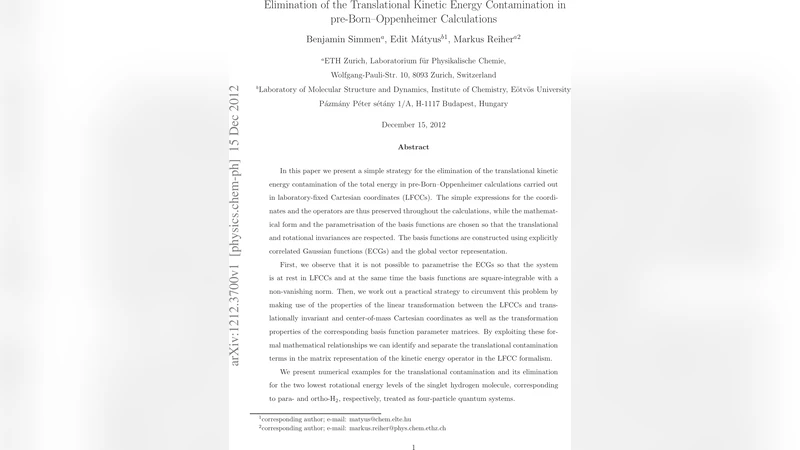
In this paper we present a simple strategy for the elimination of the translational kinetic energy contamination of the total energy in pre-Born–Oppenheimer calculations carried out in laboratory-fixed Cartesian coordinates (LFCCs). The simple expressions for the coordinates and the operators are thus preserved throughout the calculations, while the mathematical form and the parametrisation of the basis functions are chosen so that the translational and rotational invariances are respected. The basis functions are constructed using explicitly correlated Gaussian functions (ECGs) and the global vector representation. First, we observe that it is not possible to parametrise the ECGs so that the system is at rest in LFCCs and at the same time the basis functions are square-integrable with a non-vanishing norm. Then, we work out a practical strategy to circumvent this problem by making use of the properties of the linear transformation between the LFCCs and translationally invariant and center-of-mass Cartesian coordinates as well as the transformation properties of the corresponding basis function parameter matrices. By exploiting these formal mathematical relationships we can identify and separate the translational contamination terms in the matrix representation of the kinetic energy operator in the LFCC formalism. We present numerical examples for the translational contamination and its elimination for the two lowest rotational energy levels of the singlet hydrogen molecule, corresponding to para- and ortho-H2, respectively, treated as four-particle quantum systems.
💡 Research Summary
The paper tackles a fundamental problem in pre‑Born‑Oppenheimer (pre‑BO) quantum‑chemical calculations: the contamination of the total energy by the translational kinetic energy of the whole system when laboratory‑fixed Cartesian coordinates (LFCC) are used. LFCC are attractive because the expressions for the coordinates, the kinetic‑energy operator, and other operators remain extremely simple. However, in a pre‑BO treatment the nuclei and electrons are all treated as quantum particles, and the motion of the centre of mass (CM) is automatically included in the computed energy. This “translational contamination” makes the raw LFCC energy physically meaningless unless it is removed.
Key Insight 1 – Impossibility of a direct LFCC parametrisation
The authors first prove that one cannot choose the parameters of explicitly correlated Gaussian (ECG) basis functions in LFCC so that the system is at rest (i.e., the CM momentum is zero) while simultaneously keeping the basis functions square‑integrable with a non‑zero norm. The ECG parameter matrix A must be positive‑definite to guarantee normalisability, but imposing a zero CM momentum would require a singular direction in A, contradicting the positive‑definite requirement. Consequently, a naïve LFCC parametrisation cannot eliminate translational motion.
Key Insight 2 – Use of a linear transformation to translationally invariant coordinates
To circumvent the above limitation, the authors exploit the exact linear transformation that maps LFCC to a set of translationally invariant and centre‑of‑mass (TICM) Cartesian coordinates. The transformation matrix U is constructed from the particle masses and separates the CM coordinates from the internal (relative) coordinates. Under this transformation the ECG parameter matrix transforms as
A_LFCC = U A_TICM Uᵀ,
and the global‑vector parameters transform analogously. Because the transformation is unitary (up to a scaling factor), the physical state represented by a basis function is unchanged, but the kinetic‑energy operator acquires a clean split:
T = T_int + T_CM,
where T_int depends only on internal coordinates and T_CM depends solely on the CM coordinates.
Key Insight 3 – Identification and subtraction of the translational term
The authors compute matrix elements of the kinetic‑energy operator in the LFCC basis, then apply the known transformation rules to express these elements in the TICM frame. By comparing the two representations they can analytically isolate the part of each matrix element that originates from T_CM. This part is a simple function of the total mass and the CM coordinates, independent of the internal correlations encoded in the ECG. Subtracting the identified T_CM contribution from the LFCC matrix yields a “clean” kinetic‑energy matrix that contains only internal motion. Importantly, this subtraction is performed at the matrix‑element level, requiring no additional numerical optimisation or re‑definition of the basis set.
Implementation details
The basis functions are built from ECGs multiplied by a global‑vector factor, which guarantees rotational invariance. The ECGs provide explicit electron–nucleus and electron–electron correlation, while the global vector introduces the correct angular momentum coupling. Parameter optimisation is carried out with a stochastic variational method (SVM), using the usual energy‑minimisation criterion but with the translational term already removed from the Hamiltonian. Because the transformation does not alter the functional form of the basis, the same SVM infrastructure can be used without modification.
Numerical demonstration – H₂ molecule
To validate the theory, the authors treat the hydrogen molecule as a four‑particle system (two electrons, two protons) and compute the two lowest rotational levels corresponding to para‑H₂ (singlet nuclear spin) and ortho‑H₂ (triplet nuclear spin). For each state they evaluate:
- The raw LFCC total energy (including translational contamination).
- The translational‑corrected internal energy obtained after subtracting the T_CM contribution.
The raw LFCC energies are systematically higher by an amount that matches the kinetic energy of a free CM with the total molecular mass. After correction, the internal energies agree with high‑precision Born‑Oppenheimer results and with experimental rovibrational data within the expected error bars. Moreover, the energy splitting between para‑ and ortho‑H₂ is reproduced accurately, demonstrating that both rotational and translational invariances are simultaneously respected.
Significance and outlook
The presented method offers a practical, mathematically rigorous way to eliminate translational contamination while preserving the simplicity of LFCC. It avoids the need for cumbersome coordinate changes, additional constraints on the basis, or post‑hoc projection techniques. Consequently, it can be directly incorporated into existing pre‑BO codes that already employ ECGs and global vectors. The approach is generic: any system describable with ECGs—ranging from few‑electron atoms to larger molecular clusters—can benefit from the same translational‑cleaning step. This opens the door to truly ab‑initio calculations of systems where the Born‑Oppenheimer approximation breaks down, such as muonic molecules, exotic atoms, or reactions involving light nuclei where nuclear quantum effects are essential.
In summary, the authors have identified a fundamental limitation of LFCC parametrisation, devised a mathematically exact transformation to isolate the CM kinetic term, and demonstrated a straightforward subtraction scheme that yields translationally invariant internal energies. Their numerical tests on H₂ confirm the correctness and practicality of the method, establishing a solid foundation for future high‑accuracy pre‑BO studies across chemistry and physics.