General Sub-packetized Access-Optimal Regenerating Codes
This paper presents a novel construction of $(n,k,d=n-1)$ access-optimal regenerating codes for an arbitrary sub-packetization level $\alpha$ for exact repair of any systematic node. We refer to these codes as general sub-packetized because we provide an algorithm for constructing codes for any $\alpha$ less than or equal to $r^{\lceil \frac{k}{r} \rceil}$ where $\frac{k}{r}$ is not necessarily an integer. This leads to a flexible construction of codes for different code rates compared to existing approaches. We derive the lower and the upper bound of the repair bandwidth. The repair bandwidth depends on the code parameters and $\alpha$. The repair process of a failed systematic node is linear and highly parallelized, which means that a set of $\lceil \frac{\alpha}{r} \rceil$ symbols is independently repaired first and used along with the accessed data from other nodes to recover the remaining symbols.
💡 Research Summary
The paper introduces a new construction of access‑optimal regenerating codes for the exact repair of any systematic node in an (n, k, d = n − 1) setting, where the sub‑packetization level α can be any integer up to r·⌈k/r⌉. Existing MSR (minimum‑storage regenerating) constructions typically require α to be either r·k or r^{⌈k/r⌉}, and they often assume that k is an integer multiple of r. This work removes that restriction, enabling flexible code designs for a wide range of code rates, including cases where k/r is non‑integer (e.g., the (14, 10) code used by Facebook).
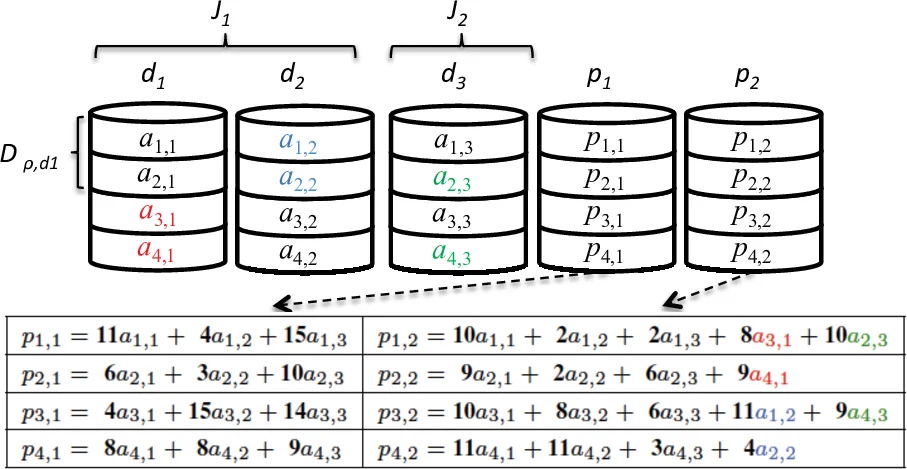
The core of the construction is a set of r index arrays P₁,…,P_r of size α × k. P₁ directly defines the linear combinations for the first parity node, while the remaining arrays are initially filled with placeholder pairs (0, 0). A two‑phase algorithm populates these placeholders:
- Phase 1 iteratively reduces a “granulation level” run = ⌈α/r⌉ by a factor of r. In each iteration it replaces (0, 0) entries with concrete (i, j) pairs that satisfy two conditions: (1) a block of r consecutive indices spaced by a step value (ensuring that ⌈α/r⌉ symbols can be repaired independently) and (2) a global partition consistency across all systematic nodes.
- Phase 2 handles any remaining placeholders, enforcing only condition 2 to guarantee a valid partition.
The algorithm uses auxiliary parameters—portion = ⌈α/r⌉, step = ⌈α/r⌉ − run, and a partition of systematic nodes into ⌈k/r⌉ groups J₁,…,J_{⌈k/r⌉}—to control the placement of indices. The resulting partitions D_{d_j} = {D_{1,d_j},…,D_{r,d_j}} dictate which symbols of a systematic node are accessed directly from the surviving nodes and which are reconstructed via parity.
Each parity symbol p_{i,l} (1 ≤ i ≤ α, 1 ≤ l ≤ r) is formed as a linear combination of systematic symbols indexed by the i‑th row of P_l, with non‑zero coefficients c_{l,i,j₁,j₂} drawn from a sufficiently large finite field F_q. By adapting Theorem 4.1 from prior work, the authors prove that if q ≥ ⌈n/k⌉·r·α, one can always choose non‑zero coefficients that make the code MDS, i.e., any k nodes (systematic or parity) suffice to reconstruct the original file.
The repair procedure (Algorithm 4) proceeds in two stages. First, ⌈α/r⌉ symbols are accessed from each of the n − 1 surviving nodes (systematic nodes and the first parity node) and repaired independently. Then, the remaining α − ⌈α/r⌉ symbols are recovered by accessing the other r − 1 parity nodes and the necessary systematic symbols that were not read in the first stage. This design yields a highly parallelizable repair process.
Proposition 1 bounds the repair bandwidth γ for a single systematic node: \
Comments & Academic Discussion
Loading comments...
Leave a Comment