Shape optimization of phononic band gap structures using the homogenization approach
The paper deals with optimization of the acoustic band gaps computed using the homogenized model of strongly heterogeneous elastic composite which is constituted by soft inclusions periodically distributed in stiff elastic matrix. We employ the homogenized model of such medium to compute intervals — band gaps — of the incident wave frequencies for which acoustic waves cannot propagate. It was demonstrated that the band gaps distribution can be influenced by changing the shape of inclusions. Therefore, we deal with the shape optimization problem to maximize low-frequency band gaps; their bounds are determined by analysing the effective mass tensor of the homogenized medium. Analytic transformation formulas are derived which describe dispersion effects of resizing the inclusions. The core of the problem lies in sensitivity of the eigenvalue problem associated with the microstructure. Computational sensitivity analysis is developed, which allows for efficient usage of the gradient based optimization methods. Numerical examples with 2D structures are reported to illustrate the effects of optimization with stiffness constraint. This study is aimed to develop modelling tools which can be used in optimal design of new acoustic devices for “smart systems”.
💡 Research Summary
The paper presents a comprehensive framework for shape optimization of phononic band‑gap structures based on the homogenization of strongly heterogeneous elastic composites. The material system consists of a stiff elastic matrix periodically embedded with very soft inclusions. By employing a two‑scale asymptotic expansion with the inclusion stiffness scaled by ε², the authors derive a first‑order homogenized model that yields an effective fourth‑order elastic tensor C⁰ and a frequency‑dependent second‑order mass tensor M(ω). The key physical insight is that the sign of the eigenvalues of M(ω) determines whether acoustic waves can propagate: when M(ω) becomes negative‑definite over a frequency interval, a band gap opens. Consequently, the low‑frequency band‑gap bounds can be identified solely from the eigenvalues of the effective mass tensor, without recourse to Bloch‑Floquet analysis of the full Brillouin zone.
The design variable is the geometry of a single soft inclusion within the representative periodic cell. The inclusion boundary is parameterized by a circular B‑spline, providing a smooth C¹ representation while allowing a relatively large number of design variables. The objective is to maximize the width of a selected band gap (either the first or the second) defined as Δω = ω_u – ω_l, where ω_l and ω_u are the lower and upper frequency limits at which the smallest eigenvalue of M(ω) changes sign. A stiffness constraint is imposed by requiring the smallest eigenvalue of the effective elastic tensor C⁰ to stay above a prescribed threshold, ensuring that the optimized microstructure retains sufficient rigidity for practical applications.
A central contribution of the work is the derivation of analytical sensitivity formulas for Δω with respect to the shape parameters. The authors formulate the cell problems for the corrector fields (periodic displacement and pressure fields) and the eigenvalue problem for M(ω). By differentiating the variational forms of the cell problems and applying the chain rule to the eigenvalue problem, they obtain expressions for the gradients that consist of (i) volume integrals involving the derivatives of material coefficients and (ii) surface integrals accounting for the movement of the inclusion boundary. The surface terms are expressed explicitly in terms of the B‑spline control points and the outward normal, avoiding the need for level‑set re‑initialization. The resulting total gradient is compatible with gradient‑based optimization algorithms such as L‑BFGS or limited‑memory quasi‑Newton methods.
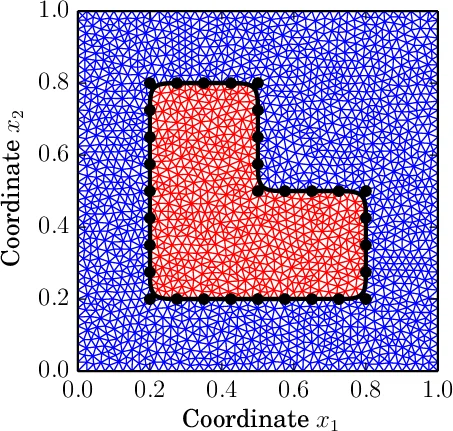
Numerical experiments are carried out in two dimensions under plane‑strain conditions. Several initial inclusion shapes (square, L‑shaped, elliptical) and volume fractions ranging from 10 % to 30 % are examined. For each case the authors solve the cell problems, compute the effective tensors, and evaluate the band‑gap bounds. Optimization of the first band gap leads to inclusion shapes with sharp protrusions (“spike‑like” features) that significantly enlarge Δω compared with the initial designs, while still satisfying the stiffness constraint. Optimizing the second band gap yields different optimal morphologies, illustrating that the objective function strongly influences the final geometry. The results confirm that, for a given volume fraction, shape optimization can achieve band‑gap enlargements of 30–50 % relative to naïve geometries.
Overall, the study demonstrates that homogenization‑based band‑gap analysis, combined with rigorous shape‑sensitivity derivation, provides an efficient and mathematically transparent alternative to full Bloch‑Floquet band‑structure calculations. The methodology scales well to high‑dimensional design spaces and can incorporate multiple physical constraints, making it suitable for the systematic design of acoustic metamaterials, phononic crystals, and, by extension, piezo‑phononic devices where active control is desired. Future work is outlined to extend the approach to three‑dimensional microstructures, nonlinear material behavior, and coupled electromechanical effects.
Comments & Academic Discussion
Loading comments...
Leave a Comment