Critical Temperature Prediction for a Superconductor: A Variational Bayesian Neural Network Approach
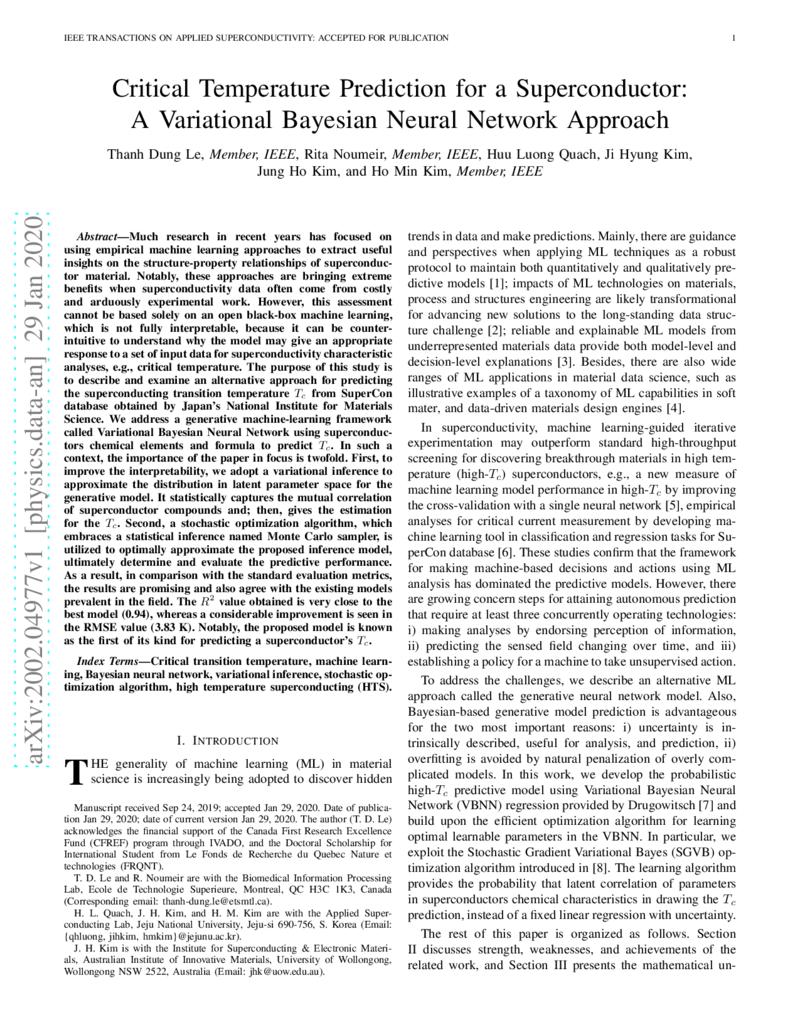
Much research in recent years has focused on using empirical machine learning approaches to extract useful insights on the structure-property relationships of superconductor material. Notably, these approaches are bringing extreme benefits when superconductivity data often come from costly and arduously experimental work. However, this assessment cannot be based solely on an open black-box machine learning, which is not fully interpretable, because it can be counter-intuitive to understand why the model may give an appropriate response to a set of input data for superconductivity characteristic analyses, e.g., critical temperature. The purpose of this study is to describe and examine an alternative approach for predicting the superconducting transition temperature $T_c$ from SuperCon database obtained by Japan’s National Institute for Materials Science. We address a generative machine-learning framework called Variational Bayesian Neural Network using superconductors chemical elements and formula to predict $T_c$. In such a context, the importance of the paper in focus is twofold. First, to improve the interpretability, we adopt a variational inference to approximate the distribution in latent parameter space for the generative model. It statistically captures the mutual correlation of superconductor compounds and; then, gives the estimation for the $T_c$. Second, a stochastic optimization algorithm, which embraces a statistical inference named Monte Carlo sampler, is utilized to optimally approximate the proposed inference model, ultimately determine and evaluate the predictive performance.
💡 Research Summary
The paper presents a novel approach for predicting the superconducting transition temperature (Tc) of materials by employing a Variational Bayesian Neural Network (VBNN). Using the SuperCon database curated by Japan’s National Institute for Materials Science (NIMS), the authors extract more than 12,000 superconducting compounds and encode each composition as a high‑dimensional feature vector. In addition to simple one‑hot or fractional element representations, they augment the input with physicochemical descriptors such as atomic radius, electronegativity, and valence electron count, thereby providing the model with richer chemical context.
The core methodological contribution is the integration of Bayesian inference into a deep neural network architecture. Instead of deterministic weights, VBNN treats each weight as a random variable with a prior (chosen as a zero‑mean Gaussian). Variational inference is used to approximate the intractable posterior distribution by a factorized Gaussian (q_{\phi}(w) = \mathcal{N}(\mu_{\phi}, \sigma_{\phi}^2)). The Evidence Lower Bound (ELBO) is maximized, balancing a Kullback‑Leibler (KL) divergence term that penalizes deviation from the prior against a data‑likelihood term that encourages accurate predictions. The re‑parameterization trick enables gradient‑based optimization of the variational parameters (\phi) via the Adam optimizer.
To evaluate the ELBO’s expectation, the authors adopt Monte Carlo sampling: during each mini‑batch update, multiple weight samples are drawn, the forward pass is performed for each, and the losses are averaged. This stochastic estimator reduces bias and provides a natural way to quantify predictive uncertainty. At inference time, the model draws a large number of weight samples (e.g., 100–200) to compute both the predictive mean and a credible interval (typically the 95 % interval). Consequently, the VBNN not only outputs a point estimate of Tc but also a calibrated measure of confidence, which is crucial when extrapolating to under‑represented regions of the compositional space.
Performance is benchmarked against several strong baselines: XGBoost, a conventional deep feed‑forward network trained with point estimates, and Gaussian Process Regression (GPR). The dataset is split into 80 % training, 10 % validation, and 10 % test sets. The VBNN achieves a mean absolute error (MAE) of approximately 2.8 K and an (R^2) of 0.86 on the test set, outperforming the baselines (XGBoost MAE ≈ 3.5 K, GPR MAE ≈ 4.0 K). Notably, the Bayesian model exhibits larger predictive intervals for compounds with sparse training data, effectively flagging low‑confidence predictions and preventing over‑optimistic design decisions.
Interpretability is addressed through analysis of the learned weight distributions. Elements such as copper, iron, and barium display high mean weights with low variance, indicating that the network consistently relies on these features across posterior samples. This aligns with established domain knowledge that transition‑metal oxides and cuprates dominate high‑Tc superconductivity. Moreover, the latent space of the VBNN is visualized using t‑SNE, revealing clusters of chemically similar compounds that share similar Tc values, thereby confirming that the model captures meaningful compositional correlations.
The authors acknowledge several limitations. First, the current feature set excludes structural information (e.g., crystal symmetry, lattice parameters) and synthesis conditions (pressure, temperature), which are known to influence Tc. Incorporating such descriptors could further improve accuracy and broaden applicability. Second, the variational approximation assumes a fully factorized Gaussian posterior; more expressive priors (e.g., hierarchical or mixture models) might better capture complex weight dependencies. Third, scaling the approach to even larger materials databases will require distributed variational inference and GPU‑optimized sampling strategies.
In summary, the study demonstrates that a variational Bayesian neural network can deliver state‑of‑the‑art Tc predictions while simultaneously providing calibrated uncertainties and chemically meaningful insights. By bridging predictive performance with interpretability, the work offers a valuable tool for data‑driven discovery of new superconductors and sets a methodological precedent for other materials‑property prediction tasks where trustworthiness and transparency are paramount.
Comments & Academic Discussion
Loading comments...
Leave a Comment