FEAST Eigenvalue Solver v4.0 User Guide
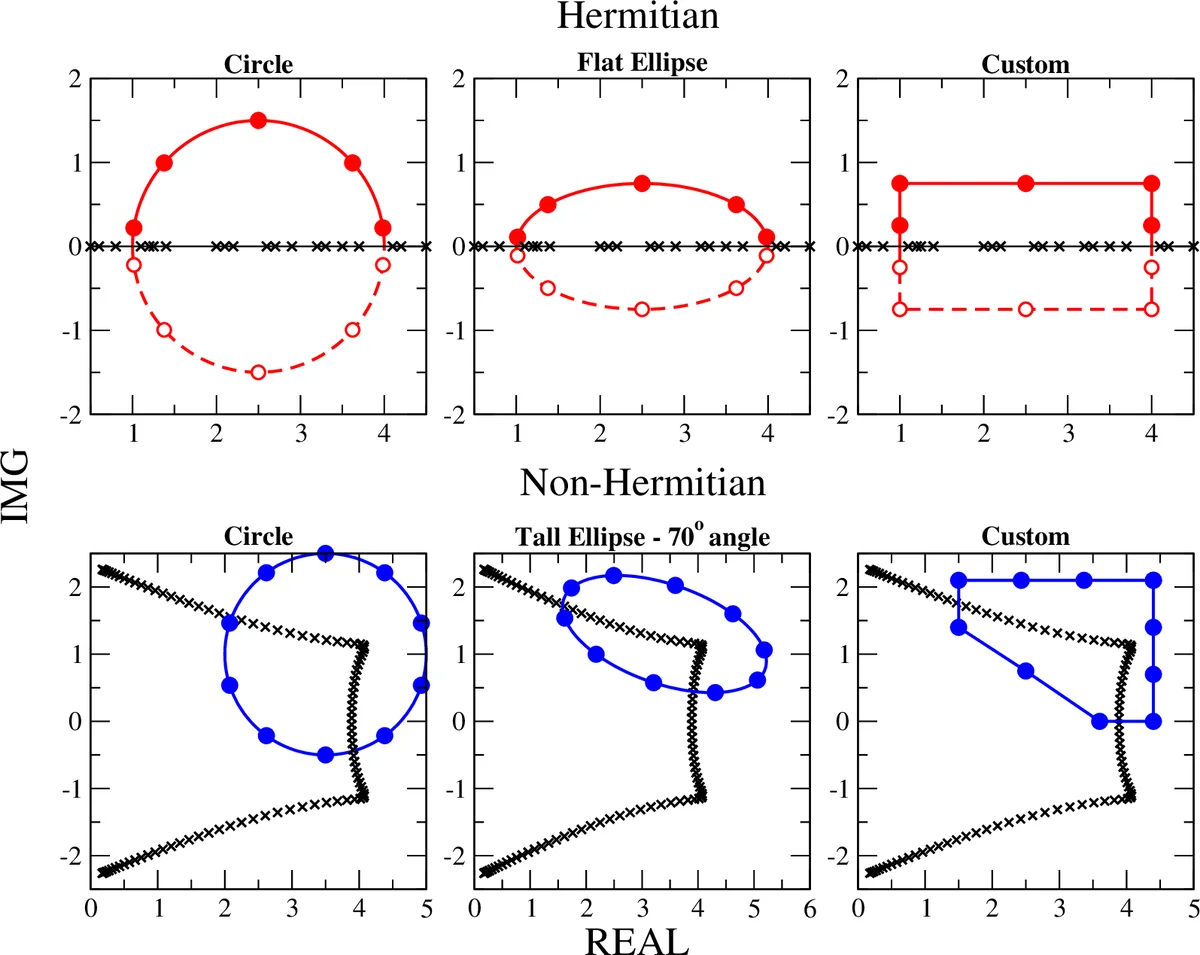
The FEAST library package represents an unified framework for solving various family of eigenvalue problems and achieving accuracy, robustness, high-performance and scalability on parallel architectures. Its originality lies with a new transformative numerical approach to the traditional eigenvalue algorithm design - the FEAST algorithm. The algorithm gathers key elements from complex analysis, numerical linear algebra and approximation theory, to construct an optimal subspace iteration technique using approximate spectral projectors. FEAST can be used for solving both standard and generalized forms of the Hermitian or non-Hermitian problems (linear or non-linear), and it belongs to the family of contour integration eigensolvers. FEAST’s main computational task consists of a numerical quadrature computation that involves solving independent linear systems along a complex contour, each with multiple right hand sides. In v4.0, FEAST has been reimplemented using an inverse residual iteration algorithm which enables the linear systems to be solved with very low accuracy (in single precision) with no impact on the FEAST double precision convergence rate. As a result, v4.0 is on average 3-4 times faster than v2.1 and v3.0 using new default optimization parameters (v2.1 has been featured as Intel-MKL’s principal HPC eigensolver since 2013). v4.0 also implements new important features such as IFEAST (using Inexact Iterative solver), Non-linear polynomial FEAST, and PFEAST with its 3-MPI levels of parallelism. FEAST is both a comprehensive library package, and an easy to use software. It includes flexible reverse communication interfaces and ready to use driver interfaces for dense, banded and sparse systems.
💡 Research Summary
The FEAST Eigenvalue Solver version 4.0 is presented as a unified, high‑performance library for solving a broad spectrum of eigenvalue problems, including standard, generalized, Hermitian, non‑Hermitian, linear, and nonlinear (polynomial) cases. Its core algorithm stems from quantum‑mechanical density‑matrix concepts and contour‑integration techniques: a user‑defined search interval is surrounded by a complex contour, and an approximate spectral projector is built by evaluating a quadrature rule on that contour. The main computational work consists of solving many independent linear systems—one per quadrature node—each with multiple right‑hand sides, which enables the use of BLAS‑3 kernels and massive parallelism.
Version 4.0 introduces a residual‑inverse iteration scheme that allows the linear systems to be solved in single precision without degrading the double‑precision convergence of the outer subspace iteration. This mixed‑precision approach reduces memory bandwidth and arithmetic cost, delivering a 3–4× speed‑up over earlier releases (v2.1 and v3.0). The new release also adds several major features:
- IFEAST – an “in‑exact” variant that replaces direct factorization with iterative solvers such as BiCGStab, making the method attractive for very large sparse matrices.
- PFEAST – a three‑level MPI parallelization strategy: (L1) different contour intervals are distributed across MPI ranks, (L2) each quadrature node’s linear system is solved on a separate rank, and (L3) the multiple RHS solves within a node are parallelized with threads. This hierarchy yields near‑linear scaling on clusters, especially when combined with Intel‑MKL‑PARDISO or its cluster variant.
- Polynomial eigenvalue support – quadratic, cubic, quartic, etc., are handled by the same contour‑integration framework, extending FEAST to nonlinear eigenproblems.
- Extreme eigenvalue mode – dedicated routines to locate the smallest or largest eigenvalues of large sparse Hermitian matrices.
- Mixed‑precision capability – single‑precision linear solves feed a double‑precision outer iteration, preserving final accuracy while cutting cost.
The library offers two user‑level interfaces. The Reverse Communication Interface (RCI) gives full control over matrix‑vector products, linear‑solver choice, and preconditioning, enabling custom kernels and extreme flexibility. The driver interface provides ready‑made wrappers for dense LAPACK, banded SPIKE, and sparse CSR solvers (MKL‑PARDISO or IFEAST’s iterative driver). Both interfaces are callable from Fortran or C, with a small set of header files.
Installation is straightforward: download the tarball, set the $FEASTROOT environment variable, and compile either the SMP version (libfeast) or the MPI version (libpfeast) via a simple make command that lets the user specify architecture, Fortran compiler, MPI implementation, and whether to link against Intel‑MKL. Linking instructions, required header includes, and example “HelloWorld” programs (Fortran, C, MPI‑enabled variants) are provided. The examples demonstrate how to initialise FEAST, set parameters (search interval, subspace size, tolerance), call the appropriate routine (e.g., dfeast_syev for real symmetric problems), and retrieve eigenvalues, eigenvectors, and residuals.
Additional documentation covers matrix storage formats, contour definition and customization, stochastic eigenvalue‑count estimation, and utility drivers. The paper also lists the development team, collaborators, and funding sources (Intel and NSF grants).
In summary, FEAST 4.0 delivers a mathematically elegant contour‑integration based subspace iteration algorithm packaged as a highly optimized, scalable, and user‑friendly library. Its mixed‑precision residual‑inverse iteration, in‑exact iterative solves, and three‑level MPI parallelism address modern high‑performance computing demands, making FEAST a powerful tool for large‑scale scientific and engineering eigenvalue computations.
Comments & Academic Discussion
Loading comments...
Leave a Comment