Delta-Ramp Encoder for Amplitude Sampling and its Interpretation as Time Encoding
The theoretical basis for conventional acquisition of bandlimited signals typically relies on uniform time sampling and assumes infinite-precision amplitude values. In this paper, we explore signal representation and recovery based on uniform amplitude sampling with assumed infinite precision timing information. The approach is based on the delta-ramp encoder which consists of applying a one-level level-crossing detector to the result of adding an appropriate sawtooth-like waveform to the input signal. The output samples are the time instants of these level crossings, thus representing a time-encoded version of the input signal. For theoretical purposes, this system can be equivalently analyzed by reversibly transforming through ramp addition a nonmonotonic input signal into a monotonic one which is then uniformly sampled in amplitude. The monotonic function is then represented by the times at which the signal crosses a predefined and equally-spaced set of amplitude values. We refer to this technique as amplitude sampling. The time sequence generated can be interpreted alternatively as nonuniform time sampling of the original source signal. We derive duality and frequency-domain properties for the functions involved in the transformation. Iterative algorithms are proposed and implemented for recovery of the original source signal. As indicated in the simulations, the proposed iterative amplitude-sampling algorithm achieves a faster convergence rate than frame-based reconstruction for nonuniform sampling. The performance can also be improved by appropriate choice of the parameters while maintaining the same sampling density.
💡 Research Summary
The paper challenges the conventional sampling paradigm, which assumes uniformly spaced time instants and infinite‑precision amplitude measurements, by proposing a dual viewpoint: uniformly spaced amplitude samples combined with infinite‑precision timing information. The authors introduce the “delta‑ramp encoder,” a system that adds a linear ramp of slope α > 0 to the input signal f(t) to form a strictly monotonic function g(t)=αt+f(t). A one‑level level‑crossing detector then records the time instants tₙ at which g(t) crosses a set of equally spaced amplitude levels nΔ (Δ > 0). These time instants constitute a “time code” that uniquely represents the original signal.
Two equivalent interpretations are presented. First, the process can be viewed as time encoding: the level‑crossings of g(t) are captured in the time domain. Second, by inverting g(t) to obtain t(g), the same information is seen as uniform sampling in the amplitude domain (amplitude sampling). Thus, the delta‑ramp encoder implements amplitude sampling in hardware while producing a time‑encoded output.
For non‑monotonic signals, a reversible transformation φ (e.g., adding a ramp) converts the signal into a monotonic function before sampling. The paper formalizes the mapping between the original signal f and an auxiliary “amplitude‑time” function h through the relations g⁻¹(u)=u/α+h(u) and h(u)=tₙ−nΔ/α. This duality is expressed in matrix form, highlighting that any property imposed on f has a counterpart in h.
A key contribution is an iterative reconstruction algorithm derived from Theorem 1. Assuming f is Lipschitz continuous with constant L < α and bounded (|f(t)| ≤ A), the algorithm initializes h₀(u)=f(u) and iterates hₙ₊₁(u)=f(u−hₙ(u)/α). The sequence converges to the true h(u), and the inverse mapping Mα⁻¹ reconstructs f from h via a symmetric iteration. The iteration can be interpreted geometrically as repeatedly drawing a straight line with slope α through the current estimate and finding its intersection with the horizontal axis.
Sampling density analysis shows that if |f′(t)| ≤ B and |α| > B, then the inter‑sample time interval satisfies Δ/|α| − B/|α|² ≤ tₙ₊₁ − tₙ ≤ Δ/|α| + B/|α|². Larger α makes the time intervals more uniform, effectively scaling the amplitude axis into time.
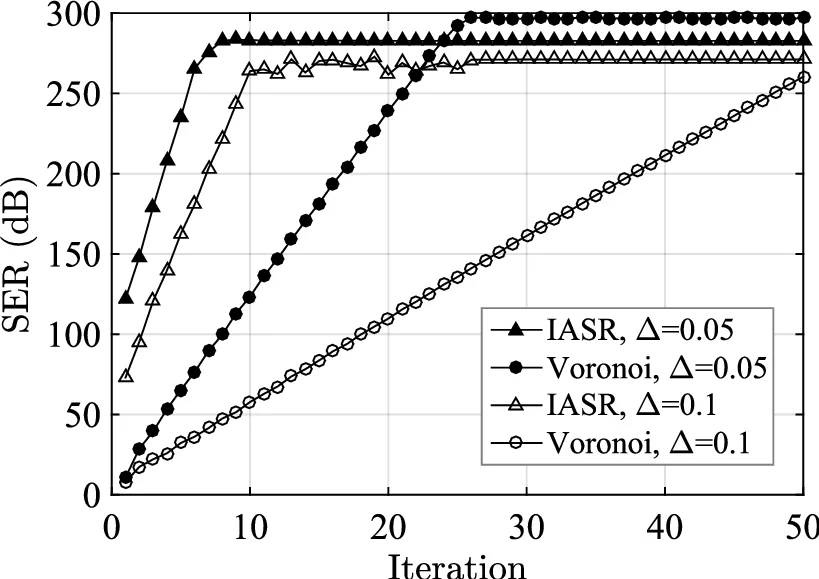
Simulation results compare the proposed iterative amplitude‑sampling reconstruction with frame‑based reconstruction for non‑uniform time samples. Under identical sampling density (determined by Δ and α), the iterative method converges faster (fewer iterations) and achieves lower reconstruction error. The authors also demonstrate that adjusting α allows control over the trade‑off between sampling uniformity and reconstruction performance.
In summary, the paper’s contributions are: (1) introducing amplitude sampling as a viable alternative to traditional time‑based sampling; (2) presenting the delta‑ramp encoder as a practical hardware realization; (3) establishing a duality framework between amplitude‑time and time‑amplitude representations; (4) deriving a fast‑converging iterative algorithm for exact signal recovery; and (5) empirically showing superior performance over existing non‑uniform sampling reconstruction techniques. These findings open new avenues for low‑power, high‑speed analog‑to‑digital conversion, sensor networks, and time‑domain signal processing where timing precision is easier to achieve than amplitude quantization.
Comments & Academic Discussion
Loading comments...
Leave a Comment