Symplectic Manifolds and Isomonodromic Deformations
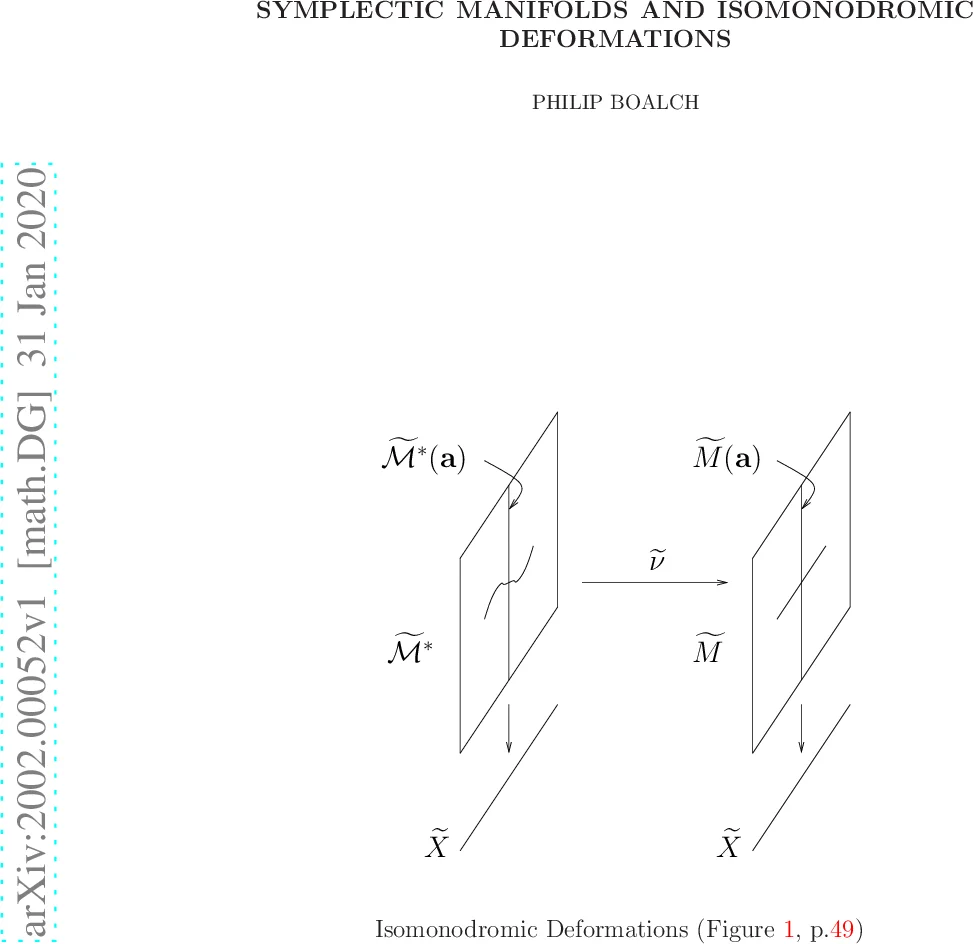
We study moduli spaces of meromorphic connections (with arbitrary order poles) over Riemann surfaces together with the corresponding spaces of monodromy data (involving Stokes matrices). Natural symplectic structures are found and described both explicitly and from an infinite dimensional viewpoint (generalising the Atiyah-Bott approach). This enables us to give an intrinsic symplectic description of the isomonodromic deformation equations of Jimbo, Miwa and Ueno, thereby putting the existing results for the six Painleve equations and Schlesinger’s equations into a uniform framework.
💡 Research Summary
The paper develops a unified symplectic framework for the moduli spaces of meromorphic connections on Riemann surfaces, allowing arbitrary pole orders, and for the corresponding generalized monodromy data that include Stokes matrices. Starting from the classical correspondence between holomorphic connections and representations of the fundamental group, the author replaces “holomorphic’’ by “meromorphic’’ and studies the resulting geometry. For simple poles the situation reduces to the well‑known Atiyah‑Bott symplectic reduction: fixing the residues in prescribed coadjoint orbits O_i and imposing the moment‑map condition ΣA_i=0 yields the finite‑dimensional symplectic quotient O_1×…×O_m // GL_n(C). The monodromy map, which sends a connection to its representation, is shown to be a local symplectomorphism.
The novelty lies in treating higher‑order poles. At each pole one must fix a formal type (the leading terms of the Laurent expansion) and a collection of Stokes matrices describing the Stokes phenomenon on sectors around the pole. The author packages these data into a “generalized monodromy datum’’ and proves that the space of such data can be realized as an infinite‑dimensional symplectic quotient, extending the Atiyah‑Bott construction to C^∞ singular connections. Because the naive extension of the Atiyah‑Bott 2‑form diverges near the singularities, a regularized form with boundary contributions is introduced; this form is invariant under the gauge group and its moment map encodes precisely the formal‑type and Stokes constraints.
The central result (Theorem 6.1) states that the monodromy map from the moduli space of meromorphic connections (equipped with an explicit symplectic structure coming from the residues and Stokes data) to the generalized monodromy space (equipped with the extended Atiyah‑Bott symplectic structure) is symplectic. Consequently, the isomonodromic deformation equations of Jimbo‑Miwa‑Ueno, which describe how the connection varies when the pole positions a_i move while keeping the monodromy data fixed, become the horizontal sections of a flat symplectic connection on a symplectic fibre bundle over the deformation parameter space. In concrete terms, the evolution equations for the residues A_i and the Stokes matrices are Hamiltonian flows; for simple poles they reduce to the classical Schlesinger equations, and for rank‑two connections on the sphere with four total pole multiplicities they reproduce the six Painlevé equations.
The paper also discusses the broader context: the “wild fundamental group’’ of Martinet‑Ramis, the relation to Frobenius manifolds (via Dubrovin’s identification of Stokes matrices with semisimple Frobenius structures), and the potential for quantisation. The symplectic description suggests a natural route to Knizhnik‑Zamolodchikov‑type equations, as explored in earlier work by Reshetikhin and Harnad. Moreover, the construction is not limited to the Riemann sphere; it extends to arbitrary compact Riemann surfaces (possibly with boundary) and to bundles of any degree, provided the appropriate infinite‑dimensional gauge‑theoretic setup is used.
In summary, the author provides a comprehensive geometric picture: meromorphic connections with arbitrary poles form a symplectic manifold; their generalized monodromy data form another symplectic manifold obtained via an infinite‑dimensional reduction; the monodromy map is a symplectomorphism; and the Jimbo‑Miwa‑Ueno isomonodromic deformation equations are precisely the condition that the symplectic connection on the parameter space be flat. This unifies the symplectic treatment of Schlesinger, Painlevé, and many other integrable systems, and opens the way for further developments in both classical and quantum aspects of isomonodromic deformations.
Comments & Academic Discussion
Loading comments...
Leave a Comment