📝 Original Info
- Title: Capacitorless Model of a VO2 Oscillator
- ArXiv ID: 1911.06983
- Date: 2020-02-04
- Authors: Researchers from original ArXiv paper
📝 Abstract
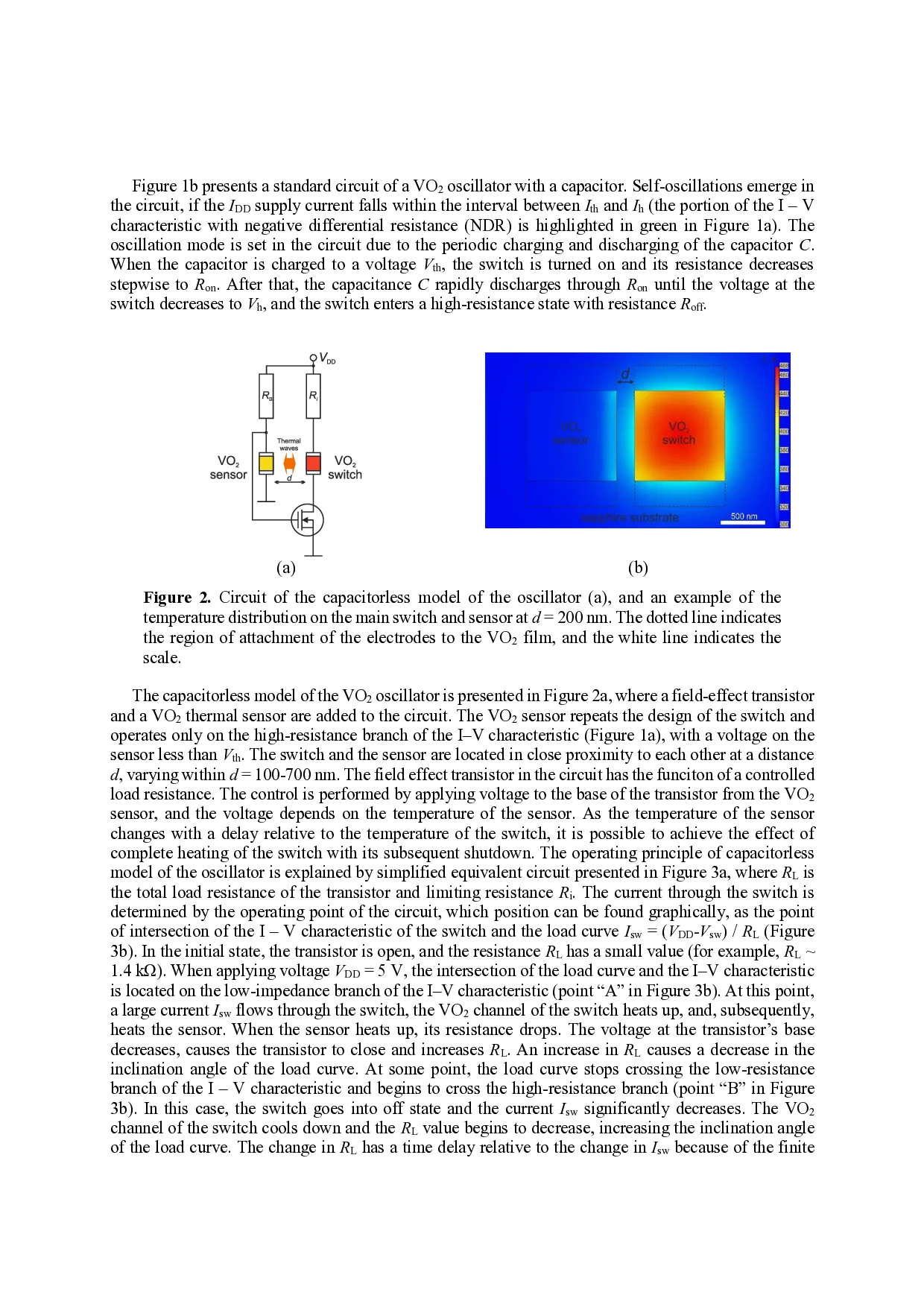
We implement a capacitorless model of a VO2 oscillator by introducing into the circuit of a field-effect transistor and a VO2 thermal sensor, which provide negative current feedback with a time delay. We compare the dynamics of current and voltage oscillations on a switch in a circuit with a capacitor and without a capacitor. The oscillation period in the capacitorless model is controlled in a narrow range by changing the distance between the switch and the sensor. The capacitorless model provides the possibility of significant miniaturization of the oscillator circuit, and it is important for the implementation of large arrays of oscillators in oscillatory neural networks to solve the problem of classification and pattern recognition.
💡 Deep Analysis
Deep Dive into Capacitorless Model of a VO2 Oscillator.
We implement a capacitorless model of a VO2 oscillator by introducing into the circuit of a field-effect transistor and a VO2 thermal sensor, which provide negative current feedback with a time delay. We compare the dynamics of current and voltage oscillations on a switch in a circuit with a capacitor and without a capacitor. The oscillation period in the capacitorless model is controlled in a narrow range by changing the distance between the switch and the sensor. The capacitorless model provides the possibility of significant miniaturization of the oscillator circuit, and it is important for the implementation of large arrays of oscillators in oscillatory neural networks to solve the problem of classification and pattern recognition.
📄 Full Content
Capacitorless Model of a VO2 Oscillator
M. A. Belyaev1, A. A. Velichko1
1Institute of Physics and Technology, Petrozavodsk State University, 33, Lenin
str., 185910, Petrozavodsk, Russia
E-mail: biomax89@yandex.ru
Abstract. We implement a capacitorless model of a VO2 oscillator by introducing into the circuit
of a field-effect transistor and a VO2 thermal sensor, which provide negative current feedback
with a time delay. We compare the dynamics of current and voltage oscillations on a switch in a
circuit with a capacitor and without a capacitor. The oscillation period in the capacitorless model
is controlled in a narrow range by changing the distance between the switch and the sensor. The
capacitorless model provides the possibility of significant miniaturization of the oscillator
circuit, and it is important for the implementation of large arrays of oscillators in oscillatory
neural networks to solve the problem of classification and pattern recognition.
- Introduction
A traditional method of computing, based on Boolean logic and implemented using CMOS circuits,
suffers from its technological limitations on the productivity growth of computing devices, and,
consequently, leads to the limit on data processing speed [1]. Alternative approach to solve this problem
offers a radically different way of organizing calculations, based on the dynamics of nonlinear systems
[2, 3], that resemble the principles of the human brain operation [4], where billions of neurons
experience impulse changes in electrical potential. These systems, called spiking neural networks
(SNNs) or third-generation networks, are implemented using various techniques [5–7]. The principles
of SNN information processing are based on the analysis of the sequence of pulses: the order of receiving
pulses at the network outputs, the distances between pulses and the time of the first appearance of a
pulse at any output, as well as on the registration of synchronous activity of different groups of neurons
within certain time windows. The latter type of information representation, called neural population
coding, reflects the collective dynamics of nonlinear systems, and represents the result of another type
of spike networks - impulse oscillatory neural networks (ONNs). Therefore, ONN represents an array
of connected oscillators (forced generators or auto-generators), and the principle of adjustment to entire
system synchronization [8–10] may underlie the new ways of information processing.
ONNs resemble Hopfield networks [11], where the network dynamics converges to one of the
equilibrium positions. However, there are a number of significant differences related to the physics of
processes and the presence of complex synchronization effects. The synchronization effect and its
metrics are powerful tools for using the collective dynamics of an oscillators array to implement the
cognitive functions of a neural network and the information processing. The development of a new
element base for oscillators as part of neural networks faces many technological difficulties. And so far,
none of the laboratories has been able to produce an oscillatory network with a significant number of
elements suitable for processing large amounts of information. The most common electrical circuits of
the relaxation oscillator [3,12–14] use a bistable switching element and a capacitance that is charged in
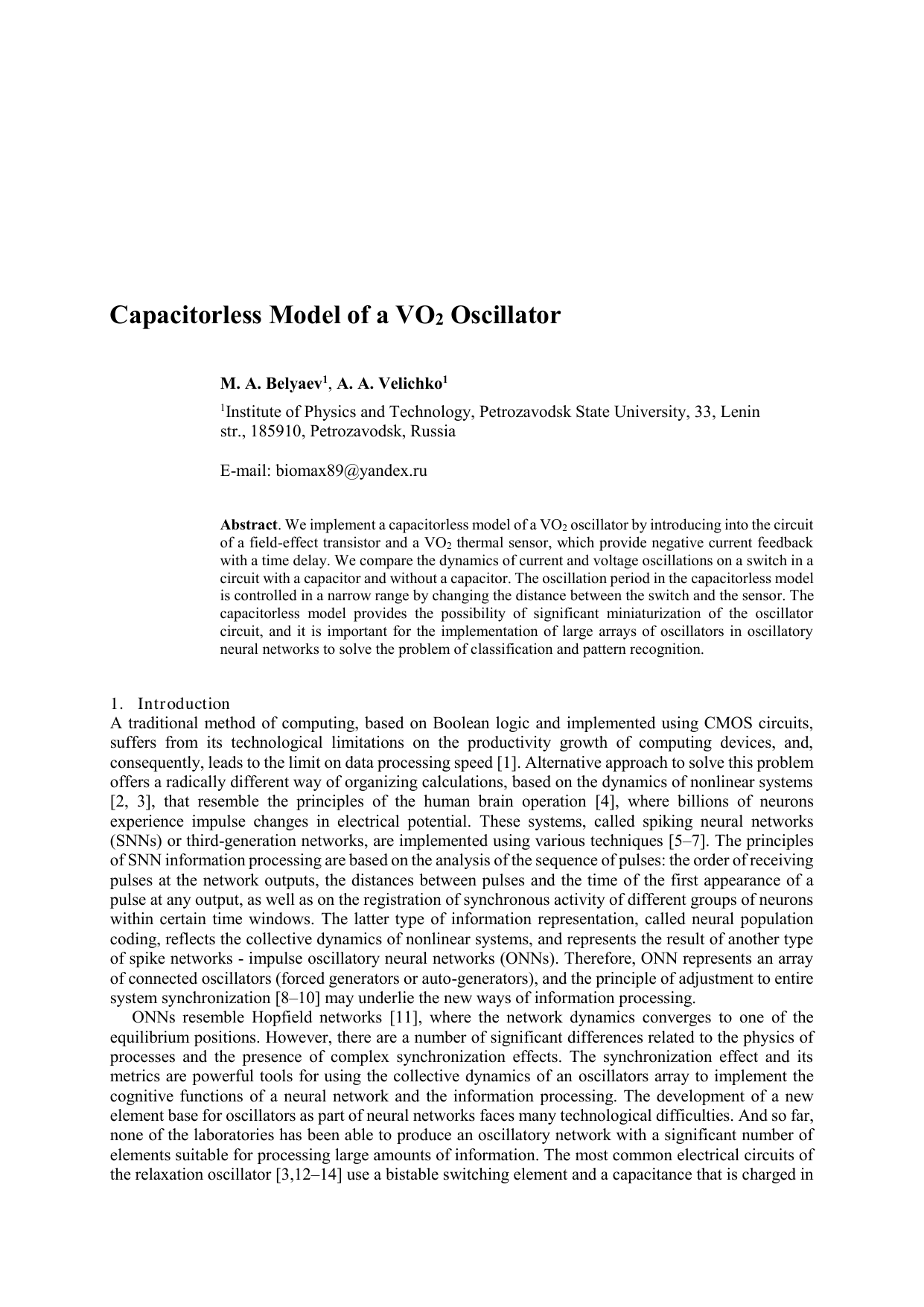
a high-resistance state and discharged in a low-resistance state of a bistable element. Switching elements
can be implemented based on the memristive switching effect [6,12], magnetic moment transfer [15]
and metal-insulator phase transition (MIT) [3,13,14,16]. The use of MIT material allows the thermal
interaction between the switches to be used for communication between oscillators [13,16].
One of the technological problems of miniaturization of oscillator circuits is the application of
capacitors that occupy a large area of the crystal using standard CMOS technology. For example, with
an inter-electrode dielectric thickness of 10 nm, the specific capacitance of the capacitor is ~ 3 fF / μm2,
and the capacitances with a nominal value of more than 1 pF are needed to generate oscillations on
submicron-sized switches [16]. When implementing the capacitor model of the oscillator, nearly 330
μm2 of the crystal area is required to manufacture the capacitor, while only ~ 1 μm2 is used to
manufacture the switch and the load or current resistors. Therefore, the area of the oscillator can be
significantly reduced (by hundreds of times), if the capacitance is not used in the oscillator circuit.
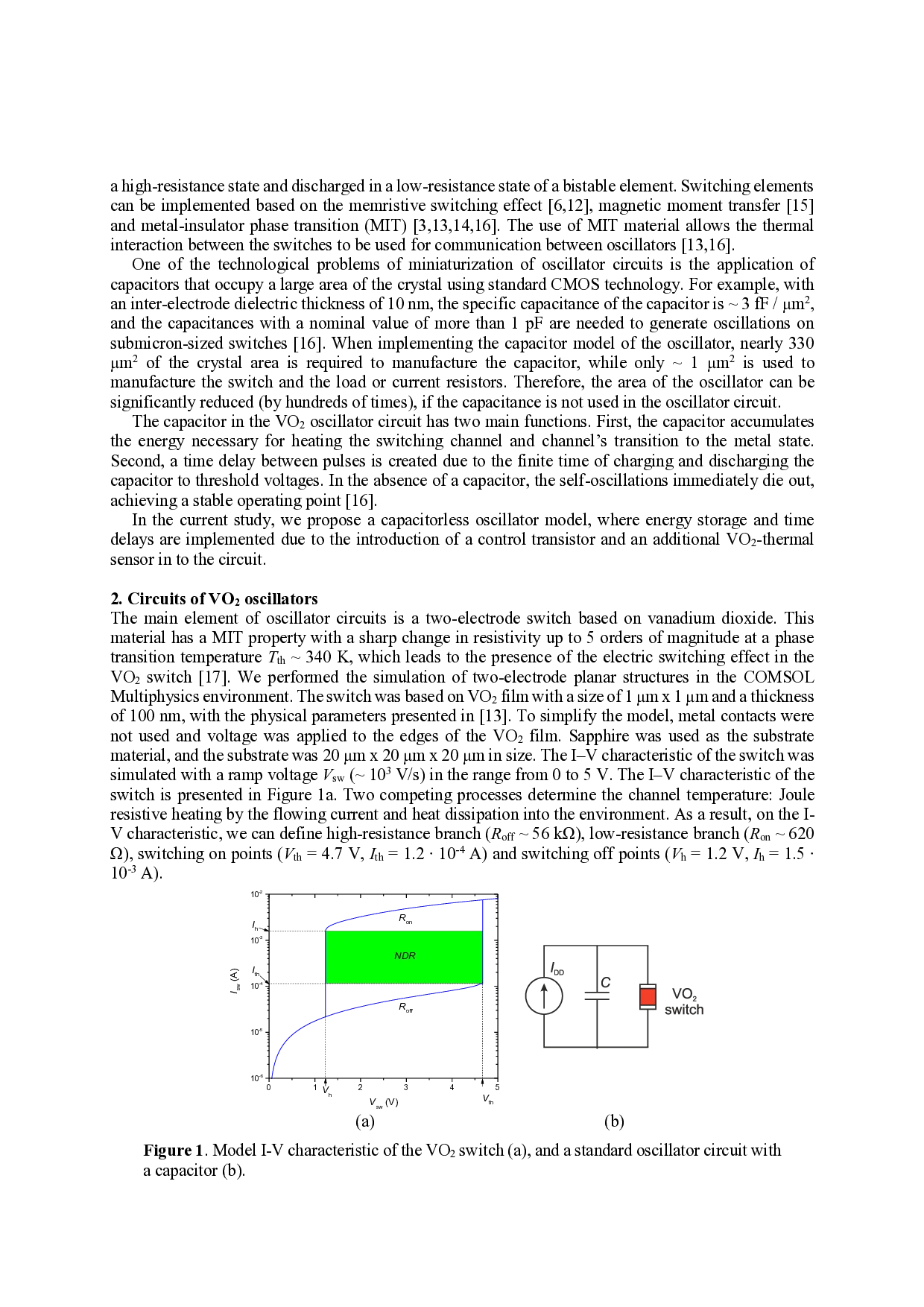
The capacitor in the VO2 oscillator circuit has two main functions. First, the capacitor accumulates
the energy necessary for heating the switching channel and channel’s transition to the metal state.
Second, a time delay between pulses is created due to the finite time of charging and discharging the
capacitor to threshol
…(Full text truncated)…
📸 Image Gallery
Reference
This content is AI-processed based on ArXiv data.