Neural Autopoiesis: Organizing Self-Boundary by Stimulus Avoidance in Biological and Artificial Neural Networks
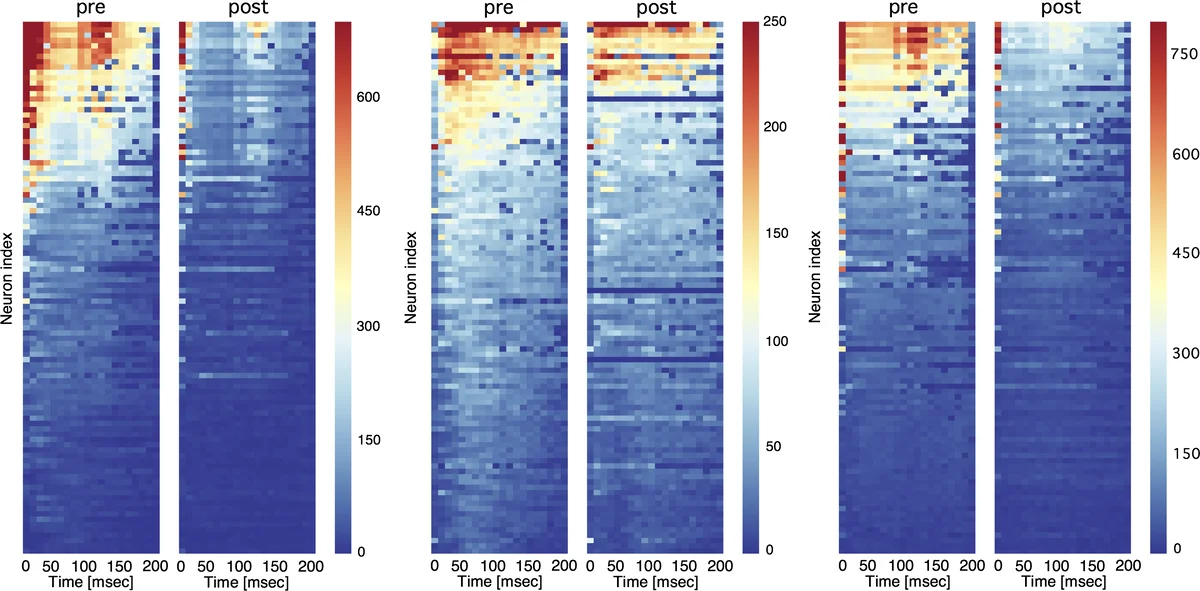
Living organisms must actively maintain themselves in order to continue existing. Autopoiesis is a key concept in the study of living organisms, where the boundaries of the organism is not static by dynamically regulated by the system itself. To study the autonomous regulation of self-boundary, we focus on neural homeodynamic responses to environmental changes using both biological and artificial neural networks. Previous studies showed that embodied cultured neural networks and spiking neural networks with spike-timing dependent plasticity (STDP) learn an action as they avoid stimulation from outside. In this paper, as a result of our experiments using embodied cultured neurons, we find that there is also a second property allowing the network to avoid stimulation: if the agent cannot learn an action to avoid the external stimuli, it tends to decrease the stimulus-evoked spikes, as if to ignore the uncontrollable-input. We also show such a behavior is reproduced by spiking neural networks with asymmetric STDP. We consider that these properties are regarded as autonomous regulation of self and non-self for the network, in which a controllable-neuron is regarded as self, and an uncontrollable-neuron is regarded as non-self. Finally, we introduce neural autopoiesis by proposing the principle of stimulus avoidance.
💡 Research Summary
This paper investigates how neural systems—both biological cultures and artificial spiking networks—self‑organize a boundary between “self” and “non‑self” by learning to avoid external stimulation. Building on earlier work that showed cultured neural networks can learn to produce a desired output in response to a low‑frequency input and thereby stop the stimulation, the authors focus on the underlying microscopic mechanism: spike‑timing‑dependent plasticity (STDP).
In the classic Learning by Stimulation Avoidance (LSA) framework, two complementary dynamics arise from STDP. When a presynaptic spike precedes a postsynaptic spike within the potentiation window, long‑term potentiation (LTP) strengthens the synapse, reinforcing behaviors that terminate the stimulus. Conversely, when a postsynaptic spike precedes a presynaptic spike, long‑term depression (LTD) weakens the synapse, suppressing behaviors that generate the stimulus. These dynamics enable a closed‑loop network to automatically reduce the frequency of external inputs.
The authors first replicate LSA in small‑scale cultured rat cortical neurons (47–110 cells) using a high‑density CMOS micro‑electrode array (11,011 electrodes, 7 µm diameter, 18 µm pitch). They map neuronal somata, classify excitatory versus inhibitory cells via spike‑shape clustering, and record spikes at 20 kHz while delivering low‑frequency (1–2 Hz) electrical pulses to a predefined input zone. When the network learns to fire a target output zone 40–60 ms after each stimulus, the stimulation is withdrawn, confirming classic LSA.
A novel observation emerges when the network fails to learn any behavior that eliminates the stimulus. Over repeated trials, the firing probability of the “uncontrollable” input neurons gradually declines, as if the network is actively ignoring those inputs. This second property is reproduced in silico with spiking neural networks that implement an asymmetric STDP rule—specifically, a depression window that is broader than the potentiation window. Under this rule, synapses from uncontrollable inputs are preferentially weakened, effectively “closing” the pathway for non‑self signals.
The authors interpret these two mechanisms as a form of neural autopoiesis: the network autonomously distinguishes controllable neurons (self) from uncontrollable ones (non‑self) and reorganizes its connectivity to protect its internal state from unavoidable external perturbations. They propose the “Principle of Stimulus Avoidance” as a foundational rule for maintaining a self‑boundary, extending the earlier phenomenological Stimulus Regulation Principle (SRP) with a concrete, synapse‑level account.
Beyond theoretical insight, the work suggests practical applications. In robotics, agents equipped with stimulus‑avoidance learning could minimize energy‑costly interactions with unpredictable environments by dynamically gating sensory inputs that cannot be controlled. In brain‑machine interfaces, similar mechanisms could automatically suppress noisy or pathological inputs, improving signal fidelity. The authors also note parallels to immune system self‑non‑self discrimination, hinting at a broader, information‑theoretic view of organismal boundaries.
In summary, the study demonstrates that (1) classic LSA via symmetric STDP enables networks to learn actions that reduce stimulation, and (2) an additional, asymmetric‑STDP‑driven suppression of uncontrollable inputs provides a second, complementary route to stimulus avoidance. Together these dynamics constitute a neural autopoietic process that maintains a self‑defined boundary, offering a unifying principle for adaptive behavior in both living and artificial neural systems.
Comments & Academic Discussion
Loading comments...
Leave a Comment