Surface mixing and biological activity in the four Eastern Boundary Upwelling Systems
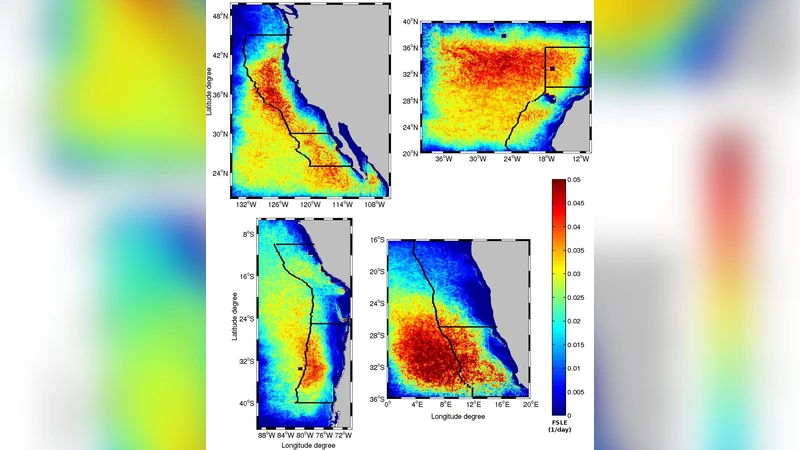
Eastern Boundary Upwelling Systems (EBUS) are characterized by a high productivity of plankton associated with large commercial fisheries, thus playing key biological and socio-economical roles. The aim of this work is to make a comparative study of these four upwelling systems focussing on their surface stirring, using the Finite Size Lyapunov Exponents (FSLEs), and their biological activity, based on satellite data. First, the spatial distribution of horizontal mixing is analysed from time averages and from probability density functions of FSLEs. Then we studied the temporal variability of surface stirring focussing on the annual and seasonal cycle. There is a global negative correlation between surface horizontal mixing and chlorophyll standing stocks over the four areas. To try to better understand this inverse relationship, we consider the vertical dimension by looking at the Ekman-transport and vertical velocities. We suggest the possibility of a changing response of the phytoplankton to sub/mesoscale turbulence, from a negative effect in the very productive coastal areas to a positive one in the open ocean.
💡 Research Summary
Eastern Boundary Upwelling Systems (EBUS) are among the most productive marine regions on Earth, supporting large fisheries and playing a pivotal role in global biogeochemical cycles. This study conducts a comparative analysis of the four major EBUS—California (North‑American), Peru‑Chile (South‑American), the Benguela system off southwestern Africa, and the upwelling zone off Cambodia in Southeast Asia—focusing on surface stirring and its relationship with phytoplankton biomass.
The authors quantify surface horizontal mixing using Finite‑Size Lyapunov Exponents (FSLEs) derived from satellite altimetry‑derived sea‑surface height fields. By initializing particle pairs at 1 km separation and tracking their divergence until they reach 100 km, the FSLE provides a time‑inverse measure of the strain rate associated with sub‑mesoscale dynamics (10‑100 km). Time‑averaged FSLE maps reveal a consistent pattern across all four systems: high values along the coast where wind‑driven upwelling and coastal jets generate strong shear, and progressively lower values offshore. Seasonal analysis shows a pronounced winter peak in FSLE for the California and Benguela systems, reflecting intensified wind stress, whereas the Peru‑Chile and Cambodian upwelling zones display relatively muted seasonal variability.
Probability density functions (PDFs) of FSLE values are skewed, resembling log‑normal distributions. The California and Benguela PDFs possess long right‑hand tails, indicating occasional extreme mixing events that dominate the mean FSLE. In contrast, the PDFs for the South‑American and Southeast Asian systems are narrower, suggesting more homogeneous stirring.
Biological activity is assessed using satellite‑derived chlorophyll‑a concentrations (SeaWiFS/MODIS). Across the four EBUS, a robust negative correlation (r ≈ ‑0.45) emerges between FSLE and chlorophyll, implying that stronger surface mixing generally reduces standing phytoplankton stocks. This relationship is interpreted through the lens of vertical nutrient transport. The authors incorporate Ekman transport estimates and vertical velocity (w) fields derived from wind stress curl. In regions of high FSLE, Ekman convergence is strong and w is predominantly negative (downwelling), which transports nutrients away from the euphotic zone and dilutes surface chlorophyll. Conversely, in offshore, low‑FSLE zones, Ekman divergence and modest upwelling (positive w) can locally enrich the surface layer, fostering higher chlorophyll despite weaker horizontal stirring.
The study therefore proposes a dual‑regime response of phytoplankton to sub‑mesoscale turbulence: a negative effect in highly productive coastal upwelling belts where intense mixing suppresses nutrient availability, and a positive effect in the open ocean where modest stirring can enhance nutrient entrainment and sustain higher biomass. This nuanced view reconciles earlier conflicting observations on the role of turbulence in marine productivity.
Implications extend to climate‑change scenarios. Projected alterations in wind patterns could modulate both FSLE intensity and Ekman‑driven vertical motions, thereby reshaping nutrient pathways and fisheries yields. A weakening of coastal winds might reduce mixing, allowing nutrients to remain in the surface layer and potentially boosting coastal productivity, whereas intensified winds could amplify downwelling, suppressing phytoplankton growth.
In summary, the paper provides a comprehensive, quantitative comparison of surface mixing across the world’s four major Eastern Boundary Upwelling Systems, demonstrates a consistent inverse relationship between FSLE‑derived stirring and chlorophyll‑a, and elucidates the underlying vertical dynamics that mediate this relationship. These findings offer valuable constraints for ecosystem models, fisheries management, and predictions of marine response to future climatic shifts.
Comments & Academic Discussion
Loading comments...
Leave a Comment