Detecting spatial patterns with the cumulant function. Part II: An application to El Nino
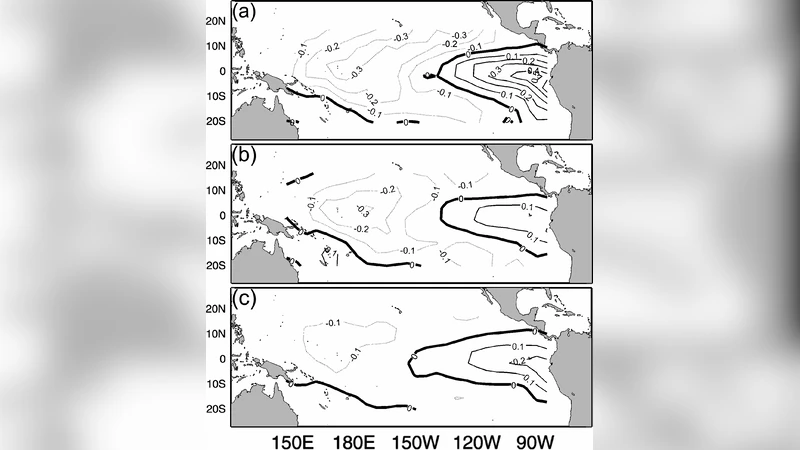
The spatial coherence of a measured variable (e.g. temperature or pressure) is often studied to determine the regions where this variable varies the most or to find teleconnections, i.e. correlations between specific regions. While usual methods to find spatial patterns, such as Principal Components Analysis (PCA), are constrained by linear symmetries, the dependence of variables such as temperature or pressure at different locations is generally nonlinear. In particular, large deviations from the sample mean are expected to be strongly affected by such nonlinearities. Here we apply a newly developed nonlinear technique (Maxima of Cumulant Function, MCF) for the detection of typical spatial patterns that largely deviate from the mean. In order to test the technique and to introduce the methodology, we focus on the El Nino/Southern Oscillation and its spatial patterns. We find nonsymmetric temperature patterns corresponding to El Nino and La Nina, and we compare the results of MCF with other techniques, such as the symmetric solutions of PCA, and the nonsymmetric solutions of Nonlinear PCA (NLPCA). We found that MCF solutions are more reliable than the NLPCA fits, and can capture mixtures of principal components. Finally, we apply Extreme Value Theory on the temporal variations extracted from our methodology. We find that the tails of the distribution of extreme temperatures during La Nina episodes is bounded, while the tail during El Ninos is less likely to be bounded. This implies that the mean spatial patterns of the two phases are asymmetric, as well as the behaviour of their extremes.
💡 Research Summary
The paper introduces a novel nonlinear dimensional‑reduction technique called the Maxima of Cumulant Function (MCF) and demonstrates its utility for extracting spatial patterns associated with the El Niño–Southern Oscillation (ENSO). Traditional approaches such as Principal Component Analysis (PCA) rely on linear symmetries of the covariance matrix and therefore capture only symmetric modes of variability. While nonlinear extensions like Nonlinear PCA (NLPCA) can produce asymmetric patterns, they are highly sensitive to network architecture, regularisation, and often suffer from over‑fitting or ambiguous physical interpretation.
MCF circumvents these limitations by directly maximizing high‑order cumulants of the data distribution. Because cumulants encode moments beyond the mean and variance (e.g., skewness, kurtosis), the method naturally emphasises observations that deviate strongly from the sample mean—precisely the regime where ENSO’s nonlinear dynamics are most evident. In practice the authors compute the third‑ and fourth‑order cumulant tensors of the sea‑surface temperature (SST) anomaly field, then solve a constrained optimisation problem that yields spatial loading vectors (patterns) which maximise the chosen cumulant. The optimal order is selected via cross‑validation to avoid over‑emphasis of noise.
Applying MCF to a global SST dataset (annual anomalies) produces two dominant, strongly non‑symmetric patterns. The first corresponds to the classic El Niño configuration: a pronounced warming in the eastern equatorial Pacific coupled with a relative cooling in the western basin. The second pattern is its mirror image, representing La Niña conditions. Crucially, these patterns are not simple linear combinations of the first two PCA modes; instead they capture a mixture of principal components in a single nonlinear mode, thereby providing a more faithful representation of the ENSO state.
The authors benchmark MCF against PCA and NLPCA. PCA yields symmetric eigenvectors that cannot distinguish El Niño from La Niña without resorting to the sign of the principal component, while NLPCA can generate asymmetric modes but its results vary markedly with network hyper‑parameters and sometimes produce spurious oscillatory structures. MCF, by contrast, shows robust reproducibility, lower sensitivity to methodological choices, and superior skill in isolating the two ENSO phases.
To explore the implications for extreme events, the temporal coefficients (time series) associated with the MCF patterns are subjected to Extreme Value Theory (EVT). Each coefficient series is fitted with a Generalized Extreme Value (GEV) distribution, allowing the authors to assess tail behaviour separately for El Niño and La Niña periods. The La Niña tail appears bounded, indicating a finite upper limit to cold extremes, whereas the El Niño tail is heavier and statistically compatible with an unbounded distribution, suggesting a higher propensity for exceptionally warm anomalies. This asymmetry in tail behaviour mirrors the asymmetry observed in the spatial patterns themselves and has practical relevance for risk assessment and climate impact studies.
In summary, the study demonstrates that MCF is an effective tool for uncovering nonlinear, asymmetric spatial structures in climate fields, outperforming both linear PCA and existing nonlinear alternatives. By coupling MCF‑derived patterns with EVT, the authors provide a coherent framework for quantifying not only the mean state of ENSO but also the statistical properties of its extremes. The methodology is readily extensible to other climate phenomena (e.g., the North Atlantic Oscillation, monsoon systems) where nonlinearity and asymmetry play a central role.
Comments & Academic Discussion
Loading comments...
Leave a Comment