Convergence of Multilevel Stationary Gaussian Convolution
It is well-known that polynomial reproduction is not possible when approximating with Gaussian kernels. Quasi-interpolation schemes have been developed which use a finite number of Gaussians at different scales, which then reproduce polynomials of low degree \cite{beatson}, and thus achieve polynomial orders of convergence. At the same time, interpolation with kernels of fixed width suffers from an explosion in condition number, and information from all data points influences the approximation at any one data point (no localisation). In \cite{HL1} the authors show that, for periodic convolution with the Gaussian kernel, a multilevel scheme can give orders of approximation faster than any polynomial. In this paper we present a new multilevel quasi-interpolation algorithm, the discrete version of the algorithm in \cite{HL1}, which mimics the continuous algorithm well, to single precision accuracy, and gives excellent convergence rates for band limited periodic functions. In this paper we explain how the algorithm works, and why we achieve the numerical results we do. The estimates developed have two parts, one involving the convergence of a low degree polynomial truncation term and one involving the control of the remainder of the truncation as the algorithm proceeds.
💡 Research Summary
This paper presents a novel multilevel quasi-interpolation algorithm using Gaussian radial basis functions (RBFs) and provides a rigorous convergence analysis for periodic functions. The work addresses well-known challenges in Gaussian kernel approximation: the inability to reproduce polynomials, the explosion of condition number for fixed-scale interpolation, and the lack of localization.
The authors propose a discrete, multilevel version of a continuous convolution algorithm previously studied. Starting with an initial sampling rate n, the algorithm constructs a stationary Gaussian quasi-interpolant, Q¹_n(f), to the target function f. The error (residual) E¹_n(f) = Q¹_n(f) - f is then computed. At the next level, the sampling rate is doubled to 2n, and a new quasi-interpolant is applied to the current residual function. This correction is added to the approximation, and the process iterates, progressively refining the approximation by targeting the residual at each level.
The core of the paper is a detailed Fourier-based analysis of the algorithm’s convergence, primarily focused on target functions belonging to the cosine family, c_m(x) = cos(2πm x), for simplicity and clarity. Key mathematical foundations are laid out: the explicit action of the quasi-interpolation operator on exponentials and cosines is derived, and a general error bound is established.
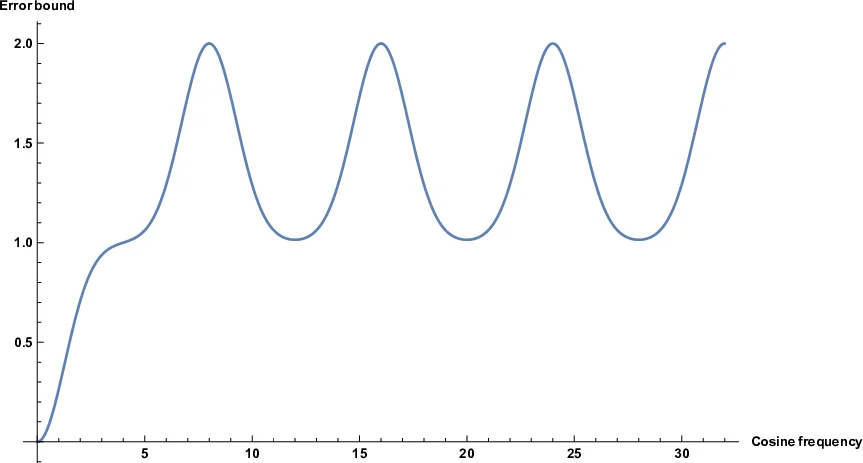
The convergence analysis strategically divides the behavior based on the relationship between the cosine frequency m and the sampling rate at a given level. Three regimes are identified: (i) where the frequency is less than half the sampling rate (the error reduction zone), (ii) a transition zone, and (iii) where the frequency exceeds the sampling rate (the error oscillation zone). The most significant analysis is devoted to regime (i). Here, the multilevel error is decomposed into two components: a truncation term consisting of a low-degree trigonometric polynomial whose coefficients decay rapidly, and a remainder term that starts extremely small (on the order of machine epsilon for single precision) but grows at a fixed, slow rate with each iteration. By meticulously tracking the size of the coefficients in the truncation term, the authors derive theoretical upper bounds that closely match numerical observations. Although the remainder term’s growth is a theoretical concern, its growth rate is so slow compared to the decay of the truncation term that it does not impact numerical convergence within a practical number of iterations (e.g., over 60 levels would be needed for it to become significant).
The paper also outlines the algorithm’s behavior for the general case, starting from a unit sampling rate, tracing its performance from early levels where the sampling rate is low relative to the frequency to later levels where the sampling rate overtakes the frequency, allowing the application of the favorable convergence results from regime (i). A concrete example following c_7 is used to illustrate the process.
In summary, this work provides one of the first rigorous convergence frameworks for a multilevel scheme using infinitely smooth, global kernels like the Gaussian. It demonstrates that by replacing interpolation with quasi-interpolation and employing a multilevel strategy that adaptively samples the residual, one can achieve convergence rates faster than any polynomial for band-limited periodic functions, while mitigating the ill-conditioning and non-locality issues inherent in standard Gaussian interpolation. The numerical experiments confirm the theoretical findings, showing excellent convergence rates.
Comments & Academic Discussion
Loading comments...
Leave a Comment