A symmetric formula of transformed elasticity tensor in PML domain for elastic wave problem
The perfectly matched layer is very important for the elastic wave problem in the frequency domain. Generally, the formulas of the elasticity tensor in the perfectly matched layers are derived from th
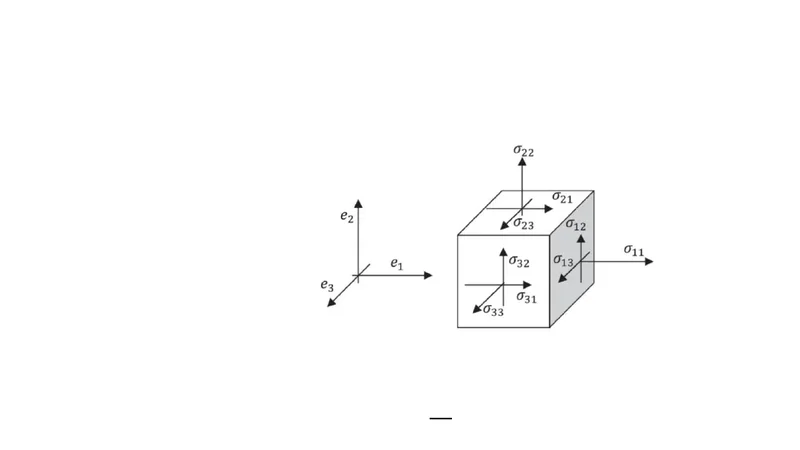
The perfectly matched layer is very important for the elastic wave problem in the frequency domain. Generally, the formulas of the elasticity tensor in the perfectly matched layers are derived from the transformed momentum equation. In this note, we proved that the transformed elasticity tensor derived in this way lost its symmetry. Therefore, these formulas are inconsistency in theory and it’s hard to explain its numerical performance. We present a new symmetrical formula of elasticity tensor from the weak form. So the theory of elasticity is still applicable in the perfectly matched layers.
💡 Research Summary
The paper revisits the theoretical foundation of perfectly matched layers (PML) for elastic‑wave simulations in the frequency domain. Conventional PML formulations for elastodynamics are derived by applying a complex coordinate stretching to the strong form of the momentum equation. This procedure yields a transformed elasticity tensor of the form
(C’{ijkl}=A{im}A_{jn}C_{mnop}A^{-1}{ok}A^{-1}{pl}),
where (A) is the Jacobian of the stretching. The authors demonstrate that, in general, this tensor does not satisfy the major symmetry (C’{ijkl}=C’{klij}) required by classical elasticity. The loss of symmetry implies that the transformed medium is no longer a true elastic material: energy conservation and the reciprocal nature of stress–strain relations are violated, and the resulting finite‑element stiffness matrix becomes non‑symmetric and potentially indefinite. Such properties can degrade numerical stability, increase the condition number, and slow down iterative solvers, even though the PML still absorbs waves effectively.
To resolve this inconsistency, the authors adopt a weak‑form (variational) perspective. Starting from the original weak statement of elastodynamics, they map both the trial (displacement) and test functions through the complex coordinate transformation and introduce the Jacobian determinant as a weighting factor to preserve the integral’s physical meaning. This leads to a new transformed elasticity tensor:
\
📜 Original Paper Content
🚀 Synchronizing high-quality layout from 1TB storage...