Lower bounds for the maximum number of runners that cause loneliness, and its application to Isolation
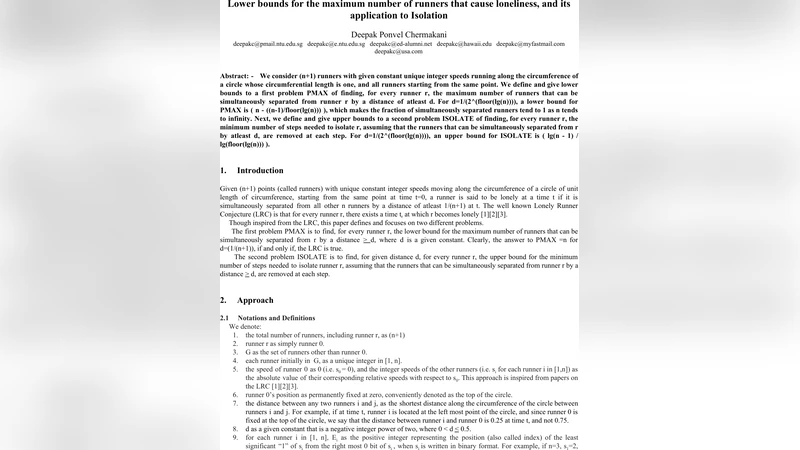
We consider (n+1) runners with given constant unique integer speeds running along the circumference of a circle whose circumferential length is one, and all runners starting from the same point. We define and give lower bounds to a first problem PMAX of finding, for every runner r, the maximum number of runners that can be simultaneously separated from runner r by a distance of atleast d. For d=1/(2^(floor(lg(n)))), a lower bound for PMAX is ( n - ((n-1)/floor(lg(n))) ), which makes the fraction of simultaneously separated runners tend to 1 as n tends to infinity. Next, we define and give upper bounds to a second problem ISOLATE of finding, for every runner r, the minimum number of steps needed to isolate r, assuming that the runners that can be simultaneously separated from r by atleast d, are removed at each step. For d=1/(2^(floor(lg(n)))), an upper bound for ISOLATE is ( lg(n - 1)/lg(floor(lg(n))) ).
💡 Research Summary
The paper investigates a deterministic “runner isolation” model on a unit‑length circle. There are (n+1) runners, each assigned a distinct integer speed, all starting from the same point at time zero. The authors introduce two optimization problems.
- PMAX (Maximum Simultaneous Separation) – For a given runner (r), determine the largest possible number of other runners that can be simultaneously at a circular distance of at least (d) from (r).
- ISOLATE (Minimum Isolation Steps) – Assuming that at each discrete step we remove all runners that satisfy the PMAX condition for (r), find the smallest number of steps required to leave (r) alone on the circle.
The analysis focuses on the specific distance
\
Comments & Academic Discussion
Loading comments...
Leave a Comment