Non-Intrusive Parametric Model Order Reduction With Error Correction Modeling for Changing Well Locations Using a Machine Learning Framework
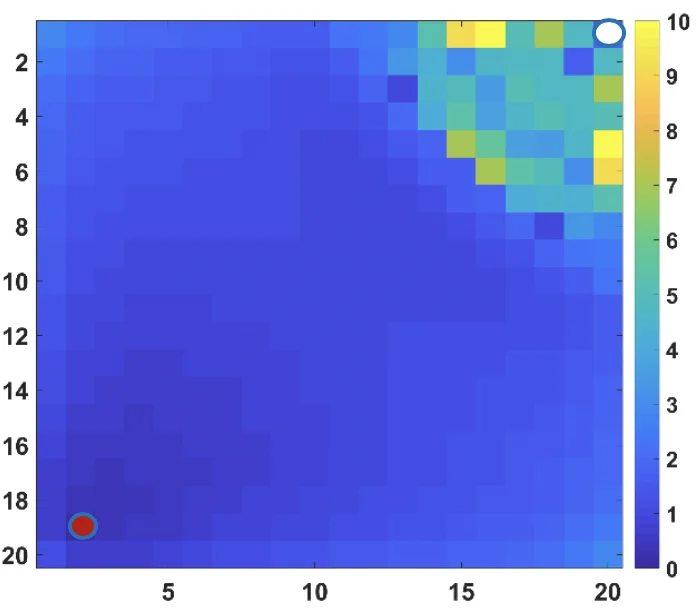
The objective of this paper is to develop a global non-intrusive Parametric Model Order Reduction (PMOR) methodology for the problem of changing well locations in an oil field, that can eventually be used for well placement optimization to gain significant computational savings. In this work, we propose a proper orthogonal decomposition (POD) based PMOR strategy that is non-intrusive to the simulator source code and hence extends its applicability to any commercial simulator. The non-intrusiveness of the proposed technique stems from formulating a novel Machine Learning (ML) based framework used with POD. The features of ML model are designed such that they take into consideration the temporal evolution of the state solutions and thereby avoiding simulator access for time dependency of the solutions. We represent well location changes as a parameter by introducing geometry-based features and flow diagnostics inspired physics-based features. An error correction model based on reduced model solutions is formulated later to correct for discrepancies in the state solutions at well gridblocks. It was observed that the global PMOR could predict the overall trend in pressure and saturation solutions at the well blocks but some bias was observed that resulted in discrepancies in prediction of quantities of interest (QoI). Thus, the error correction model that considers the physics based reduced model solutions as features, proved to reduce the error in QoI significantly. This workflow is applied to a heterogeneous channelized reservoir that showed good solution accuracies and speed-ups of 50x-100x were observed for different cases considered. The method is formulated such that all the simulation time steps are independent and hence can make use of parallel resources very efficiently and also avoid stability issues that can result from error accumulation over timesteps.
💡 Research Summary
The paper presents a fully non‑intrusive parametric model order reduction (PMOR) framework tailored for the challenging problem of changing well locations in reservoir simulations. Traditional reduced‑order models (ROMs) have focused on well‑control optimization with fixed well configurations and rely on intrusive projection techniques that still require costly Jacobian and residual evaluations. In contrast, the authors develop a global ROM that can handle any well placement without modifying the underlying commercial simulator code.
The methodology proceeds in three stages. First, high‑fidelity pressure and saturation snapshots are collected for a set of training well locations, and proper orthogonal decomposition (POD) is applied to extract a reduced‑order basis (ROB) that captures the dominant dynamics of the full model. This basis is shared across all possible well positions, eliminating the need for a separate basis for each configuration.
Second, a non‑intrusive machine‑learning surrogate replaces the traditional intrusive projection. The authors design feature vectors that encode (i) temporal information (time‑step index), (ii) geometric information describing the well location (coordinates, grid indices), and (iii) flow‑diagnostic quantities such as local permeability, pressure gradients, and well‑rate ratios. Using these features, a Random Forest regressor predicts the POD coefficients for each time step, effectively reconstructing the reduced‑order state without any access to the simulator’s internal matrices. Because each time step is treated independently, the approach is naturally parallelizable and avoids error accumulation over time.
Third, the authors observe that while the global PMOR reproduces the overall pressure and saturation trends, it introduces a systematic bias in quantities of interest (QoI) such as oil production rates and water cut at the well blocks. To correct this, they train an artificial neural network (ANN) error‑correction model that takes the physics‑based reduced‑order solutions and the same geometric/flow features as inputs and learns the residual between the ROM predictions and the high‑fidelity reference. Applying this correction dramatically reduces QoI errors.
The framework is validated on two test cases. A homogeneous reservoir demonstrates that the ROM predicts pressure and saturation with average relative errors below 0.5 % and that the ANN correction brings production‑rate errors down to under 5 %. A heterogeneous, channelized SPE10 section (high permeability contrast) shows similar trends: the raw ROM yields pressure/saturation errors around 1.2 %, while the corrected model halves these errors. Computationally, the non‑intrusive ROM eliminates the need to assemble or solve large Jacobian systems; inference with the Random Forest and ANN is orders of magnitude cheaper. The authors report speed‑ups of 50–100× compared with a conventional fully implicit Newton‑Krylov solver on a single node, and the method scales efficiently across multiple cores because each time step can be processed in parallel.
Key contributions include: (1) a global, non‑intrusive POD‑based ROM that works for arbitrary well locations; (2) a feature engineering strategy that embeds temporal, geometric, and flow‑diagnostic information, enabling the surrogate to capture the underlying physics without direct simulator access; (3) an ANN‑based error‑correction layer that restores high‑fidelity QoI accuracy; and (4) demonstration of substantial computational savings on both homogeneous and highly heterogeneous reservoirs.
The paper also discusses limitations. Training data still require a set of high‑fidelity simulations, so the upfront cost is non‑trivial. The surrogate’s accuracy depends on sufficient coverage of the well‑location parameter space; extrapolation beyond the sampled region may degrade performance. Moreover, the current study focuses on two‑phase oil‑water flow; extending to multi‑phase, compositional, or thermal processes will require additional development. Nonetheless, the presented approach offers a practical pathway to integrate ROMs into closed‑loop reservoir management (CLRM) and closed‑loop field development (CLFD) workflows, where repeated, rapid simulations of many well configurations are essential. Future work is suggested on active learning for efficient sampling, incorporation of more complex physics, and robust uncertainty quantification within the non‑intrusive PMOR framework.
Comments & Academic Discussion
Loading comments...
Leave a Comment