Two Decades of Network Science as seen through the co-authorship network of network scientists
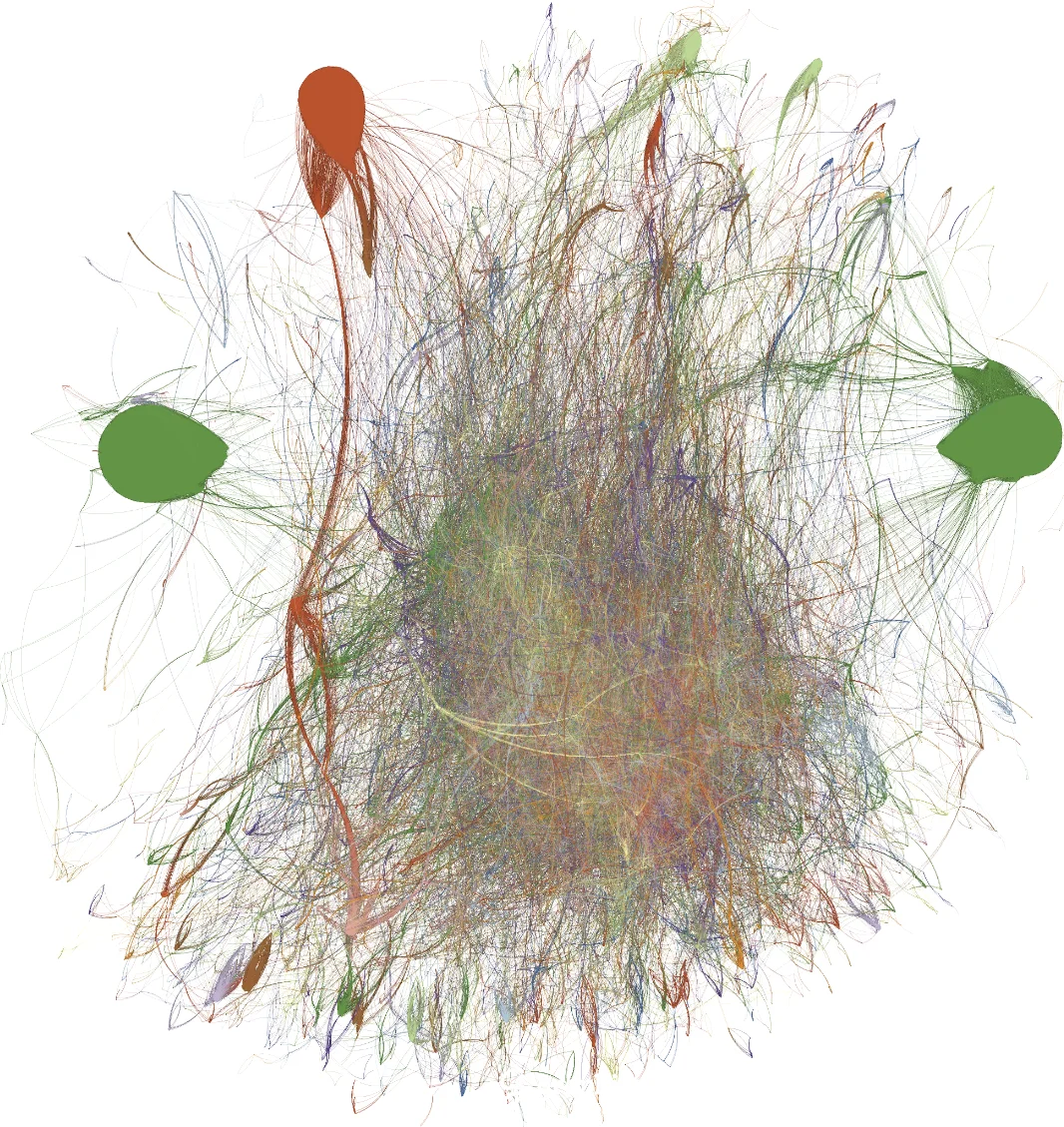
Complex networks have attracted a great deal of research interest in the last two decades since Watts & Strogatz, Barab'asi & Albert and Girvan & Newman published their highly-cited seminal papers on small-world networks, on scale-free networks and on the community structure of complex networks, respectively. These fundamental papers initiated a new era of research establishing an interdisciplinary field called network science. Due to the multidisciplinary nature of the field, a diverse but not divided network science community has emerged in the past 20 years. This paper honors the contributions of network science by exploring the evolution of this community as seen through the growing co-authorship network of network scientists (here the notion refers to a scholar with at least one paper citing at least one of the three aforementioned milestone papers). After investigating various characteristics of 29,528 network science papers, we construct the co-authorship network of 52,406 network scientists and we analyze its topology and dynamics. We shed light on the collaboration patterns of the last 20 years of network science by investigating numerous structural properties of the co-authorship network and by using enhanced data visualization techniques. We also identify the most central authors, the largest communities, investigate the spatiotemporal changes, and compare the properties of the network to scientometric indicators.
💡 Research Summary
The paper presents a comprehensive scientometric study of the evolution of the network science community over the past two decades. Using the three seminal works—Watts & Strogatz (1998) on small‑world networks, Barabási & Albert (1999) on scale‑free networks, and Girvan & Newman (2002) on community detection—as anchors, the authors define a “network‑science paper” as any article that cites at least one of these three references. From the Web of Science database they retrieve 38,321 citing records, clean and deduplicate them, and end up with 29,528 unique papers published between 1998 and 2019. Every author of at least one such paper is labeled a “network scientist,” yielding a set of 52,406 scholars.
A co‑authorship network is built where two scientists are linked if they have co‑authored at least one network‑science paper. The resulting graph is simple, undirected, and unweighted, comprising 52,406 nodes and 329,181 edges. The average degree is 12.56, but the median degree is only 4, indicating a long‑tailed degree distribution with many low‑degree researchers and a few highly connected hubs. The largest connected component (LCC) contains 32,904 nodes (≈63 % of all scholars). Degree distribution analysis shows a heavy tail; the maximum degree observed is 444 (Paul M. Thompson). The network exhibits strong assortative mixing (r = 0.57), an exceptionally high global clustering coefficient (0.98) and a high average local clustering (0.77), and the average shortest‑path length in the LCC is 6.8, confirming the small‑world nature typical of scientific collaboration networks.
Centrality measures (betweenness and harmonic centrality) identify the most structurally important researchers. The top ten include Jürgen Kurths, Eugene Stanley, Guanrong Chen, Albert‑László Barabási, Y. He, T. Zhou, W. Wang, Shlomo Havlin, Z. Wang, and Edward T. Bullmore. Barabási stands out with 69,738 citations, far exceeding any other author, and his high betweenness reflects a bridging role across sub‑communities. A scatter plot of citations versus betweenness (colored by harmonic centrality) reveals a strong positive correlation, suggesting that scholars who are central in the collaboration network also tend to be highly cited.
The authors also explore disciplinary and temporal shifts. In the first decade (1998‑2009) network‑science papers are dominated by physics journals (Physical Review E, Physica A) and topics such as “scale‑free,” “small‑world,” and “preferential attachment.” In the second decade (2010‑2019) computer science, biology, neuroscience, and social science journals gain prominence, and keywords move toward “community detection,” “social network analysis,” “big data,” “machine learning,” and “link prediction.” Geographic analysis based on the first author’s affiliation shows the United States and China as the leading producers, with China’s output accelerating sharply after 2015.
Methodologically, the study addresses author name disambiguation by constructing a dictionary of known variants; while acknowledging the limitation of not distinguishing homonyms (especially among Asian names), the authors argue that the impact on global network metrics is minimal, consistent with prior work (e.g., Newman, Barabási et al.).
Compared with earlier, smaller‑scale analyses (e.g., Newman’s 1,589‑author network), this work expands the scope by a factor of >30 and covers a longer time horizon, providing a more robust picture of the field’s structural dynamics. The findings highlight that network science has become a highly interdisciplinary arena, with strong collaborative ties, a small‑world topology, and a clear trend toward data‑driven and application‑oriented research.
In conclusion, the paper demonstrates that over the past twenty years network science has evolved from a physics‑centric discipline to a broad, multi‑disciplinary field, maintaining dense collaborative structures and producing influential scholarship. The quantitative insights into community formation, central actors, and temporal‑geographic trends offer valuable guidance for funding agencies, institutional planners, and researchers aiming to navigate or shape the future of network science.
Comments & Academic Discussion
Loading comments...
Leave a Comment