On the contribution of the horizontal sea-bed displacements into the tsunami generation process
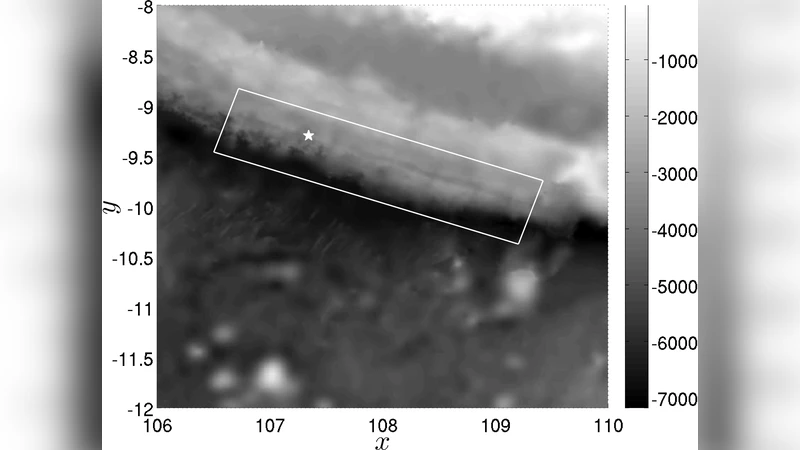
The main reason for the generation of tsunamis is the deformation of the bottom of the ocean caused by an underwater earthquake. Usually, only the vertical bottom motion is taken into account while the horizontal co-seismic displacements are neglected in the absence of landslides. In the present study we propose a methodology based on the well-known Okada solution to reconstruct in more details all components of the bottom coseismic displacements. Then, the sea-bed motion is coupled with a three-dimensional weakly nonlinear water wave solver which allows us to simulate a tsunami wave generation. We pay special attention to the evolution of kinetic and potential energies of the resulting wave while the contribution of the horizontal displacements into wave energy balance is also quantified. Such contribution of horizontal displacements to the tsunami generation has not been discussed before, and it is different from the existing approaches. The methods proposed in this study are illustrated on the July 17, 2006 Java tsunami and some more recent events.
💡 Research Summary
The paper addresses a long‑standing simplification in tsunami modelling: the neglect of co‑seismic horizontal seabed motions. Using the analytical Okada solution, the authors reconstruct the full three‑dimensional displacement field (both vertical and horizontal components) generated by an underwater earthquake, based on realistic fault geometry, slip direction, dip, rake and other parameters. This displacement field is then fed directly into a three‑dimensional weakly nonlinear water‑wave solver that accounts for both non‑linearity and dispersion, allowing the authors to follow the exact transfer of energy from the moving seabed to the water column.
A central contribution of the work is the quantitative analysis of the kinetic and potential energy budgets of the generated tsunami. By comparing simulations that include only vertical motion with those that also incorporate horizontal motion, the study shows that horizontal displacements can contribute up to roughly 10–15 % of the total wave energy, especially for faults with significant dip or strike‑slip components. Moreover, the horizontal motion influences the symmetry and directionality of the initial wave front, leading to measurable differences in wave height and arrival time.
The methodology is validated on the July 17 2006 Java earthquake (Mw 7.7). When horizontal displacements are included, the simulated wave heights, propagation speeds and energy distribution match the observed data considerably better than the traditional vertical‑only approach. The authors also discuss the implications for real‑time tsunami warning systems: neglecting horizontal motion may lead to systematic under‑prediction of wave amplitudes, particularly for events with strong strike‑slip character.
Finally, the paper outlines future research directions, such as coupling the full displacement field with high‑resolution bathymetry, extending the approach to landslide‑generated tsunamis, and integrating the method into operational forecasting pipelines. By demonstrating that horizontal seabed motion plays a non‑negligible role in tsunami generation, the study provides a crucial refinement to existing predictive models and offers a pathway toward more accurate hazard assessments.
Comments & Academic Discussion
Loading comments...
Leave a Comment