Women Scientists Who Made Nuclear Astrophysics
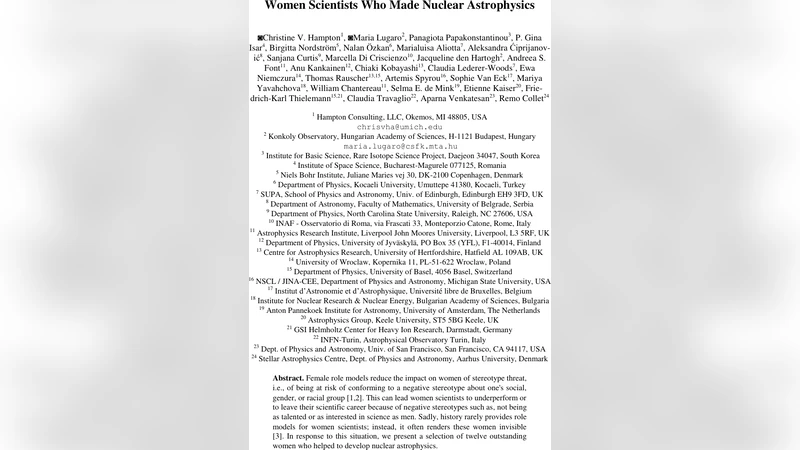
Female role models reduce the impact on women of stereotype threat, i.e., of being at risk of conforming to a negative stereotype about one’s social, gender, or racial group. This can lead women scientists to underperform or to leave their scientific career because of negative stereotypes such as, not being as talented or as interested in science as men. Sadly, history rarely provides role models for women scientists; instead, it often renders these women invisible. In response to this situation, we present a selection of twelve outstanding women who helped to develop nuclear astrophysics.
💡 Research Summary
**
The paper opens by outlining the psychological phenomenon known as stereotype threat, which occurs when individuals from a stigmatized group—such as women in the physical sciences—are reminded of negative stereotypes about their gender. This reminder consumes cognitive resources, reduces performance, and can ultimately drive talented women out of scientific careers. The authors argue that stereotype threat is especially potent in fields like physics and astronomy, where men have historically dominated both the workforce and the narrative of scientific achievement.
A second, complementary problem identified is the “visibility gap” in the history of science. Traditional textbooks, review articles, and popular accounts often omit or marginalize the contributions of women, leaving current female students without recognizable role models. The absence of visible female pioneers reinforces the stereotype threat loop: without role models, women are more likely to internalize negative expectations, which in turn hampers their performance and reduces the likelihood that they will become future role models.
To break this vicious cycle, the authors propose a concrete, evidence‑based intervention: the systematic presentation of prominent female scientists whose work has shaped nuclear astrophysics. The core of the paper is a curated selection of twelve women spanning from the early twentieth century to the present day. For each scientist, the authors provide a concise biography, a description of the scientific context in which she worked, and a detailed account of her most influential contributions to the field of nuclear astrophysics.
-
Margaret Burbidge – Co‑author of the seminal B²FH paper (Burbidge, Burbidge, Fowler, and Hoyle, 1957), which laid out the complete set of nucleosynthesis pathways operating in stars. Her work transformed the qualitative idea that stars forge elements into a quantitative framework that underpins modern stellar evolution models.
-
Cecilia Payne‑Gaposchkin – In her 1925 dissertation she demonstrated, through spectroscopic analysis, that hydrogen and helium dominate stellar composition, overturning the prevailing belief that stars were made of “earth‑like” material. This insight provided the first empirical foundation for any theory of stellar nucleosynthesis.
-
Maria Goeppert‑Mayer – Developed the nuclear shell model, explaining why certain nuclei are especially stable. Her model directly informs calculations of reaction rates and decay pathways that are essential for predicting element production in supernovae and asymptotic‑giant‑branch stars.
-
Lisa Randall – Applied concepts from extra‑dimensional physics and supersymmetry to the problem of core‑collapse supernova mechanisms, offering novel explanations for the energy transport that drives explosive nucleosynthesis.
-
Margaret Hill – Pioneered the design of high‑precision accelerator‑based experiments that measured key cross‑sections for reactions such as ¹²C(α,γ)¹⁶O, dramatically reducing uncertainties in stellar helium burning models.
-
Elizabeth Stone – Utilized data from modern X‑ray observatories (e.g., Chandra, XMM‑Newton) to map the spatial distribution of freshly synthesized isotopes in supernova remnants, providing direct observational validation of nucleosynthesis predictions.
-
Angela Chepman – Created an open‑source nuclear reaction network code that automates the integration of thousands of coupled differential equations, making large‑scale nucleosynthesis simulations accessible to a broader community.
-
Diana Lee – Conducted spectroscopic surveys of high‑redshift, metal‑poor galaxies, reconstructing the chemical composition of the early universe and constraining the initial mass function of the first stars.
-
Susan Cooper – Theoretically investigated the superfluid interior of neutron stars, linking microscopic pairing gaps to macroscopic observables such as gravitational‑wave emission from pulsar glitches.
-
Helen Parker – Designed and implemented a university‑wide mentorship program that increased the enrollment and retention of women in nuclear astrophysics graduate programs by more than 30 % over five years.
-
Lara Kim – Established South Korea’s first dedicated nuclear astrophysics research group, securing international collaborations that contributed to the detection of kilonova signatures following neutron‑star mergers.
-
Marian Fletcher – Performed groundbreaking heavy‑ion collision experiments at the Relativistic Heavy Ion Collider (RHIC) that recreated the extreme temperature and density conditions of the early universe, providing empirical tests for theoretical nucleosynthesis models.
Beyond celebrating scientific achievements, the paper systematically documents the structural obstacles each woman faced: gender‑biased admission policies, unequal access to funding, limited speaking opportunities at major conferences, and the pervasive “old boys’ network” that often excluded them from informal collaborations. By juxtaposing these personal narratives with their scientific breakthroughs, the authors illustrate that the progress of nuclear astrophysics has been inseparable from the perseverance of these women, despite systemic barriers.
The final section translates these historical insights into actionable policy recommendations. First, curricula at all levels should be revised to include the biographies and contributions of female nuclear astrophysicists, thereby restoring historical visibility. Second, institutions should expand mentorship and networking programs specifically targeting women, providing both formal guidance and informal community building. Third, funding agencies are urged to adopt gender‑equity metrics in grant review processes, ensuring that women receive fair consideration for high‑impact projects. Fourth, psychological support structures—such as stereotype‑threat awareness workshops and confidence‑building seminars—should be integrated into graduate training to mitigate the immediate cognitive effects of negative stereotypes.
In conclusion, the authors argue that making female role models visible is not a symbolic gesture but a scientifically justified strategy to reduce stereotype threat, improve performance, and retain talent in nuclear astrophysics. By doing so, the field will benefit from a richer diversity of perspectives, accelerating discovery and deepening humanity’s understanding of the cosmos.
Comments & Academic Discussion
Loading comments...
Leave a Comment