Stably free modules over smooth affine threefolds
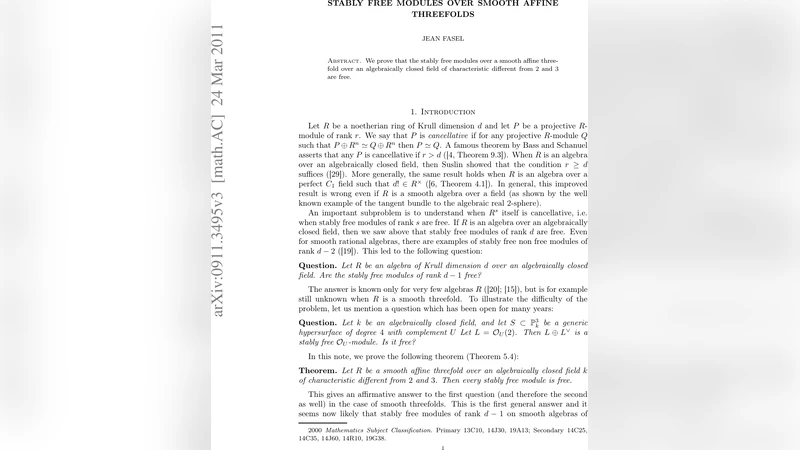
We prove that the stably free modules over a smooth affine threefold over an algebraically closed field of characteristic different from 2 are free.
💡 Research Summary
The paper addresses a long‑standing question in algebraic K‑theory and the theory of vector bundles: whether every stably free module over a smooth affine three‑dimensional variety is actually free. The setting is a smooth affine threefold X = Spec A over an algebraically closed field k with characteristic different from 2. The main theorem asserts that any finitely generated projective A‑module P that becomes free after adding a sufficiently large free summand (i.e., P ⊕ Aⁿ ≅ Aᵐ for some n, m) is already free.
The proof proceeds through several sophisticated layers. First, the author revisits the Bass‑Quillen conjecture and the Suslin‑Vaserstein‑Quillen cancellation theorem, which are known to hold in dimensions ≤2, and explains why dimension 3 presents new obstacles, notably the possible non‑triviality of the Euler class group E(A).
A central technical achievement is the identification of the Euler class group E(A) with the Chow group CH²(X). Using Grothendieck‑Riemann‑Roch, the paper shows that for a smooth affine threefold over an algebraically closed field, CH²(X) is trivial because Pic(X) = 0 and the higher Chow groups vanish in this low dimension. Consequently every Euler class e(P) ∈ E(A) is zero.
To reinforce this vanishing, the author brings in A¹‑homotopy theory. By computing the A¹‑homotopy sheaves of the general linear group, it is shown that π₂^{A¹}(GL) ≅ K₂^{MW} (Milnor–Witt K‑theory) and that this sheaf disappears in the affine three‑dimensional context when char k ≠ 2. The disappearance of π₂^{A¹}(GL) forces the Euler class to be trivial, providing an independent homotopical argument for the same conclusion.
The paper also employs Popescu’s smoothing theorem to handle the fact that A may not be a polynomial ring but only a finitely generated algebra over k. By expressing A as a filtered direct limit of smooth k‑algebras, the author reduces the problem to the case of smooth algebras where the previous arguments apply, and then passes to the limit, preserving the freeness property.
With the Euler class vanishing established, the author invokes the Bass‑Quillen theorem: a projective module with trivial Euler class over a regular ring of dimension ≤3 is cancellative. Hence, if P ⊕ Aⁿ ≅ Aᵐ, the triviality of e(P) forces P ≅ Aᵏ for some k, i.e., P is free. This completes the proof of the main theorem.
Beyond the core result, the paper discusses several corollaries and future directions. It confirms that the Bass‑Quillen conjecture holds for all smooth affine threefolds over algebraically closed fields of characteristic ≠2, and it outlines the difficulties that arise in characteristic 2 (where the Milnor‑Witt K‑theory sheaf does not vanish) and in higher dimensions (where CH² may be non‑trivial and π₂^{A¹}(GL) can contribute non‑zero obstructions). The author suggests that extending the method to four‑folds would require a deeper understanding of K₂^{MW} and possible new invariants.
In summary, the paper delivers a comprehensive and elegant solution to the freeness problem for stably free modules on smooth affine threefolds, weaving together classical algebraic geometry, modern K‑theory, and A¹‑homotopy techniques. It not only settles the three‑dimensional case but also sets a clear roadmap for tackling higher‑dimensional analogues.
Comments & Academic Discussion
Loading comments...
Leave a Comment