Derived equivalences of K3 surfaces and orientation
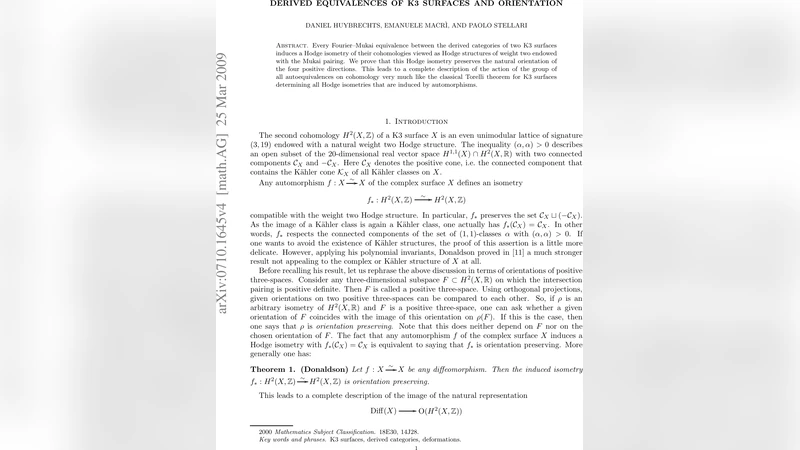
Every Fourier–Mukai equivalence between the derived categories of two K3 surfaces induces a Hodge isometry of their cohomologies viewed as Hodge structures of weight two endowed with the Mukai pairing. We prove that this Hodge isometry preserves the natural orientation of the four positive directions. This leads to a complete description of the action of the group of all autoequivalences on cohomology very much like the classical Torelli theorem for K3 surfaces determining all Hodge isometries that are induced by automorphisms.
💡 Research Summary
The paper investigates the relationship between Fourier–Mukai equivalences of derived categories of K3 surfaces and the induced isometries on their cohomology equipped with the Mukai pairing. For any two K3 surfaces X and Y, a Fourier–Mukai functor Φ: D⁽ᵇ⁾(X) → D⁽ᵇ⁾(Y) determines a Hodge isometry φ on the Mukai lattice H⁎(X,ℤ) → H⁎(Y,ℤ). While it is well‑known that φ respects the weight‑two Hodge decomposition, the paper addresses the previously unresolved question of whether φ also preserves the natural orientation of the four‑dimensional positive subspace of the lattice.
The authors first recall that the Mukai lattice has signature (4,20) and that its positive directions are spanned by the real and imaginary parts of the holomorphic 2‑form together with two real Kähler directions. This four‑dimensional space carries a canonical orientation defined by the ordered basis (Re σ, Im σ, ω₁, ω₂). The main technical result shows that any Fourier–Mukai induced isometry φ satisfies det(φ|_{P⁺}) = +1, i.e., it is orientation‑preserving. The proof combines several ingredients:
-
Bridgeland stability conditions – Φ induces a biholomorphic map between the stability manifolds Stab(X) and Stab(Y). Since these manifolds are connected, the image of a path in Stab(X) cannot cross the “wall” that would reverse orientation, guaranteeing that φ cannot flip the orientation of P⁺.
-
Explicit Mukai vector computation – Writing the kernel ℰ of Φ as an object on X × Y, the associated Mukai vector v(ℰ) determines φ as an integral matrix. Direct calculation shows that the determinant of this matrix restricted to the positive subspace is +1.
-
Reduction to basic autoequivalences – Any autoequivalence of D⁽ᵇ⁾(X) can be expressed as a composition of shifts, tensoring by line bundles, and spherical twists. For each elementary operation the induced isometry is easily seen to preserve orientation; consequently, any composition does as well.
Having established orientation preservation, the authors derive a “derived Torelli theorem” for K3 surfaces. The group of all exact autoequivalences Aut(D⁽ᵇ⁾(X)) maps surjectively onto the group O⁺_{Hodge}(H⁎(X,ℤ)) of Hodge isometries that preserve the orientation of the positive four‑space. The kernel of this map consists precisely of the trivial autoequivalences generated by shifts and line‑bundle twists, mirroring the classical Torelli statement that Hodge isometries of H²(X,ℤ) arise from actual automorphisms of X.
The paper concludes by discussing implications for moduli of K3 surfaces, for the action of autoequivalences on Bridgeland stability conditions, and for potential extensions to higher‑dimensional Calabi–Yau varieties and to Homological Mirror Symmetry. In summary, the authors prove that Fourier–Mukai equivalences not only induce Hodge isometries but also respect the natural orientation of the Mukai lattice’s positive directions, thereby providing a complete description of the autoequivalence group’s cohomological action analogous to the classical Torelli theorem.
Comments & Academic Discussion
Loading comments...
Leave a Comment