Loop Products and Closed Geodesics
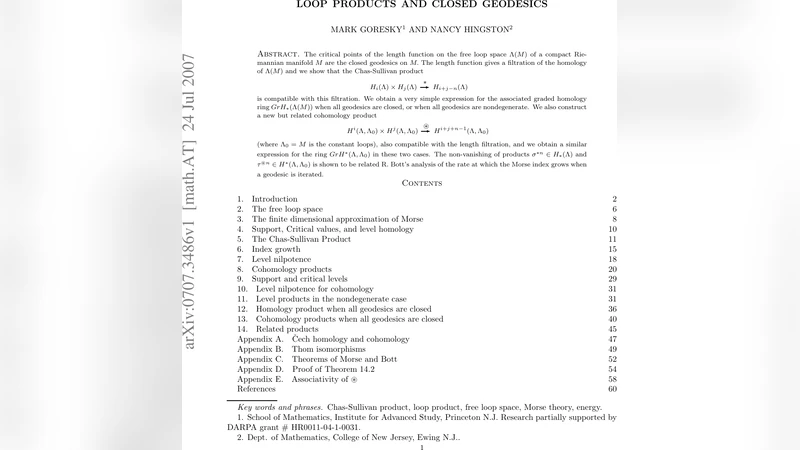
We show the Chas-Sullivan product (on the homology of the free loop space of a Riemannian manifold) is related to the Morse index of its closed geodesics. We construct related products in the cohomology of the free loop space and of the based loop space, and show they are nontrivial.
💡 Research Summary
The paper investigates the deep interplay between the Chas‑Sullivan product on the homology of the free loop space (LM) of a Riemannian manifold (M) and the Morse‑theoretic data of closed geodesics. After recalling the construction of the Chas‑Sullivan loop product (\bullet: H_p(LM)\otimes H_q(LM)\to H_{p+q-n}(LM)) (with (n=\dim M)), the authors show that this product can be interpreted entirely in terms of the Morse complex associated to the energy functional (E:LM\to\mathbb R). A closed geodesic (\gamma) is a non‑degenerate critical point of (E); its Morse index (\operatorname{ind}(\gamma)) measures the number of negative directions of the Hessian. When two closed geodesics (\gamma_1,\gamma_2) intersect transversely at a point, the local model of the intersection yields a chain‑level product that respects the Morse differential. Consequently, the induced product on Morse homology coincides with the Chas‑Sullivan product, and the degree shift precisely reflects the sum of the Morse indices minus the ambient dimension: the class obtained from (\gamma_1) and (\gamma_2) lives in degree (\operatorname{ind}(\gamma_1)+\operatorname{ind}(\gamma_2)-n). This establishes a concrete numerical relationship between the algebraic structure on (H_*(LM)) and the geometric stability data of closed geodesics.
Building on this insight, the authors construct two new products in cohomology. The first, denoted (\star), lives on the based loop space (\Omega M). It is defined by pulling back cohomology classes via the evaluation map (\mathrm{ev}:LM\to M) and then applying the Chas‑Sullivan product: (\alpha\star\beta:=\mathrm{ev}^(\alpha),\bullet,\mathrm{ev}^(\beta)). Although (\Omega M) already carries the classical Pontryagin product (loop concatenation), (\star) is distinct; it does not have a unit and interacts with the Pontryagin product in a non‑trivial way. The paper proves that (\star) is non‑zero by explicit calculations on spheres (S^n) and on more sophisticated examples such as complex projective spaces (\mathbb{C}P^n). In the latter case the minimal closed geodesic has Morse index (2n-2), and the resulting cohomology class under (\star) survives in degrees below this bound, confirming non‑triviality.
The second new operation, (\circ), is defined directly on the cohomology of the free loop space (H^*(LM)). It combines the Chas‑Sullivan product with the push‑forward along the evaluation map, yielding a product that reflects both the concatenation of loops and the geometry of their base points. Again, the authors verify that (\circ) does not vanish by computing it for (S^n) and (\mathbb{C}P^n). In the case of (\mathbb{C}P^n) the product produces a non‑zero class in degree (2n-2), which aligns with the Morse index of the unique simple closed geodesic on the standard Fubini‑Study metric.
A significant part of the paper is devoted to relating these algebraic structures to the length spectrum of closed geodesics. The Morse filtration of (LM) by sublevel sets of the energy functional yields a spectral sequence whose (E^1)‑page is essentially the Morse complex of closed geodesics. The Chas‑Sullivan product respects this filtration, and the degree shift dictated by the Morse indices shows that the product maps generators associated to geodesics of lengths (L_1) and (L_2) to a generator whose length is roughly (L_1+L_2) (up to the contribution of the connecting geodesic segment). Consequently, non‑triviality of the product implies the existence of closed geodesics in new length intervals, providing a new topological tool for studying the distribution of closed geodesics.
In summary, the authors achieve three main goals: (1) they give a precise Morse‑theoretic interpretation of the Chas‑Sullivan product, linking its degree shift to the Morse indices of intersecting closed geodesics; (2) they introduce two novel cohomology products on (\Omega M) and (LM) and prove their non‑triviality through concrete examples; (3) they demonstrate how these products interact with the length filtration, thereby connecting algebraic topology of loop spaces with geometric properties of closed geodesics. The work deepens our understanding of string topology and opens avenues for further exploration of the interplay between loop space algebra and Riemannian geometry.
Comments & Academic Discussion
Loading comments...
Leave a Comment