Impact of climate change on the cost-optimal mix of decentralised heat pump and gas boiler technologies in Europe
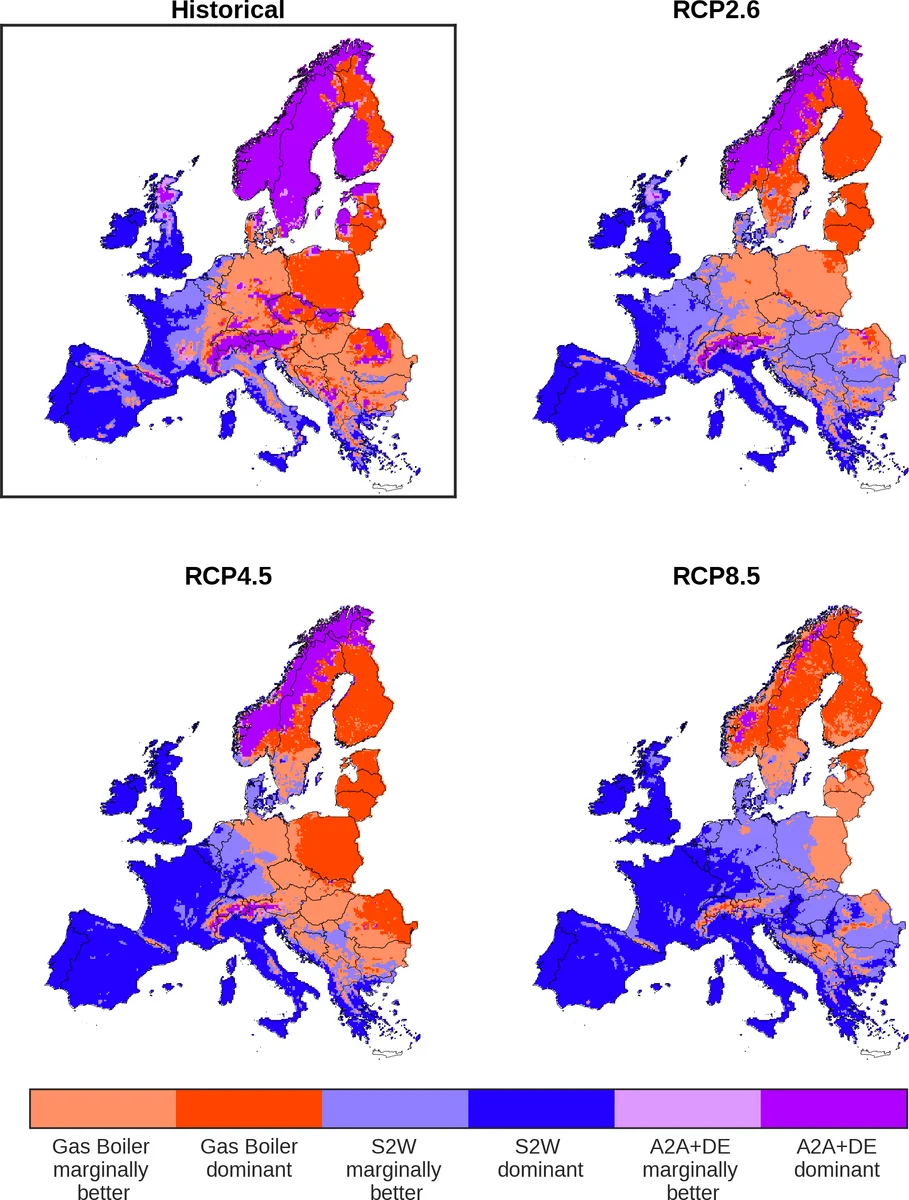
Residential demands for space heating and hot water account for 31% of the total European energy demand. Space heating is highly dependent on ambient conditions and susceptible to climate change. We adopt a techno-economic standpoint and assess the impact of climate change on decentralised heating demand and the cost-optimal mix of heat pump and gas boiler technologies. Temperature data with high spatial resolution from nine climate models implementing three Representative Concentration Pathways from IPCC are used to estimate climate induced changes in the European demand side for heating. The demand side is modelled by the proxy of heating-degree days. The supply side is modelled by using a screening curve approach to the economics of heat generation. We find that space heating demand decreases by about 16%, 24% and 42% in low, intermediate and extreme global warming scenarios. When considering historic weather data, we find a heterogeneous mix of technologies are cost-optimal, depending on the heating load factor (number of full-load hours per year). Increasing ambient temperatures toward the end-century improve the economic performance of heat pumps in all concentration pathways. Cost optimal technologies broadly correspond to heat markets and policies in Europe, with some exceptions
💡 Research Summary
**
This paper investigates how 21st‑century climate change will reshape the demand for residential space heating in Europe and, consequently, the cost‑optimal mix of decentralized heating technologies—specifically air‑source heat pumps (ASHP), ground‑source heat pumps (GSHP), hybrid air‑to‑air heat pumps with electric boilers (A2A+EB), and conventional gas, oil, and biomass boilers.
Data and methodology
The authors use high‑resolution (3 h, 0.11° × 0.11°) temperature outputs from nine climate simulations that combine four regional climate models (RCMs) with five global climate models (GCMs) under three Representative Concentration Pathways (RCP2.6, RCP4.5, RCP8.5). Historical (1970‑1990) and end‑century (2080‑2100) periods are examined. Heating demand is proxied by heating‑degree‑days (HDD), which are converted into a heat load factor (HLF, µ) defined as the ratio of annual total heat demand to the peak heating capacity. µ captures the intensity of use: high µ in cold climates (long running hours) reduces the unit cost of technologies with high fixed costs, while low µ in milder climates favours low‑capital solutions.
On the supply side, a simplified techno‑economic model is built. For each technology the authors include capital expenditures (equipment + installation), annual fixed O&M, and marginal operating costs (fuel or electricity). Heat pump performance is modeled explicitly: COP is calculated for each grid cell and hour based on ambient air or ground temperature and a fixed sink temperature (55 °C for water‑based systems, 30 °C for air‑to‑air). Ground temperature is approximated by a 20‑year moving average of air temperature, representing conditions at roughly 50 m depth. All technologies are assumed to have a standardized installed capacity of 10 kW, which does not affect relative cost rankings.
The total annualized cost for a technology θ in grid cell x is expressed as:
X_TOT(x,θ) = X_CAP(θ) + µ(x)·X_OP(x,θ)
This linear relationship yields “screening curves” that show, for any µ, which technology yields the lowest cost.
Key results
-
Demand reduction – Under the three warming scenarios, total residential space‑heating demand falls by approximately 16 % (RCP2.6), 24 % (RCP4.5), and 42 % (RCP8.5). The decline is strongest in northern and eastern Europe, where winter temperatures rise most; southern Europe experiences a smaller relative change.
-
Shift in optimal technology – In the historical climate, the cost‑optimal mix is heterogeneous: gas boilers dominate in regions with low µ, while heat pumps become competitive where µ is higher. As temperatures rise, COPs of ASHP and GSHP improve, moving the screening curves downward. Consequently, in the high‑warming scenario, heat pumps (especially GSHP) become cost‑optimal across most of the continent, even in areas that previously favoured gas boilers.
-
Policy alignment – The spatial pattern of the model’s optimal technologies broadly mirrors current European heating policies: countries with strong subsidies or carbon taxes already show higher heat‑pump penetration, while those relying on fossil‑fuel boilers correspond to regions where the model still favours gas under low‑warming scenarios. The study highlights a few mismatches where policy incentives could be adjusted to accelerate the transition.
Limitations and future work
The analysis holds the existing technology stock constant, ignoring replacement cycles and the capital required to retire fossil‑fuel equipment. Energy price trajectories (electricity, natural gas, biomass) are assumed static, and building envelope improvements (insulation, airtightness) are not modeled. Infrastructure constraints such as the availability of gas networks or the capacity of distribution grids for large‑scale electric heating are also omitted. The authors suggest that incorporating dynamic technology turnover, price scenarios, and grid constraints would refine policy recommendations.
Implications
The paper provides robust evidence that climate‑driven warming will substantially lower space‑heating demand and simultaneously improve the economics of heat pumps. Policymakers can therefore anticipate a natural shift toward electrified heating, but targeted measures (subsidies, carbon pricing, grid reinforcement) will be needed to overcome regional inertia and ensure that the cost‑optimal pathway aligns with decarbonisation goals.
Comments & Academic Discussion
Loading comments...
Leave a Comment