Characterising optical fibre transmission matrices using metasurface reflector stacks for lensless imaging without distal access
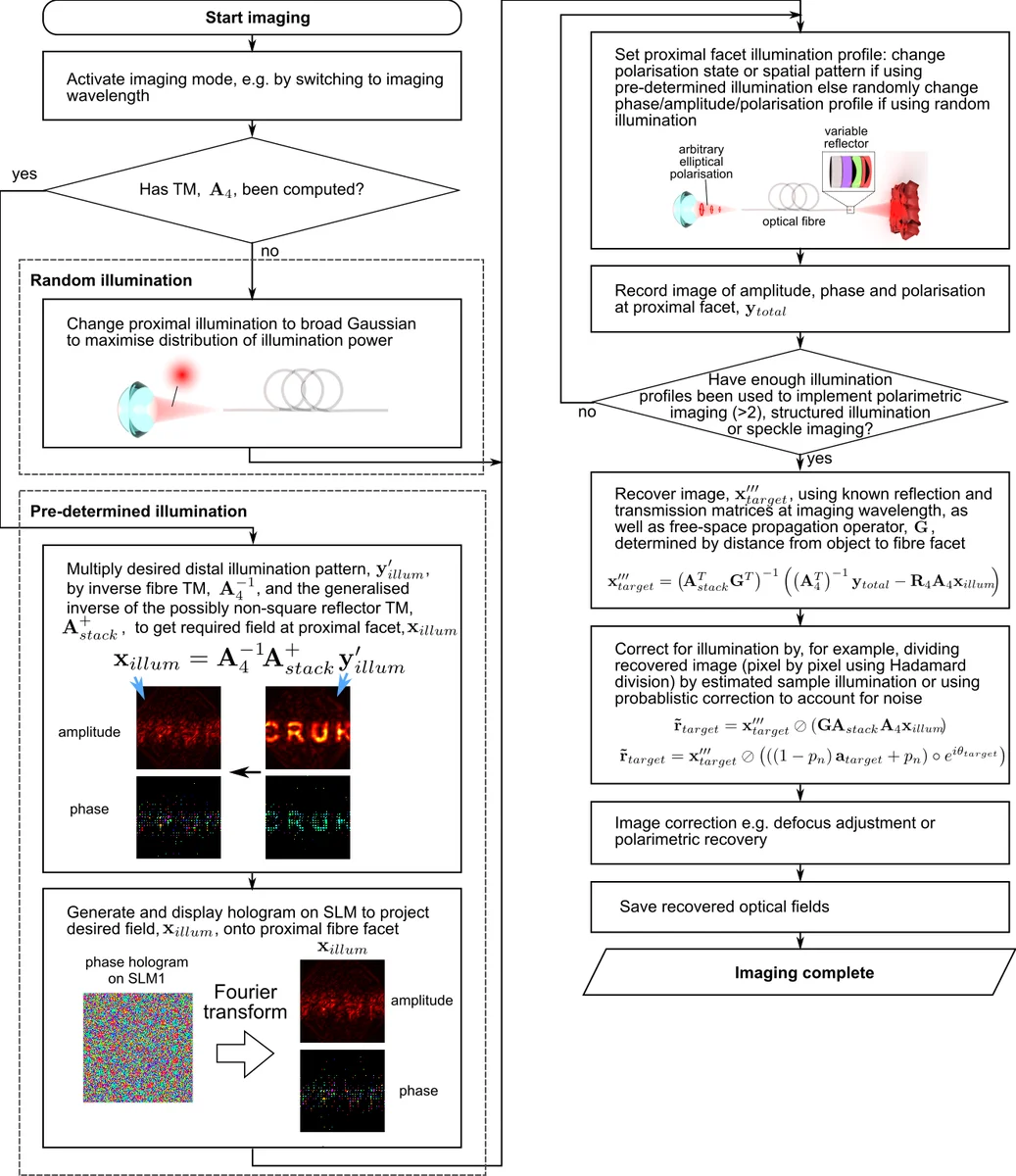
The ability to form images through hair-thin optical fibres promises to open up new applications from biomedical imaging to industrial inspection. Unfortunately, deployment has been limited because small changes in mechanical deformation (e.g. bending) and temperature can completely scramble optical information, distorting images. Since such changes are dynamic, correcting them requires measurement of the fibre transmission matrix (TM) in situ immediately before imaging. TM calibration typically requires access to both the proximal and distal facets of the fibre simultaneously, which is not feasible during most realistic usage scenarios without compromising the thin form factor with bulky distal optics. Here, we introduce a new approach to determine the TM of multi-mode fibre (MMF) or multi-core fibre (MCF) in a reflection-mode configuration without access to the distal facet. A thin stack of structured metasurface reflectors is used at the distal facet to introduce wavelength-dependent, spatially heterogeneous reflectance profiles. We derive a first-order fibre model that compensates these wavelength-dependent changes in the TM and show that, consequently, the reflected data at 3 wavelengths can be used to unambiguously reconstruct the full TM by an iterative optimisation algorithm. We then present a method for sample illumination and imaging following TM reconstruction. Unlike previous approaches, our method does not require the TM to be unitary making it applicable to physically realistic fibre systems. We demonstrate TM reconstruction and imaging first using simulated non-unitary fibres and noisy reflection matrices, then using much larger experimentally-measured TMs of a densely-packed MCF, and finally on an experimentally-measured multi-wavelength set of TMs recorded from a MMF. Our findings pave the way for online transmission matrix calibration in situ in hair-thin optical fibres
💡 Research Summary
The paper addresses a critical bottleneck in lens‑less imaging through ultra‑thin optical fibers—namely, the need to know the fiber’s transmission matrix (TM) at the moment of imaging. Conventional TM calibration requires simultaneous access to both the proximal and distal ends of the fiber, which is impractical for in‑vivo or deep‑tissue applications where the distal facet is buried inside the subject and any additional distal optics would destroy the hair‑thin form factor. The authors propose a reflection‑mode approach that eliminates the need for distal access by attaching a thin stack of engineered metasurface reflectors to the distal facet. Each metasurface layer consists of spatially heterogeneous wire‑grid polarizers combined with long‑pass filters, creating a reflectance profile that varies both across the facet and with wavelength.
The key insight is that by illuminating the fiber at three distinct wavelengths, three different reflection matrices (RMs) are obtained, each corresponding to a different effective reflector matrix R₁, R₂, R₃. The forward TM at each wavelength (A₁, A₂, A₃) satisfies Cₙ = Aₙᵀ Rₙ Aₙ, where Cₙ is the measured RM. If the three reflectors have distinct eigen‑spectra (a design requirement satisfied by the metasurface), the set of equations can be solved uniquely for the unknown TMs, even when the fiber is non‑unitary (i.e., exhibits loss). The authors first present a “zeroth‑order” model that assumes the TM does not change with wavelength (A₁ = A₂ = A₃ = A₄). Under this assumption the solution can be derived analytically, providing a fast initial estimate.
Because real fibers do exhibit wavelength‑dependent phase shifts, the authors develop a “first‑order” model that treats the TM’s wavelength dependence as a linear phase perturbation. Using coupled‑mode theory, the infinitesimal coupling matrix dA is extracted from the logarithm of the TM measured at the first wavelength (dA = log(A₁)/ℓ₁, where ℓ₁ is the propagation length). The TM at the other wavelengths is then approximated by exponentiating this perturbation (A₂ ≈ exp(dA Δℓ) A₁, etc.). An iterative numerical optimisation (e.g., Levenberg‑Marquardt) refines the TM estimates to minimise the discrepancy between the predicted and measured RMs. This approach only requires the TM to be invertible, not unitary, making it applicable to realistic, lossy fibers.
The methodology is validated in three stages. First, simulated 32 × 32 non‑unitary TM data with added Gaussian noise demonstrate robustness to measurement noise. Second, the algorithm is applied to experimentally measured 1648 × 1648 TM data from a densely packed multi‑core fiber (MCF). Using a simulated metasurface stack, three wavelength RMs are generated, the TM is recovered, and a fourth wavelength is used for sample illumination. High‑fidelity images (intensity, phase, and polarisation) are reconstructed, achieving >95 % structural similarity to ground‑truth images. Third, a set of multi‑wavelength TMs from a step‑index multi‑mode fiber (MMF) is measured experimentally; the same reconstruction pipeline yields accurate TM recovery and lens‑less imaging, confirming that the first‑order physical model correctly captures real wavelength‑dependent TM variations.
Overall, the work demonstrates that metasurface‑based distal reflectors combined with multi‑wavelength reflection measurements enable in‑situ, non‑unitary TM calibration without any distal bulk. This opens the door to real‑time TM updates in flexible, hair‑thin fibers subject to bending, temperature drift, or other dynamic perturbations, paving the way for practical endoscopic, biomedical, and industrial imaging applications where conventional distal access is impossible. Future directions include optimizing metasurface designs for broader spectral coverage, integrating faster optimisation algorithms, and extending the approach to scattering media beyond fibers.
Comments & Academic Discussion
Loading comments...
Leave a Comment