Distributed flow optimization and cascading effects in weighted complex networks
We investigate the effect of a specific edge weighting scheme $\sim (k_i k_j)^{\beta}$ on distributed flow efficiency and robustness to cascading failures in scale-free networks. In particular, we analyze a simple, yet fundamental distributed flow model: current flow in random resistor networks. By the tuning of control parameter $\beta$ and by considering two general cases of relative node processing capabilities as well as the effect of bandwidth, we show the dependence of transport efficiency upon the correlations between the topology and weights. By studying the severity of cascades for different control parameter $\beta$, we find that network resilience to cascading overloads and network throughput is optimal for the same value of $\beta$ over the range of node capacities and available bandwidth.
💡 Research Summary
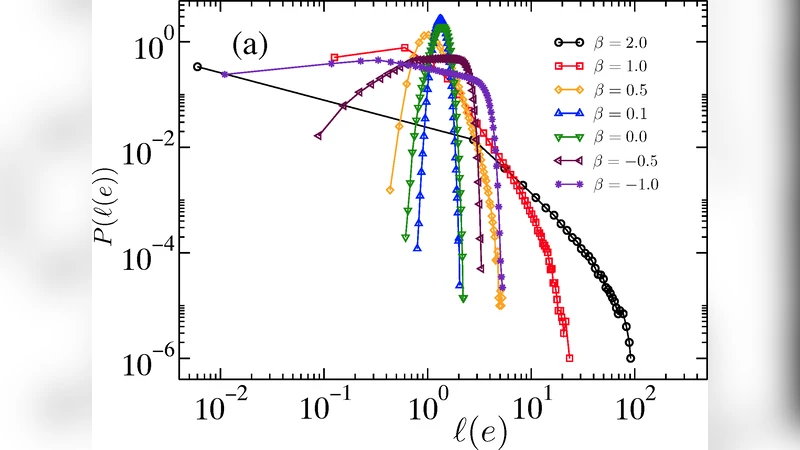
The paper investigates how a simple edge‑weighting rule, (C_{ij}\propto (k_i k_j)^{\beta}), influences distributed flow efficiency and resilience to cascading failures in complex networks, focusing on scale‑free graphs and an empirical Internet AS‑level topology. Using the classic random resistor‑network model, the authors compute exact node and edge currents for a configuration where every node acts as a source and a randomly chosen distinct node acts as its sink. The conductance exponent (\beta) controls the bias of the flow: positive (\beta) concentrates current on high‑degree hubs, while negative (\beta) pushes it toward low‑degree nodes.
Two key load measures are defined: vertex load (\ell_i) (total absolute current through a node) and edge load (\ell_{ij}) (total absolute current through an edge). By varying (\beta), the authors observe how these loads redistribute. For (\beta\approx -1) the vertex loads become almost uniform, minimizing the maximum node load (\ell_{\max}). For (\beta\approx 0.1) the edge loads are balanced, minimizing the maximum edge load (\ell^{(e)}_{\max}).
Throughput is quantified in two limiting scenarios. In the node‑limited case, all nodes have unit processing capacity while edges have infinite bandwidth; the maximal admissible input current is (\Phi^{(n)}c = 1/\ell{\max}). In the edge‑limited case, node capacities are infinite and each edge has unit bandwidth, giving (\Phi^{(e)}c = 1/\ell^{(e)}{\max}). Simulations on random scale‑free networks (degree exponent (\gamma) between 2.5 and 3.5) and Erdős‑Rényi graphs show that (\Phi^{(n)}_c) peaks at (\beta\approx -1) (hub‑avoiding flow), whereas (\Phi^{(e)}_c) is maximal near (\beta\approx 0.1) (slightly hub‑biased flow). The edge‑limited throughput is always larger than the node‑limited one, indicating that node capacity constraints are more restrictive than bandwidth limits.
The authors also apply the framework to a real‑world Internet snapshot (2296 autonomous systems, average degree ≈4.2, disassortative mixing). Because of the negative degree‑degree correlation, the optimal (\beta) for node‑limited throughput shifts further negative (≈ −1.75), reflecting a stronger need for hub avoidance to equalize loads. The edge‑limited optimum remains near (\beta=0), consistent with the theoretical findings that edge loads are less sensitive to degree correlations.
Cascading failure dynamics are modeled by assigning each node a capacity (C_i = (1+\alpha)\ell_i), where (\alpha) is a tolerance parameter. When a node exceeds its capacity, its load is redistributed to neighbors, possibly triggering further overloads. By scanning (\alpha) for different (\beta) values, the authors find that the same (\beta) values that maximize throughput also maximize the critical tolerance (\alpha_c) at which a cascade becomes system‑wide. Thus, the optimal (\beta) simultaneously optimizes flow efficiency and robustness.
In summary, the study demonstrates that a single tunable exponent (\beta) in the edge‑weighting scheme can be used to steer distributed currents either toward or away from hubs, thereby balancing node and edge loads. Hub‑avoiding flows ((\beta\approx -1)) are best when node processing limits dominate, while slightly hub‑biased flows ((\beta\approx 0.1)) are optimal when bandwidth limits dominate. The same settings also provide maximal resilience against overload cascades. These insights are validated on synthetic scale‑free networks, Erdős‑Rényi graphs, and a real Internet topology, offering practical guidance for designing weighted communication, power, or transport networks that need to achieve high throughput while remaining robust to cascading failures.
Comments & Academic Discussion
Loading comments...
Leave a Comment