When Machine Learning Meets Big Data: A Wireless Communication Perspective
We have witnessed an exponential growth in commercial data services, which has lead to the ‘big data era’. Machine learning, as one of the most promising artificial intelligence tools of analyzing the deluge of data, has been invoked in many research areas both in academia and industry. The aim of this article is twin-fold. Firstly, we briefly review big data analysis and machine learning, along with their potential applications in next-generation wireless networks. The second goal is to invoke big data analysis to predict the requirements of mobile users and to exploit it for improving the performance of “social network-aware wireless”. More particularly, a unified big data aided machine learning framework is proposed, which consists of feature extraction, data modeling and prediction/online refinement. The main benefits of the proposed framework are that by relying on big data which reflects both the spectral and other challenging requirements of the users, we can refine the motivation, problem formulations and methodology of powerful machine learning algorithms in the context of wireless networks. In order to characterize the efficiency of the proposed framework, a pair of intelligent practical applications are provided as case studies: 1) To predict the positioning of drone-mounted areal base stations (BSs) according to the specific tele-traffic requirements by gleaning valuable data from social networks. 2) To predict the content caching requirements of BSs according to the users’ preferences by mining data from social networks. Finally, open research opportunities are identified for motivating future investigations.
💡 Research Summary
This paper presents a comprehensive examination of the synergistic integration of big data analytics and machine learning (ML) for enhancing next-generation wireless networks (5G and beyond). It moves beyond a generic discussion to offer a domain-specific framework and actionable insights for the wireless communication field.
The authors begin by contextualizing machine learning within the broader sphere of Artificial Intelligence (AI), contrasting data-driven ML approaches with traditional rule-based expert systems. They identify the explosion of data traffic from diverse sources as both a challenge and an opportunity for future networks.
The core of the paper is structured around two pillars. First, it provides a detailed taxonomy of big data sources in wireless networks: (i) Wireless Data: encompassing spectral usage patterns, interference, and congestion information, applicable to proactive resource allocation and security surveillance. (ii) Social Network Data: rich with user context, preferences, and real-world event correlations, enabling “social network-aware” wireless services that adapt to societal trends. (iii) Cloud Data: characterized by content popularity distributions and individual user preferences, which can optimize edge caching, content recommendation, and handover procedures.
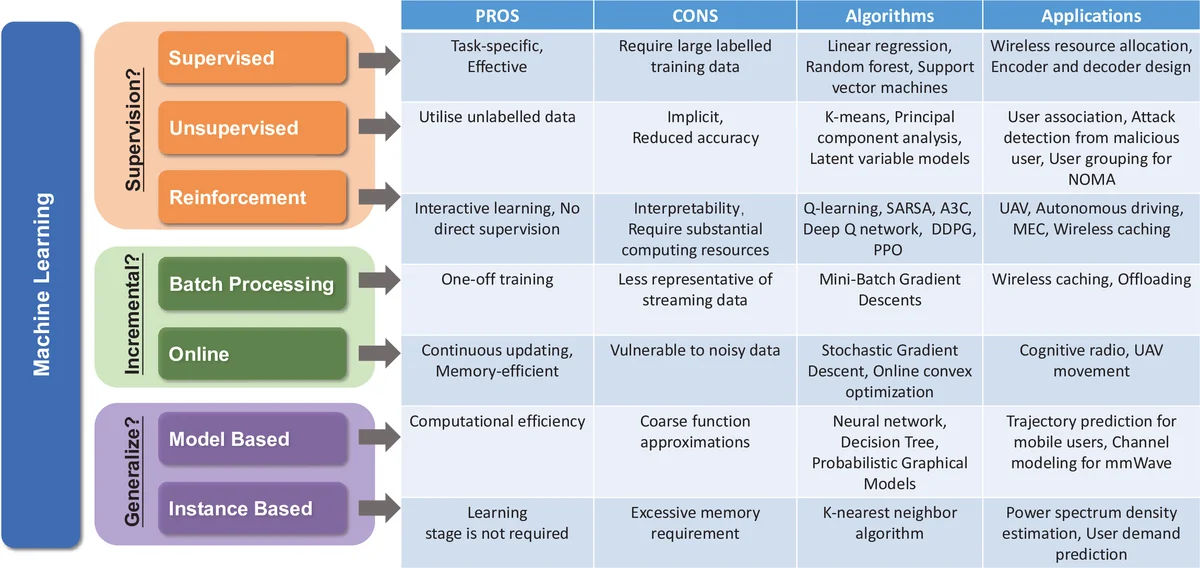
Second, the paper systematically classifies machine learning techniques relevant to wireless applications. It introduces two primary classification axes: 1) Based on human supervision requirement: Supervised Learning (suitable for resource allocation, encoder/decoder design), Unsupervised Learning (ideal for user association, anomaly detection), and Reinforcement Learning (effective for UAV communications, caching placement). 2) Based on learning capability: Batch Learning (for offline tasks like caching strategy design) and Online/Incremental Learning (for real-time adaptation in cognitive radio or UAV trajectory control). For each category, the pros, cons, and compelling wireless use cases are elaborated.
Synthesizing these concepts, the authors propose a unified big-data aided machine learning framework. This practical framework consists of three sequential stages: Feature Extraction (from raw data), Data Modeling (using appropriate ML algorithms), and Prediction/Online Refinement (deploying the model and continuously improving it with new data). The primary advantage of this framework is its ability to use big data to refine the very motivation, problem formulation, and methodology of ML algorithms within the wireless domain.
To demonstrate the framework’s efficacy, two concrete case studies are presented:
- Intelligent UAV-mounted Base Station Placement: Leveraging data mined from social networks (e.g., tweets about events) to predict spatial and temporal tele-traffic hotspots. This prediction then drives the optimal positioning of aerial base stations (UAV-BSs) to meet anticipated demand.
- Proactive Content Caching at Base Stations: Analyzing social network data to infer users’ content preferences (e.g., trending videos). These predictions guide the pre-caching of popular content at edge base stations, significantly reducing backhaul load and improving user experience through lower latency.
In conclusion, the paper argues that the confluence of big data and ML is transformative for wireless networks, enabling a shift from reactive to proactive and intelligent network management. It identifies open research challenges and motivates future work towards realizing truly autonomous, self-optimizing wireless systems that are deeply integrated with the social and physical context of their users.
Comments & Academic Discussion
Loading comments...
Leave a Comment